Saturday, 27 January 2024

Facing photography burn-out. Will 2024 be better?

It's late January, and this is my first post of 2024. Hardly something to brag about. I only wrote 7 posts in 2023 - which makes it my second-worst year (my worst was 2014 when I only wrote 4). That should tell you something about my photography mindset for most of 2023 (and a good deal of 2022 if I'm honest).

It's ironic really. Since 2023 was also the year that I finally, FINALLY, got a brand new camera. The Panasonic Lumix S5. I've wanted a new camera for well over ten years, and spent most of that time with second-hand gear, trying to figure out what I actually wanted in a camera system. And in 2023 I got it. A small (relatively speaking), full-frame 24 MP camera with excellent ergonomics, outstanding optics, and a tonne of features - some of which I may actually use. If, that is, I can be bothered using my camera at all!?

Late Bloomer. Panasonic Lumix S5 with S 20-60mm 3.5/5.6. F8 @ 1/60th, ISO 3200

For someone like me, for whom photography has been more like an addiction than a passion, that last sentence above is quite alarming. My wife has, in fact, asked me if I may actually be depressed? For somebody who has lived and breathed photography for the last 30 years of their life, to be so uninterested in any of it, is certainly rather strange. 

But I'm not - depressed that is. At least I don't think I am? I think what has happened is something akin to burn-out. Saturation point was finally reached a couple of years ago, and I think it's required time-off to work through it. Something similar may have happened, or may end up happening, to you?

Clearly Defined. Lumix S5 with S 20-60mm. F5.6 @ 1/60th, ISO 200

If this does happen to you (photography burn-out or whatever you want to call it), then my advice is to just let it. Don't panic. Don't rage against it. Don't try to 'push' through' regardless. Just let it take its course. However long it takes. Give yourself the time you need work through it. Do something else. Find another hobby. Put your camera away. And eventually, when the time is right, your passion for photography will start to come back. Probably....

Sunny Bight Track, Kaniere. Lumix S5 with S 20-60mm. F6.3 @ 1/80th, ISO 800

I'm no expert, but speaking as someone who has gone (is going?) through this myself - I can only give my personal experience. Initially I did fight it. I tried everything I could to 'ignite' the passion again. Nothing really worked. Not even a trip away down South to Dunedin - although I did enjoy the trip and got a few good images.

In the end, I put my camera away and focused on other hobbies. After all, what's the worst that could happen? Would it be so bad if I never enjoyed photography again? Gulp.....

But then, as it so often does, fate stepped in and began to turn things around. 

We are thinking of selling our house and moving to a more central location in the town where we live. And so we have been talking to real estate agents, have gone to a few open homes, and have had some agents look at our house.

One of those agents remarked on all the photographs up in our house, and so my wife told him I was a photographer. He got very excited at hearing this, because he was looking for a photographer to do some Real Estate work for him. I think you can see where this is going....

Sunny Bight, Kaniere. Lumix S5 with S 20-60mm. F8 @ 1/200th, ISO 100

So Real Estate work has rekindled my passion for photography! Who'd have thunked it!? Certainly not me! But it has. And now I'm watching YouTube photography videos again, taking my camera out and getting familiar with it once more - and even thinking about investing in an ultra wide angle lens!

And the great thing about this resurgence of interest is that it hasn't been forced. I didn't find photography again - photography found me!

It's early days, for sure. And yet the above images were all shot today, because I wanted to go out and take photos! It was the wrong time of the day, with the wrong kind of light, in an area I've been dozens of times before. But it didn't matter. I just went out with my camera to enjoy the experience. And enjoy it I did.

So if you are in a photography funk - or any other kind of funk for that matter - my advice would be - just let it be. Don't push the issue. Drop it. And in time, God willing, your passion will return. Sometimes in the most surprising and unlikely of ways....

Thursday, 19 October 2023

Is there life after Adobe?

John Lennon once sang that 'the best things in life are free' (yes, I know it's an old Motown song, but I grew up with the Beatles version). He then, however, went on to say that he'd rather have money. And I'm sure that this is a sentiment shared by most in the west today.

Don't get me wrong, I need money just as much as the next person. But with the price of living sky-rocketing, I also need to be careful how I spend it. Which is a long(ish) way of saying that I've decided to end a couple of my software subscriptions.

One of these just happens to be Adobe's photography subscription which gives you Lightroom and Photoshop. It's actually pretty good value to be fair. But it's still a monthly subscription, and I still can't afford it. 

So of course, that means that I start looking around for alternatives. FREE alternatives. Yeah - right! But hang on a minute. There actually are some very good, open-source, free alternatives to Lightroom and Photoshop. And it turns out they are actually very - very good. 

Raw Therapee 5.9 Catalogue interface.

The first one I downloaded was Raw Therapee - an Adobe Lightroom alternative with a very similar look and feel to Lightroom. The one (major) advantage that Raw Therapee has over Lightroom is that it doesn't require you to set up a catalogue. Instead it simply accesses the images from your hard drive and uses the file structure you already have.

You can key-word, tag, compare and stack images, just like in Lightroom, and the thumbnails can display a good amount of shooting information (or none). Speed is very good, since there's not a catalogue to slow things down, and if you've used Lightroom, you should feel right at home with Raw Therapee.

Raw Therapee 5.9 Editor interface.

Double-clicking a thumbnail in the File Browser loads the Raw file into Raw Therapee's Image Editor. And BTW, it reads the Raw files from my Lumix S5 with absolutely no issues.

Again, anyone with even a limited knowledge of Lightroom will feel at home in Raw Therapee. All the slider controls are on the right side of the screen, and are all arranged in a mostly obvious order. Which is a good thing. Because there are a LOT of controls. Which is also a good thing. Although it may mean a bit of a learning curve - especially for newbie photographers. But stick at it if you are considering trying a free Raw processing programme, because Raw Therapee is incredibly powerful and you will be richly rewarded with first-class results. Amazing for FREE software!

A quick tip for anyone who is new to Raw image processing and is thinking about giving Raw Therapee a go - use the 'Auto levels' button in the Exposure tab. There's no shame in it, and it will get you in the right ball-park immediately (very much like the same button in Lightroom will).

Buoyed by my overall positive impressions of Raw Therapee, I decided to download another free, open-source image conversion software that I'd heard a lot about - Darktable.

Darktable 4.4.2 Image Browser (Lighttable)

If Raw Therapee reminded me of Lightroom from a few versions ago (and it did), Darktable upped the ante even more - reminding me of a somewhat more up-to-date Lightroom. Again, navigation is easy and logical, with a plethora of options when it comes to key-wording and image tagging.

Moving into the editing (Darkroom) section is as straight forward as double-clicking on a thumbnail - and again, as with Raw Therapee, speed is decent because it works off of your already created computer file system. Whenever you make changes to the Raw file, it simply adds a sidecar .xmp file to note the changes. So just like Lightroom, it is 100% non-destructive (as is Raw Therapee).

Darktable 4.4.2 'Darkroom' module. Look familiar at all?

Of the two (Darktable vs Raw Therapee), Darktable seems the more feature-packed - but also comes with a slightly steeper learning curve? I've watched a few Darktable tutorials on the interwebs, and the features and explanations can get pretty complex. But I also find Darktable to be the programme I gravitate towards - maybe because I am a fairly experienced Adobe user, and Darktable is the more modern Lightroom-like of the two. 

Having said that, both programme are absolutely amazing. And well worth the money.

Yes, that's a joke. Because remember folks, both of these programmes are absolutely FREE! Gratis. Nada. Zilch. Mind officially blown!

Arthur's Pass Viaduct, Developed in Darktable. Lumix S5 with 20-60mm. f/10 @ 1/100th, ISO 100

I've been an Adobe Lightroom user since version one. And was an Apple Aperture user before that. I love the Adobe Lightroom interface - but I don't love the monthly bill. With the price of living ever-increasing, it's hard to justify yet another monthly subscription charge. Something has to give. And as someone who doesn't make a living from his photography, a monthly subscription to Lightroom (especially when I haven't been shooting all that much over the last year), was an obvious choice to let-go.

I may be struggling financially, but I'm also not crazy! I do need a Raw conversion programme of some description. But to be honest, I hadn't really taken the open-source (free) programmes very seriously. I mean they are Free after all, so how good could they be - right?

Fortunately for me (and you), it turns out they can be good. Very, very good. Maybe even (dare I say it) as good as (if not in some areas maybe even better than) Adobe Lightroom.

Is there a bit of wishful thinking and self-delusion involved in all of this because I want them to be as good as Lightroom? Maybe. But I don't really think so. Having downloaded and 'played' around with both open-source programmes, I have been super impressed.

I still have a lot to learn, and am riding the learning curve at the moment. But even that gives me hope. Because neither Raw Therapee or Darktable are 'simplistic' versions of Lightroom, dumbed-down for the masses. Oh contraire. They are both fully-fledged Raw conversion programmes that are serious contenders for the best software out there - money aside. 

So do yourself a favour. Download both and give them a go. You might just find that the Beatles were right. The best things in life might really be free!?

Sunday, 15 October 2023

Back from the Wilderness.

Kia ora (hello) everyone. 

Shock - horror, I'm back with a new post! It's been 6 months (almost exactly) since I've written on the blog, and I'd like to say I've been too busy with photography to post. But that would be a lie.

I've been busy alright. But not with photography.

Family life has been very busy, and somewhat stressful, but it looks like I may be climbing out of some darkness and into the light. I won't go into great detail, but I will say that part of the reason (a very large part) for my lack of posting and photography has been my work situation. I started a new job at the beginning of this year, but it hasn't gone so well. That's the bad news.

The good news is that I have found a new job, and a change of career! And this is, in a very large way, the reason for this post (on photography - yes, I AM getting there 😄)

Hagley Park, Christchurch. Panasonic Lumix S5 with 20-60mm f3.5/5.6. f8 @ 1/30th, ISO 400

I finish my old job this week (as I write this), and start the new one two weeks later. So that gives me a two week break in-between jobs. My wife and I have decided to take the opportunity to go away on holiday - which means lots of photography! Yay!!!!

This is a big deal for us, since we don't tend to go on many dedicated holidays. It has, in fact, been about 25 years since we went away on holiday together - just us alone - and that was our honeymoon! But even then, we stayed with friends in Australia, so it wasn't really 'on our own'. So yes, it's been a while.

I'm also suffering from a bit of 'local landscape lethargy' if I'm honest - which even the purchase of a brand new camera couldn't overcome. I've written about this in the past here and here. What I really need to give my photography juices a boost, is a good holiday! A change of scene. A different view that will inspire me to use the camera. And that's exactly what this trip will offer. And I can't wait!

Spidey Boy! Panasonic Lumix S5 with Lumix S 20-60mm. f/5.6 @ 1/4000th, ISO 400

We are going to take a trip down the eastern side of the South Island, through Ashburton, to end up at Mosgiel. From there we will explore the city of Dunedin and maybe travel one day to Invercargill. We plan to go to The Moeraki Boulders, Larnach Castle and the Dunedin Chinese Gardens, as well as The Church of the Good Shepherd at Lake Tekapo and check out the steampunk themed town of Oamaru. These are areas of New Zealand that my wife and I have never really explored. To say I'm excited is an understatement!

So yes, there is photography - lots of photography - coming to this blog in the very near future.

No guesses on what gear I'll be taking. Unlike other times when I may have had a few systems or configurations to choose from, I now have just the one - awesome - system. And I will probably stick to just the one camera/lens combination. The S5 with the Lumix S 20-60mm f/3.5-5.6 will be a fantastic travel kit that I'm sure I will use 99% of the holiday. But I will take the 50mm f1.8, just in case....

Finally new content going forwards. And a chance to really get to know my Panasonic Lumix S5.  Happy days.

Monday, 10 April 2023

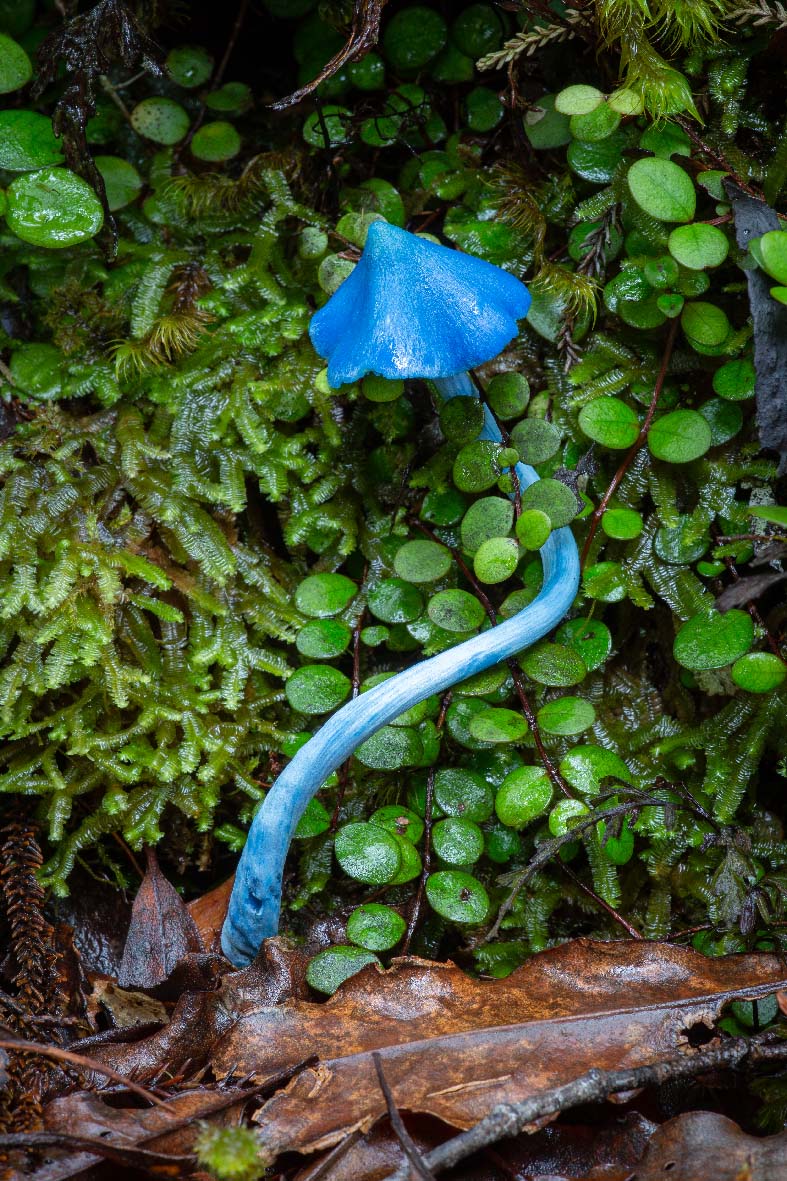
Photographing New Zealand's native Blue Mushroom

It is autumn here in New Zealand at the moment - and autumn for many photographers ushers in the start of something special - fungi season.

I'm a relative newcomer to fungi photography, having really only gotten interested at the tail end of last season. But I've got the bug - hard - and have been waiting patiently (or not so patiently as the case may be) for the new crop to start appearing. 

We have had a very hot, dry, summer on the West Coast of New Zealand - and it's taken a while for the rains to come. But come they have. And with it, comes the appearance of one of New Zealand's most iconic native mushrooms - the Blue Pinkgill.

Entoloma Hochstetteri - Blue Pinkgill. Sony a99 with Minolta 100mm macro. f/8 @ 1/3rd sec, ISO 100

Two weeks earlier (as I write this), my wife and I had taken a drive to Lake Kaniere. My wife has some friends coming from Australia to visit, and we were scouting locations to take them to. I suggested we go to Sunny Bight, to a small bushwalk there, and see if it was somewhere worth taking them to. It had been raining earlier in the week - although not a lot - so I really wasn't expecting much.

On the small walk at the Sunny Bight picnic area, we came across a little patch of Calocera viscoa, or Yellow Staghorn - a coral fungi that I had never seen before. I was very excited by this find and took a couple of quick snaps. But I didn't have my macro gear with me, so made a mental 'note-to-self' to return as soon as I could with my macro setup.

Calocera viscosa - Yellow Stagshorn. Sony a99 with 100mm macro. f/16 @ 2.5secs, ISO 100

Since the Sunny Bight picnic area walk is just a short 10 minute loop through native bush, we decided to explore further. Just past the picnic area is a dirt road that leads to the Lake Kaniere Walk - a 7hr return tramp that I had never taken a look at. We walked up the road, again surrounded by native bush, until we got to the carpark that is located at the start of the trail. Since neither of us were keen on a 7hr tramp, we turned around to head back to the picnic area. Just a few metres back along the road, a flash of brilliant blue caught me eye. And then another. And another! I stopped my wife and called her over, and together we discovered a a forest floor blooming with Entoloma hochstetteri - the native Blue Mushroom. 

I was so excited - never having seen one 'in the flesh' before. We spent the rest of the afternoon exploring, finding more and taking photos (mostly just snapshots), completely enthralled by this beautiful little fungi. It is the most beautiful, vibrant, almost iridescent blue. I was delighted to have discovered them, and couldn't wait to come back to photograph them properly.

Unfortunately, that wouldn't be until two weeks later!. Fortunately, they were still there - if not in even greater abundance than last time. Again I was so excited and set about making the most of my afternoon.

Twisted. Sony a99 with 100mm macro. f/16 @ 3.2secs, ISO100

With such a vast array of subjects, I was somewhat spoilt for choice. Believe me, I'm not complaining. But it did mean I could be a bit more picky about my subjects. Normally I come across one or two mushrooms and get to choose between the two. But the blue fungi were everywhere I looked! So much so that I needed to be careful where I walked (and I was - no mushrooms were harmed in the making of these photos).  I therefore started looking for either the unusual - or the most photogenic and prisitne examples that I could find. 

Mostly the blue mushrooms grow tall and straight. But the one exception I found was of the image above - appropriately titled 'Twisted'. As soon as I saw it I knew I had to take a photo of it - as unusual as it was amongst all the other upright specimens.

Out from Under. Sony a99 with 100mm macro. f/11 @ 1 sec. ISO 400

Entoloma hochstetteri is thought to engage in mycorrhizal relationships with Nothofagus and Podocarpus tree species. Mycorrhizas are beneficial fungi growing in association with plant roots, and exist by taking sugars from plants 'in exchange' for moisture and nutrients gathered from the soil by the fungal strands. The mycorrhizas greatly increase the absorptive area of a plant, acting as extensions to the root system. The native Kahikatea tree (a Podocarpus tree species) grows all around Lake Kaniere, providing a perfect breeding ground for the small blue mushroom species. Find a Nothofagus or Podocarpus tree species in New Zealand, and you are likely to find Entoloma hochstetteri at a certain time of the year.

Together alone. Sony a99 with 100mm macro. f/16 @ 15 secs, ISO 100

Photographing fungi is a bit like bird-watching - in that when you find and photograph a particular species you tend to tick it of your list. I wanted to find the New Zealand Blue, as occasionally it can be somewhat elusive. But not this year. This year there seems to have been an abundance at the start of the season - although that's the other thing about fungi. They seem to go as quickly as they come. Only to be replaced by another species as the season progresses.

I don't know what I'll find the next time I'm out on a fungi forage - but that's also a large part of the fun. But whatever the season brings, I'm thrilled that I've already got Entoloma hochstetteri in the bag!

Saturday, 25 March 2023

Setting up the Lumix S5 for stills photography

I've had a couple of forays out with my new Panasonic Lumix S5 and have gradually been setting it up for my shooting style.

The S5 has 3 custom dials (although you can set up to 13 shooting styles since C3 has slots for 10 different variations), and I have programmed all 3. I don't usually use Custom modes (in fact I don't think I ever have), but since this was a brand-new camera, and the option was there, I thought 'why not'?

Waterways. Lumix S5 with 20-60mm. F/8 @ 1/2sec, ISO 100

There are certain settings I change on all cameras as soon as I get them. First things first - the autofocus confirmation 'beep' gets turned off! Then the file format is set to RAW (I seldom bother with RAW+Jpeg), and the control dial is set to 'A' (aperture priority). I'm shooting a lot in M (manual) now too, but for casual shooting I stick with 'A'.

Then it's a matter of tweaking the rest of the buttons and dials to work how I like them to. And fortunately, with most of todays cameras, there isn't a dial or a button that can't be reprogrammed! I do, however, try to keep it as simple as possible and I don't go changing all the buttons functions.

The Lumix S5 is a great camera to reprogramme, since it allows you to name each custom setting with something that makes sense to you (and not just CS1, CS2 etc). I have called CS1 'General Photography' and CS2 'Landscape Tripod'. Pretty self-explanatory, don't you think!? The CS3 setting (with 10 extra slots for different variations) I've kept for 'fun' at the moment, and have programmed some black and white settings. In this post I'll just concentrate on the CS1 and CS2 settings - the two I will use most often.

Old Mine Site. Lumix S5 with 20-60mm. F/11 @ 1/15thsec, ISO 100

For both CS1 and CS2, I have them set up in Aperture Priority, to start with an aperture of f/8 and an ISO of 100. Because I'm working in A mode, the front dial is set to choose the aperture, the back dial is set to change the exposure compensation, and the real control wheel is set to change ISO. When (and if) I switch to M mode (manual), the exposure compensation rear wheel changes to controlling shutter speed. So with the two top control wheels, and the rear control dial, I have the exposure triangle instantly accessible.

Also, and very importantly, I have 'Constant Preview' set to ON! This is set to OFF by default (don't ask me why), and means that if you're changing the exposure you won't see the effect in real-time in the viewfinder! If you want to see what is happening when you change exposure values, make sure 'Constant Preview' is set to ON.

You will also need to enable the histogram to appear in the viewfinder as well - which is also OFF by default!? The great thing about the histogram in the S5 is that you can place it wherever you choose within the frame (I have it bottom right). Very cool.

The level gauge in the viewfinder is on by default. I find it somewhat annoying so turn it off. This is easy to do by simply hitting the 'back arrow' button on the camera body - which will toggle between the level gauge being on or off when in live view.

For the CS1 'General Photography' setting, I have picture mode on 'Normal'. This gives me a fairly good indication of how the RAW file is going to look. For my CS2 'Landscape Tripod' setting, I have the picture mode set to Landscape. This gives me punchier colours and helps me visualise what my final, processed image might look like.

In CS1 I have single autofocus area (centre) and single shot mode activated. For CS2 I have the self-timer automatically set for 2 seconds, and I have the Image Stabilisation turned OFF (it's turned ON for my CS1 general photography setting). In CS2 Landscape Tripod mode, I also have the 'touch to focus' screen activated (it's turned OFF in CS1).

The Blue Men. Lumix S5 with 20-60mm. F/8 @ 1/80th, ISO 6400

I hope that's not too confusing? Basically in Landscape Tripod mode I have IS OFF (because the camera is on a tripod), 2 second self timer, and touch to focus activated.

As mentioned earlier, you can 'tweak' the camera to your heart's content. But the more you fiddle and change, the more you need to remember what you changed it too! So I try to keep the fiddling to a minimum - just changing the parameters that make sense for what I'm trying to achieve with my images.

Of course none of this relates to video - this is purely a stills-centric setup. As much as the S5 is a film-making beast, I will never use the video. Video is there because we demand it (apparently). I'd be more than happy if it wasn't included, but there you are. That's progress I guess.

There are other settings I could mention, but really they come down to personal preference. You can, for instance, change the direction of the dials as they relate to moving the settings, tell the camera what to do for both card slots, set up auto ISO, control AF magnification, change photo gridlines, focus peaking colours - the list goes on, and is practically endless. 

Which is why I have only changed a few parameters so far, and I live with them for a while. Then, when I'm out in the field actually taking photos and I think - "I wish I could change/add this...", that's when I know I need to dig back into the menu and add this functionality to my custom settings.

So the custom mode settings are used somewhat fluidly, and can be changed or added to over time. But I think I'm fairly set now with my C1 'General Shooting' and C2 'Landscape Tripod' custom modes.

If you haven't set up the custom modes on your camera before then give them a try. They speed-up the shooting process considerably. Just make sure you can remember what you re-programmed all those buttons and dials to do!

Sunday, 12 March 2023

My new 'forever' camera system

In my last post I discussed my struggles recently with the Sony system. More specifically the A-mount system. I won't go over this again (read my last few posts) - needless to say I had decided it was time to move on to something else. Something 'new'.

And this time, when I say 'new' I actually mean it. In the past on this blog, when I have changed systems and introduced my 'new' camera, it's always been placed in inverted commas. 'New' has meant 'new - for me', but second-hand in reality. And I can't say that I've had a brilliant run with used camera equipment in the last year.

I'm not going to draw this out too long (you'll be pleased to know) - other than to say that I did do some serious thinking, and a bit of research to try and figure out what my 'forever' camera should be. But in the end, as is often the case (weirdly), the decision was almost made for me. How so?

I had a good idea of the features I wanted, if I was going to stick with this camera/system for the rest of my life (yes, you heard that right). And to be fair, my list wasn't long. I really don't have a large wish-list of must-haves - especially if you take video out of the equation altogether (which I do). Several brands could have quite easily have fit the bill.

And then a post came through my Facebook page from Photo & Video in Christchurch. And I had 'found' my forever camera and system. They were (and still currently are as I write this) having a fantastic deal on the Panasonic Lumix S5 with 20-60mm (almost $1k off the price) - while stocks last!

Panasonic Lumix S5 with 20-60mm f3.5/5.6
To be honest, I didn't know all that much about the Lumix S5. I'm not even sure I knew it existed! The Lumix S1 had vaguely been on my radar a few years ago when Panasonic launched it - but it wasn't a camera - or a system - that I'd taken much notice of. It was a) full frame, b) big and heavy, and c) didn't have many lenses available for the system.

But that was about four years ago, and the system has grown since then. Panasonic have addressed all of the above issues during that time. The S5 is smaller and lighter than the S1, is still full frame, and the lens lineup has grown substantially. This has been helped by the S series being built around the Leica 'L' mount, and the establishment of the 'L' Alliance between Leica, Panasonic and Sigma. With all three companies producing lenses for the system, the line-up has trebled almost overnight! That's great news for anyone looking to 'invest' in the Lumix S full-frame system.

And if that wasn't enough, the S5 itself is an absolute beast of a camera (in terms of specs). It is mentioned, and reviewed, favourably - up against the likes of the Sony a7iii, Canon R6 and Nikon Z6. Of course Lumix are well known as a video brand, and as such the S5 is crammed with seriously impressive video specs (including built-in vlog). But since I'm only interested in it as a stills camera, those are really the specs that interest me. And the S5 doesn't disappoint. 

For a start, it has a fantastic 24MP full-frame sensor with dual ISO (whatever that is!?), amazing low-light image quality and 14+ stops of dynamic range! It has dual card slots (one UH1 and one UHII), Live Composite Mode, High Res Shooting Mode (for a 96MP image), Image Stacking, Intervalometer, Face and Animal Focus/Tracking, and a host of other features I'll probably never use. Although it uses contrast detection AF, Panasonic have mastered this for stills photography, and the AF is as fast and as accurate as any other system on the market. Once I'd read the specs on the S5, and watched a few review videos on Youtube, I couldn't order one fast enough!

But first things first - I needed to convince my wife that we should be buying me a brand new camera!

Moana Sunrise. First image shot on my Lumix S5 with 20-60mm lens. f/11 @ 1.3secs, ISO 100

I've been writing this blog for over 15 years now, and I've stopped counting the number of times I've changed camera gear. In numerous posts I've written about my latest purchase being 'the one' - only to change to something else six months later. Anyone could be forgiven for rolling their eyes when I claim that 'this is the one'. But my wife, who has followed along on this journey with me, has more reason than most to be sceptical. So when I sat her down and proposed that we buy me a brand new 'forever' camera, I could completely understand (and was expecting) her scepticism.

But to her great credit, she did listen. And she did understand my frustration at the second-hand gear woes I had been having. She doesn't understand all the techy jargon I throw at her, but she does appreciate my knowledge and enthusiasm for all things photographic. So in the end, she said 'yes' (thanks honey), and I purchased the camera on-line that evening.

Lake Brunner Reflection. Lumix S5 with Lumix S 20-60mm. f/11 @ 5 secs, ISO 100

Is her support misplaced? Am I going to change my mind in six months time?

No, I'm not. Unequivocally. And here's why... 

I've been a serious photographer for over 35 years. And in that time, I've purchased maybe four cameras brand-new. My first was the Canon T70 - my first film camera. The second was the Canon EOS 10, which I purchased new after trading in all my manual focus Canon gear once they had changed their lens mount to the EF auto focus technology. My third was the Nikon D70 when I moved (eventually) from film to digital. And my last brand-new camera purchase was the Canon 5D. 

I loved the 5D, and would probably still be using it (or have upgraded to the Mk2/3/4) were it not for the fact that it developed a circuit board problem. Although to be fair, even that statement is somewhat disingenuous, since the 5D isn't a mirrorless system. And I have, for a very long time, been an advocate for mirrorless cameras. So in fairness, my change to mirrorless was inevitable. But that's also the point...

Whenever I have purchased a new camera, it has been at a pivotal moment in technology, and I have moved with the times (eventually). The T70 was replaced by the EOS10 when Canon switched to autofocus. The Nikon D70 was brought when I moved from film to digital. And the 5D was purchased when digital cameras finally went to full-frame sensors. I've never purchased a new mirrorless camera. The closest I got was with the Olympus OMD-EM-5Mk2. And I wanted to love that camera. I really did. But in the end, it was too small and fiddly, and really not for me.

Mt.Te Kinga, Moana. Panasonic S5 with Lumix S 20-60mm. f/11 @ 1/25th, ISO 100

The Panasonic Lumix S5 is my first - and last - brand new mirrorless camera. And I do say this with utmost confidence. I have thought for a few years now that cameras - at least if you are primarily concerned with stills photography - have seriously peaked. Manufacturer's just don't make bad cameras anymore. Period. I honestly believe that camera technology for the stills photographer has plateaued. To the point where 'what' camera you buy if you are a general (travel/landscape/portrait) stills photographer has basically become irrelevant.

Does that mean manufacturers will stop adding new features to their cameras? No, of course not. But most, if not all, of the 'new' features will be 'fluff'. Heck, most of the upgraded features on cameras for the last five years could be considered fluff. Nice to have, but fluff. In a recent review video I watched for the new Canon R8, at the end of the video the reviewer said that he hated reviewing modern cameras. Because they are just all brilliant. They all have everything that 99% of photographers will ever need.

Which is why I can say, with the utmost confidence, that the Panasonic Lumix S5 will be the only camera I will ever need. And, barring accidents or malfunction (please no), it will be the camera I will use for the rest of my life! There, I've said it.

Andersonia. Panasonic Lumix S5 with S 20-60mm. f/8 @ 160th, ISO 100

I'm 56 this year (don't tell anyone). God willing and if my eyesight holds up, I may have another 30 years of taking photos left in me? The S5 should last 30 years (I've got a Nikon D70 that is coming up for 20 years old and still takes great images) all things being equal. But even if I get 20 years of solid work out of it (I'm no longer a heavy shooter) I'll consider that a win.

As you can see from this post, I have already been out on my first shoot with the S5. And very successful it was too - as can be seen in the images. The full-frame 24MP sensor is fantastic, the lens is sharp and contrasty - with a great range for travel/landscape photography, and the body controls and ergonomics are a joy to use. Can I finally say I've found my mirrorless home? Yes, I think I can.

Saturday, 11 March 2023

What is it with me and Sony?

In my last post I talked about getting ready to shoot a wedding, and the gear that I was planning on using for it. I had my Sony a77ii and a bag of lenses that I was looking forward to putting through their paces on a wedding day. Good times ahead....

Because the a77ii was a very recent purchase, and the bag full of lenses hadn't been used for quite a while, I decided to do due diligence and test everything before the big day. And boy am I glad I did! 

Te Kinga Macrocarpas. Sony a77ii. f/8 A 1/200th, ISO 100

To cut a very long (and very stressful) story short, it seemed that most of the lenses I had 'acquired' for the a77ii were past their best and badly in need of calibration. I've already discussed in previous posts how I've decided to build an A-mount Sony kit around the very generous gifting of a camera bag full (literally) of Minolta and Sony lenses. Well it seems like I may have been a little hasty in my decision.

I'm not going to cram this post full of slightly un-sharp photos just to prove a point, but basically that's what I was getting with the lenses I had. With a couple of exceptions.

The Minolta 85mm f1.4 was bitingly sharp. Ironically, for portraiture, you might even say it was a bit too sharp! The same goes for the Minolta 50mm f2.8 macro used as a regular 50mm lens. Incredibly sharp on my a77ii. So I know the camera can produce sharp images - with the right lenses.

But try as I might (and believe me, I did try), all the zoom lenses I had for the a77ii just didn't cut the mustard (as they say). For some they were sharp at the long end, but not so sharp at the wide end - and for others it was the exact opposite! The Minolta 24-70mm F2.8D wasn't sharp at all, at any focal length. While the Sony Zeiss 16-35mm f2.8 and Sony Zeiss 24-70mm f2.8 were just 'so-so'.

I took so many 'test shots' (thanks to my wife for being a willing(?) and very patient model) and poured over so many images at 100% that I started second-guessing myself and tying myself up in knots! One moment I'd think everything was 'soft', and the next I'd decide that some of them weren't 'too' bad. But were any of them good enough to shoot a wedding with? I didn't think so....

Rapahoe Relics. Sony a77ii. f/11 @ 1/50th, ISO 100

With only a week to go, and no lenses that I was happy with (other than an 85mm and 50mm prime), I was in panic mode. And wishing I hadn't agreed to shoot the damn wedding! But, once again, my mate Stew came to the rescue. Since I was getting all of his 'old' gear, and he was replacing it with new E-mount gear, he let me borrow his new Sony a7iii and Sony 24-105mm f4 to shoot the wedding with. Whew!

And again, long story short - it worked perfectly! Of course. In fact it was a joy to use. And I'm even getting used to the Sony A7 series ergonomics! So I'm getting one - right?

Hold that thought for a moment. Because yes, I have decided that the Sony A-mount system is obviously not for me. The a57 with the sensor alignment issue was the start of my A-mount woes. And although the a77ii is an amazing piece of kit, getting lenses for it has proven to be somewhat of a challenge. As much as I want to love the system, it seems the powers that be have other ideas.

So what's next, you may ask? And that, dear reader, is a very good question. Perhaps it's already been answered with my favourable experience with the Sony a7iii? But there are a couple of things that give me pause to jump straight into the Sony E-mount system.

First, it's a Sony. Duh! Do I really want to continue to tempt fate with my Sony woes? Who's to say these won't extend into the E-Mount system? And while no - I'm not a suspicious person by nature - this seems too much like out of the frying pan....

Trapdoor Spider. Sony a77ii with Minolta 100mm f2.8 macro. f/18 @ 1/4sec, ISO 400

The good thing about switching to the Sony E-mount is that it's a) full frame, and b) fairly plentiful on the used market. I could pick up an a7ii body for about $1k, and then have to figure out what lens to put with it (and how I'm going to afford it!?).

Then again, I could go back to my old flame - micro four thirds. A used Olympus E-M1 mk2 with a lens would be about the same price as an a7ii body - and further lenses down the track are surprisingly affordable.

But you know what... I think I've had it with second-hand gear! Recently it feels like I've just been inheriting somebody else's problems, and I'm getting tired of it. I'm also getting old, and frankly fed up with changing systems all of the time - even when there have been good reason to. I want a system, and a camera, that I can 'hang my hat on' so to speak - and grow old with. So yes, I think I'm going to buy new this time (and for the last time).

No, I haven't won the lottery, or fallen into a big pit of money. But my wife and my circumstances have changed recently. I've started a new job this year, with a bit more pay, so I think it's now or never! All I have to do is decide what my 'forever' camera system will be - oh, and convince my wife that it's a good idea! One of those things will be easier than the other 😳😂