Showing posts with label Sony a99. Show all posts

Monday, 10 April 2023

Photographing New Zealand's native Blue Mushroom

It is autumn here in New Zealand at the moment - and autumn for many photographers ushers in the start of something special - fungi season.

I'm a relative newcomer to fungi photography, having really only gotten interested at the tail end of last season. But I've got the bug - hard - and have been waiting patiently (or not so patiently as the case may be) for the new crop to start appearing. 

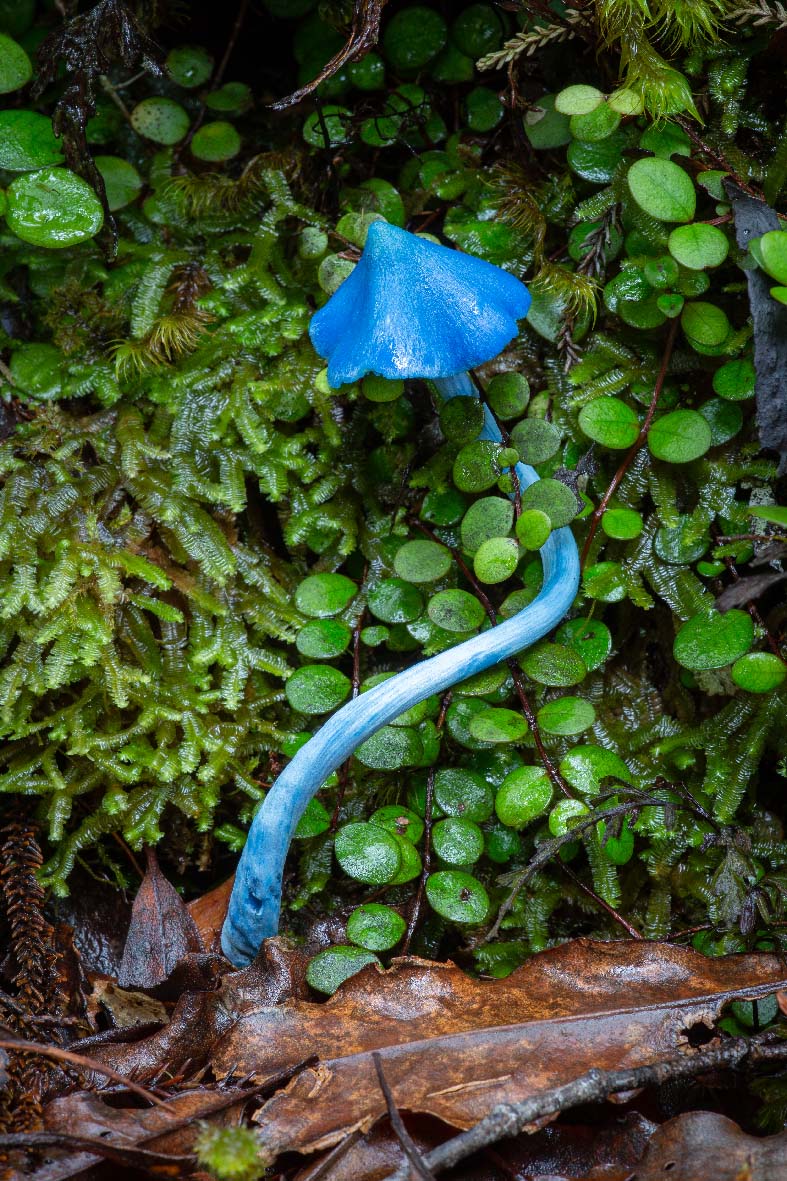
We have had a very hot, dry, summer on the West Coast of New Zealand - and it's taken a while for the rains to come. But come they have. And with it, comes the appearance of one of New Zealand's most iconic native mushrooms - the Blue Pinkgill.

Entoloma Hochstetteri - Blue Pinkgill. Sony a99 with Minolta 100mm macro. f/8 @ 1/3rd sec, ISO 100

Two weeks earlier (as I write this), my wife and I had taken a drive to Lake Kaniere. My wife has some friends coming from Australia to visit, and we were scouting locations to take them to. I suggested we go to Sunny Bight, to a small bushwalk there, and see if it was somewhere worth taking them to. It had been raining earlier in the week - although not a lot - so I really wasn't expecting much.

On the small walk at the Sunny Bight picnic area, we came across a little patch of Calocera viscoa, or Yellow Staghorn - a coral fungi that I had never seen before. I was very excited by this find and took a couple of quick snaps. But I didn't have my macro gear with me, so made a mental 'note-to-self' to return as soon as I could with my macro setup.

Calocera viscosa - Yellow Stagshorn. Sony a99 with 100mm macro. f/16 @ 2.5secs, ISO 100

Since the Sunny Bight picnic area walk is just a short 10 minute loop through native bush, we decided to explore further. Just past the picnic area is a dirt road that leads to the Lake Kaniere Walk - a 7hr return tramp that I had never taken a look at. We walked up the road, again surrounded by native bush, until we got to the carpark that is located at the start of the trail. Since neither of us were keen on a 7hr tramp, we turned around to head back to the picnic area. Just a few metres back along the road, a flash of brilliant blue caught me eye. And then another. And another! I stopped my wife and called her over, and together we discovered a a forest floor blooming with Entoloma hochstetteri - the native Blue Mushroom. 

I was so excited - never having seen one 'in the flesh' before. We spent the rest of the afternoon exploring, finding more and taking photos (mostly just snapshots), completely enthralled by this beautiful little fungi. It is the most beautiful, vibrant, almost iridescent blue. I was delighted to have discovered them, and couldn't wait to come back to photograph them properly.

Unfortunately, that wouldn't be until two weeks later!. Fortunately, they were still there - if not in even greater abundance than last time. Again I was so excited and set about making the most of my afternoon.

Twisted. Sony a99 with 100mm macro. f/16 @ 3.2secs, ISO100

With such a vast array of subjects, I was somewhat spoilt for choice. Believe me, I'm not complaining. But it did mean I could be a bit more picky about my subjects. Normally I come across one or two mushrooms and get to choose between the two. But the blue fungi were everywhere I looked! So much so that I needed to be careful where I walked (and I was - no mushrooms were harmed in the making of these photos).  I therefore started looking for either the unusual - or the most photogenic and prisitne examples that I could find. 

Mostly the blue mushrooms grow tall and straight. But the one exception I found was of the image above - appropriately titled 'Twisted'. As soon as I saw it I knew I had to take a photo of it - as unusual as it was amongst all the other upright specimens.

Out from Under. Sony a99 with 100mm macro. f/11 @ 1 sec. ISO 400

Entoloma hochstetteri is thought to engage in mycorrhizal relationships with Nothofagus and Podocarpus tree species. Mycorrhizas are beneficial fungi growing in association with plant roots, and exist by taking sugars from plants 'in exchange' for moisture and nutrients gathered from the soil by the fungal strands. The mycorrhizas greatly increase the absorptive area of a plant, acting as extensions to the root system. The native Kahikatea tree (a Podocarpus tree species) grows all around Lake Kaniere, providing a perfect breeding ground for the small blue mushroom species. Find a Nothofagus or Podocarpus tree species in New Zealand, and you are likely to find Entoloma hochstetteri at a certain time of the year.

Together alone. Sony a99 with 100mm macro. f/16 @ 15 secs, ISO 100

Photographing fungi is a bit like bird-watching - in that when you find and photograph a particular species you tend to tick it of your list. I wanted to find the New Zealand Blue, as occasionally it can be somewhat elusive. But not this year. This year there seems to have been an abundance at the start of the season - although that's the other thing about fungi. They seem to go as quickly as they come. Only to be replaced by another species as the season progresses.

I don't know what I'll find the next time I'm out on a fungi forage - but that's also a large part of the fun. But whatever the season brings, I'm thrilled that I've already got Entoloma hochstetteri in the bag!

Monday, 31 October 2022

Sony a77ii. Getting serious about Sony A mount.

I'm not going to beat-around-the-bush with a long teaser introduction to this post. I'm too excited.

I've done it. I've purchased a Sony a77ii. And in doing so, I've placed my stick in the ground, so to speak.

From the beginning of this year when I started getting into macro photography (fungi in particular), using the Sony a99, I already had a foot in the Sony camp.

Then in February I jumped in, boots and all, and traded in my Olympus E-M1 for a Sony a57. And while the a57 was certainly no a99, I did enjoy using it, and took some of my favourite landscapes from this year with the camera.

As it transpires, the a57 had a problem with the sensor being out of alignment. Not noticeable when the camera was focused at infinity (for landscapes), but very obvious if you tried to focus on a subject closer.

So unfortunately the a57 went back, and my E-M1 was returned to me. I started using the micro four thirds system again, and that would have probably been that. Had it not been for a recent phone call.

I had been 'borrowing' the Sony a99 from a friend, together with a 50mm macro lens, and this is the kit I'd been enjoying using for macro fungi photography. Although I had also used the E-M1 with standard lenses as well. Stewart is a professional photographer who has been transitioning from Sony a-mount to Sony e-mount for a while. He rang to ask me if I was still interested in using a-mount gear, and would I like any of his? Of course I said 'yes', and in doing so, my fate was sealed.

Stewart has a load (and I mean a load) of a-mount lenses that he can 'give' me - basically on permanent loan. That's good enough for me - Stewart is definitely a man of his word. But lenses are no good without a camera body to go with it. And the a99 is really in no fit state to guarantee continued performance, or build an entire system on. So I needed a camera body. In my price range. Enter the Sony a77ii.

The Sony a77ii is, to all intents and purposes, a 'baby' a99. It has a 24 megapixel CMOS sensor (rather than full frame), a superior 79 point autofocus system, and the same design and layout. Including the same excellent flip up, down and around articulating lcd screen that I love on the a99. It has a solid magnesium alloy body, is weather resistant, only has one SD card slot (nevermind), and shares the same excellent OLED viewfinder. It is Sony's last, top-of-the-line cropped sensor camera, with fast 12fps shooting and a superb autofocus system. As such, it became very popular with sports action and wildlife photographers looking for the extra reach that an APSC cropped sensor can give. All I had to do now was find one for the right price!

The Sony a99's and a77's don't seem to come up on the used market as regularly as other cameras. And when they do, the seller is often asking a ridiculously high price for them. And I do mean ridiculous. There are a couple on TradeMe (an NZ online auction site) for almost NZ$2k for an a77 and almost NZ$3k for an a99 - both mark 1 versions! No thank you.

Fortunately, if you are patient (I've been watching the market for over 10 months), a bargain will eventually appear. One such bargain showed up recently in my watchlist. But even then I didn't pull the trigger straight away, since I don't really have the money to purchase the camera.

A couple of questions emailed to the seller indicated that he was happy to wait for a little while for me to get the $$ together should I win the auction. And then, a timely query for a paid photography job sealed the deal and I bid on the camera in the dying seconds of the auction. And I won. For the starting price (which was actually less than I put in an early offering bid for but which was rejected by the seller). Score!

The images in this blog are of the actual camera I have won, taken from the auction site photos. So yes, it looks in pretty good shape. It also comes with two standard Sony lenses - the 18-55 and the 55-200mm kit lenses. Probably won't use them that much (if at all), but hey, they come with the camera. So that's a bonus. It also comes with a charger (obviously), two Sony batteries (yay), two remote controls, and a Peak Design Capture camera clip for placing on a backpack strap. Never used one of those before, so will be keen to try it out.

All for a lot less than any of the other a77 mark 1 cameras on TradeMe presently. Bargain! At least I hope it is!? We'll see when I have it in my hot little hand. Which should be no more than a couple of weeks away?

I'm already eyeing up an after-market grip for it so I can extend the shooting time and have a vertical shutter release. I would prefer an original Sony one, but these are even rarer than the cameras on the secondhand market, so a third-party offering will have to do.

Super-excited to be getting the Sony a77ii, and using it next fungi season for some serious macro photography! Oh and yeah, I also have a wedding to shoot early next year. Could be a good season of photography coming up! I'll keep you posted.

Saturday, 5 March 2022

Testing the Sony SAL75300 and Sony SAL18250 lenses

a57 with 75-300. f/8 @ 1/320th, ISO 800
I have continued to persevere with bird photography now that I have the Sony a57 and SAL75300 lens. On an APS-C sensor that equates to a 450mm equivalent fov (field of view), so I can get reasonably close to the wildlife.

But I can't say that I have been blown away by the performance of the Sony 75-300mm f/4.5-5.6 lens. It's certainly not 'tack' sharp (or even close) at the 300mm end - which is exactly where you want to be if you buy a telephoto lens. 

Case-in-point - the other evening I went back down to my local lagoon and followed a Grey Heron around for about an hour. He slowly became used to my presence, and so I got reasonably close. I managed to get some decent poses, fairly close up, but the light was low, so I had to crank the ISO up (again). I've had to do this on both occasions now and I'm beginning to think that the high ISO's are contributing to the overall 'softness' I'm experiencing with this lens?

Of the 250-ish images I shot of the grey heron, I kept just four. All the rest were just too soft. And the four I kept only just snuck through.

So I decided that on the next sunny day, I was going to go out in the middle of the afternoon, in bright conditions, and test the lens at ISO 100. On a tripod. With a 2 second delay on the shutter. At all focal lengths and apertures. Just to see what this lens is really capable of in a 'best case' scenario. So that's what I did this weekend.

And while I was at it, I thought I'd test the SAL18250 at the same time. Just - ya know - because. So sit back, relax, get a beverage, and lets find out how good(?) these two lenses are...

Greymouth Wharf from Cobden. Sony a57 with SAL75300. f/8 @ 1/250th, ISO 100 (at 135mm)

Looking across to the Greymouth Wharf area from Cobden Lagoon is a great place to do these kinds of telephoto lens tests. First because there's plenty of space to set up your tripod, second because it provides lots of details and contrast to lock in on, and third because it's only five minutes from my house 😆

I set up as outlined above; on a tripod, with 2 second timer, central focus point (yes, I auto-focused because that's what I do 99% of the time in real-world shooting conditions), steady shot off (because I'm on a tripod) and aperture priority mode so I could speed up the process, since I would be working through all the apertures at every focal point marked on the lens barrel. Easy...

After I had all the images, I opened them in Lightroom, looked through each set of f/stops for each focal length I shot at, and chose the sharpest of the set. The lenses 'sweet spot' at that focal length, if you will. Below, are the results.

The selections above are all central crops at 100%, made in Photoshop, with my 'normal' sharpening applied (Unsharp Mask Filter applied at 125%, Raduis 1, Threshold 0). It might be difficult to make out what's happening from a low-res internet image, so I'll just tell you what I found....

The Sony SAL75300 lens (at least my copy of it), is soft at 75mm across the aperture range - with f/16 being somewhat presentable. But this isn't a lens I will be shooting at the 75mm end. Period 

From 100mm through to about 250mm, the lens is what I would call 'acceptably' sharp from f/5.6 to f/11 - with f/8 more than likely being the sweet spot. Images within this aperture and focal range are sharp, without being 'tack' sharp. This lens never really manages tack sharp.

At 300mm there is a fall-off in overall sharpness again, although not as bad as at the 75mm end (where it really is horrendous). At the 300mm focal length, f/5.6 to f/8 is 'reasonably' sharp, but I would stick to the 100 - 250mm range for better performance if I could. The lens has other issues at 300mm as well, exhibiting high levels of purple fringing. This is very evident at f/5.6, becoming better (although not completely gone) at f/8. Even with 'Remove Chromatic Aberrations' ticked in Lightroom's lens correction tab.


I thought that maybe the 16MP sensor of the a57 wasn't doing the SAL75300 any favours, and it may perform better on the full-frame 24MP sensor of the a99? So, of course, I tested this theory as well.

Once again, I'll decipher the low-res findings for you...

Basically, nothing changes. Apart for the fact that the a57 crop sensor is producing a slightly bigger fov for equivalent focal lengths - the actual sharpness remains relatively the same. Yes, the a99 is ever so slightly 'cleaner' (ISO 50 compared to ISO 100), and maybe a hair sharper? Maybe. But nothing that makes it shockingly different.

So bottom line with the Sony 75-300mm f/4.5-5.6 (SAL75300); don't shoot at 75mm (at all), stick between 100-250mm and between f/5.6 to f/11 (let's just call it f/8 shall we?), and you should get 'acceptably' sharp results. Depending, of course, on your idea of 'sharpness'.

Cobden Lagoon. Sony a57 with SAL18250. f/8 @ 1/400th, ISO 100 (at 18mm)

Ok. So having established that the SAL75300 is really a 100-250mm, lets tackle the 18-250mm super zoom shall we!?

The SAL18250 is another one of those lenses that gets a bad rap from some reviewers. Actual users, on the other hand, often have some good things to say about this lens. Let's find out for ourselves.

Same process as above for the 75-300mm lens, although I changed position slightly so that there would be some interesting foreground in the image. Going through the apertures and focal lengths on this lens, what did I find?

Deciphering the above from what I see full-screen on my desktop computer at home, there's some good news if you want to use this lens as a pseudo landscape lens (as I do).

From 18mm up to 70mm, the lens performs very well in terms of sharpness - from f/5.6 to f/11. I wouldn't hesitate to use any combinations of the above. 18mm up to 35mm is even sharp through to f/16, which is a great result for us landscape photographers. Lens correction at the extreme 18mm end works well in Lightroom, and the corners are also nice and sharp. So at the 'wide' end of the lens, I'm very happy.

From 100mm up things change slightly. At 100mm sharpness is good from f/5.6 to f/8, and at 200mm from f/6.3 to f/8. At the extreme telephoto end of 250mm, only f/8 is what I would call 'acceptably' sharp.

So again, the good news for this lens, as a walk-around/travel/do-it-all superzoom, is that if you lock the aperture down at f/8, then practically all your images will be sharp. And if you want to use it as a landscape lens at the wider ends, then you have a great range of f/stops and focal lengths to choose from (up to about 100mm).

All-in-all I think this is a great result, and I'm well pleased with the SAL18250. 

I'm less pleased with the SAL75300, due to the less than impressive performance at 300mm (and 75mm). So does that mean I should just use the SAL18250 for everything and leave the 75-300mm at home?

Actually - no. Because again, based on my testing, the SAL75300 is a decent performer from 100mm to about 250mm. And the SAL18250 is an excellent performer from 18mm to about 100mm. Can you see the synergy here? The 75-300mm picks up where the 18-250mm leaves off. So effectively, with both lenses, I have decent (to sometimes excellent) performance from 18 to 250mm using both lenses. I did, of course test this theory out as well...

Hopefully you can clearly see that the SAL75300 is sharper from 100mm to 250mm than the SAL18250. Which means that it is still worth keeping both lenses, and taking both with me when I go out. If the 75-300mm lens was a big, heavy beast, then I'd think twice about bringing it. But it's not (it's only 460grams).

Am I disappointed with the lenses performance at 300mm? Yes, I am. And if I had the money, I would be changing it for either the Tamron SP 70-300mm f/4-5.6 or the Sony 70-300mm f/4.5-5.6 G SSM lens - both of which would, I believe, be infinitely better.

But I don't (have the money), so the Sony SAL75300, confined to shooting between 100 to 250mm, and from f/5.6 to f/8, will have to do during the meanwhile...

Sorry for the long post - and thanks for sticking with me this far (if you have). But it's a good, and important, exercise to do for yourself if you want to get the best out of your lenses. No matter what they might be. Lens testing doesn't have to be about boring test charts and brick walls. Get out in your natural environment and do some 'real-world' testing. I find this is always the best kind of testing. And the results may surprise, delight, or upset you!? 😄
__________________________________________________________________________________

UPDATE: 15/04/22
Take all of the above with a grain of salt... 
I have recently discovered that my a57 isn't focusing properly - the sensor is probably out of alignment. So my overall impression of 'softness' is not surprising - and therefore all of the above is probably somewhat invalid!

Friday, 4 March 2022

First landscapes with the Sony a57

Having gone out the previous night with my 'new' (new for me, but second-hand) Sony a57 to photograph some birds (see last post), I thought it only fair that I go out again the next night, to put it through its landscape paces. It is, after all, mainly what I use my camera gear for.

I thought I would go back to Rapahoe Beach, to the spot where I had last tested out the a99 (see the images here). I love the images I get out of the Sony a99 - just gorgeous. So I thought "what the heck", why not put the a57 up against some serious competition and see how it fares!?

Rapahoe Pier structure. Sony a57 with SAL18250. f/11 @ 1/3 sec, ISO 100

What do you reckon? Didn't do too badly now, did it? In fact, lets get right down to it - it did fantastically

Now I'm not going to lie to you (honest). Obviously the images from the full-frame 24MP a99, shot at ISO 50 with the Minolta 17-35mm G lens are cleaner, clearer and sharper. They just are. In fact they are some of the most impressive files out of a camera that I think I've ever seen.

But honestly, who wouldn't be happy with the above image, taken with a 16MP APS-C camera and lens combination that all-up cost me $395.00 NZ! These are great results at ISO 100. The camera can achieve an 11-stop dynamic range (the a99 has almost 13 stops - 12.8 to be exact), which is plenty to be able to retain detail in both the shadows and the highlights of a well-exposed image - even in tricky landscape lighting scenarios.

Beachwood, Rapahoe. Sony a57 with SAL18250. f/11 @ 1/13th, ISO 100

Case-in-point is the image above. There is obviously very strong side lighting on the right from the setting sun, but I wanted to retain detail in the highlights, so I exposed for the sky and let the shadows darken. As you can see, they were recoverable in post, and the camera sensor has handled the extreme dynamic range in the scene very well. Again, perhaps it's not as 'clean' as a file from the a99 might have been - but 'again', it's a fifth of the price of the a99 (and that's not counting the Minolta lens).

Meandering. Sony a57 with SAL18250. f/11 @ 1 sec, ISO 100 

I'm doing something with the a57 that I've never really done with any other camera before. Shooting in full manual. Perhaps that's a shocking thing for someone who has been a photographer for over 35 years to say, but it's also true. For practically all of my photography career, since owning my very first film camera (the Canon T70), I've shot - whenever possible - in Aperture priority mode. It's ingrained in me. It's just the way I think photographically. I've trained myself to think in apertures, and that's how I approach every scene. My first consideration - what aperture do I want. Dial that in, and let the camera do the rest.

I've tried to adapt to full manual a few times - when I used digital cameras with optical viewfinders. But I always found it a complete faff, and eventually ended up where I wanted to be if I had been shooting in aperture priority anyway (for the most part).

But with mirrorless, and an evf (electronic viewfinder), I've found that shooting manual is actually now a fast and viable option. Shooting in full manual on the a57 is a breeze. And still centers around dialing in the aperture first.

Ripples in motion. Sony a57 with SAL 18250. f/11 @ 1/6th sec, ISO 100

Setting the aperture manually on the a57 is a two-step process unfortunately, since it has no rear control dial. So you press the AEL button and spin the front control wheel to choose your aperture. Once set, you then also use the front control wheel to choose your shutter speed, and next to that is the ISO button. So the exposure triangle is 'somewhat' at your fingertips.

So why does this make it any better for full manual control? Actually it doesn't. What makes it 'better' is seeing the exposure changes in the evf! With the aperture locked in, and the ISO chosen, all that remains is to toggle the front wheel that controls the shutter speed, and the scene lightens or darkens accordingly! When it was a purely optical viewfinder, you would have to change your exposure value a bit, take another shot, and 'chimp' to see how close you got. If not, then rinse and repeat until you did. By then, the light had probably changed, and you would have to repeat the process all over again! Aarrgghhh.

But with the evf, all of that 'guess' work goes away. You actually get to see what's happening. And for me, this has been somewhat revelational! Yeah, I know, I'm a bit slow on the uptake...

Rapahoe Beach at Sunset. Sony a57 with SAL18250. f/11 @ 5 secs, ISO 100

Long story short, I actually enjoyed shooting in full manual. For the first time ever! Probably helped by the fact that I was working on a tripod (as I am mostly with landscapes) and the apeture never left f/11 nor did the ISO leave 100. So all I had to worry about was the shutter speeds. Which also wasn't a concern, since I was on a tripod. So yeah, we'll see how long full manual control lasts....

Were there things I didn't like with the a57? Of course...

For a start, I find the focus area to be too small. I want more focus points further out towards the edges. But to be fair, this is also a complaint I have with the Sony a99 too - so it's not just an issue with the a57.

Also, the flip down screen is just plain annoying. I'd much prefer if it just slid down like the one on my Olympus OM-D E-M1 did. Or better still, give me the full articulation of the Sony a99. That thing is the bomb! The screen on the a57, hinged as it is at the bottom, gets stopped by my tripod mount, so doesn't really flip out on an angle to aid when viewing on the tripod. I've figured a work-around, where I now mount the camera on the tripod 'back to front' so the locking mechanism is now operated from the front of the camera. But I'm not crazy about this.

Another rear control wheel would be great, so changing the aperture wasn't a two-step process. Not a deal-breaker, but a nice-to-have.

And lastly... yeah, ok - I wish it had the 24MP sensor of the a99 and went down to ISO 50 (or even 64), for a cleaner image. That would be nice. But not, like, essential...

So really, what I'm saying, is that I wish it was an a99?! Maybe, I guess. I've been a bit spoiled by having one at the same time as I got the a57. And let's face it, any APS-C camera would pale in comparison to the full-frame, full-metal, full-control awesomeness that is the a99.

And yet it can still take some fantastic images. As seen above. I did have a fantastic time out with my new a57. And I thoroughly expect to have many more.

Thursday, 24 February 2022

More Landscapes with the Sony a99

I'm really starting to enjoy using the Sony SLT cameras - in particular the a99 (my a57 is on its way). So when my wife said she had an appointment on Wednesday night and I needed to be out of the house, I didn't need telling twice!

The day was gloriously fine and hot, the clouds were puffy and white, and the chances of a colourful sunset looked very promising. In the weekend I had gone to Motukiekie Beach along the coast road (see post here) but the sunset never eventuated. Still got some great shots though. On the way to Motukiekie, I almost stopped at the beach before there, at Rapahoe. At low tide you can get some fantastic reflections in the wet sand and some great views of the coast. So that was my destination this time around..

Rapahoe Beach jetty posts. Sony a99 with Minolta 17-35mm f/3.5 G. f/11 @ 1/13th, ISO 50

I got to the beach fairly early - at 7.30pm. Sunset was another hour away, and the setting sun was very bright. It also seemed to always be pointed directly into the lens from where I wanted to shoot from!

Recently (within the last year or so), some old jetty posts have become uncovered on the beach, and I had been meaning to photograph them for a while. I've been going to Rapahoe beach for about twenty years to take photos, so these recently(ish) uncovered old jetty posts are a very exciting and welcome addition. On my previous visits, I seem to have timed it all wrong - with the posts either completely submerged in the high tide, or left high and dry during low tide. This time, however, I was in luck. I arrived on the out-going tide, with two hours to go before low tide. Perfect timing. Now I just had to wait for the perfect light 😊

Rapahoe Bridge. Sony a99 with Minolta 17-35mm f/3.5 G. f/8 @ 1/20th, ISO 100 + polariser

Since I had some time to kill before the main attraction, I decided to head away from the sun, down the beach, towards a bridge I have photographed before. The light was racking down the beach and through the bridge beautifully and the polariser on the lens really made the white clouds 'pop'. The colours coming out of the Sony a99 24mp full-frame sensor are just gorgeous, and the files are incredibly robust. Both shadow and highlight detail recovery is amazing as long as you have a well-exposed image.

Old jetty posts, Rapahoe Beach. Sony a99 with 17-35mm f/3.5 G. f/11 @ 1/6th sec, ISO 50

I've said it before, and I'll say it again - the a99 is a joy to shoot landscape images with. The articulating LCD screen is clear, bright, and can be placed in the perfect position no matter your shooting scenario. For most of my landscape images - shot in 'landscape' orientation on a tripod, I lift the LCD screen up, out, and over - angled towards me on the top of the camera's viewfinder - for almost a top-down medium-format hasselblady type of shooting experience. Just wonderful. The articulation of the a99 screen has defined for me what a rear screen is capable of, and it will be very difficult to go back to one that is less flexible. Might just have to save my pennies for an a99 on my own! Yes, it really is that good.

Rapahoe Beach Sunset. Sony a99 with Minolta 17-35mm f/3.5 G. f/11 @ 1/8th sec, ISO 50

The above image is very similar in composition to the first image in this post. But what a difference an hour makes in terms of the lighting! There was still quite a lot of strong side-lighting coming from the setting sun to the right, but the sensor has captured plenty of detail. I was able to selectively darken the right side of the image to match the left side, with a gradient adjustment in lightroom. Once again, the richness of colour and detail coming off the 24MP sensor at ISO 50 is astounding. And I'm finding that, very much like the Fuji's X-Trans sensor, the sensor in the Sony a99 gives a very 'filmic' look. It's not overly digital feeling. The images have a subtle softness to them (although they are plenty sharp and crisp enough) that doesn't scream 'digital'. And I like it - a lot.

Rapahoe Jetty Posts, Sunset. Sony a99 with Minolta 17-35mm G. f/11 @ 2 secs, ISO 50.

This final image sums up the night, and the Sony a99, perfectly. It sums up the night because it has a beautiful calm, stillness to the image - which is exactly how I felt while I was there. It was a great night shooting, and has gone a long way to reviving my landscape juices...

It sums up the a99 because it's an image that I wasn't convinced I was going to get away with. And yet the a99's sensor has handled it brilliantly. To get any definition in the sunset area of the sky, I had to under-expose by two stops. As a result, the posts were completely silhouetted in the viewfinder, and in the RAW image as it appeared in Lightroom. I had basically resigned myself to a silhouette image, with the whole left-side of the composition in complete darkness. But I also took the image to see what would happen, and how much latitude I did actually have in post-processing.

I started moving the Shadows slider to the right, to open up the shadow areas, and the colours and detail of the posts magically started to appear. This in itself is fantastic. But at ISO 50, it is also so 'clean' and noise-free.

Yes, if you can't tell, I am thoroughly enjoying using the Sony a99 as a landscape camera. I also think that the amazing glass of the Minolta 17-35mm f/3.5 G is in no small way a contributing factor to the wonderful images it is producing. I am looking forward to getting my a57 as well, but I am also preparing myself for a little bit of a let-down, since it is certainly not in the a99's league. 

But I knew this, and I can't afford an a99 (yet). But I am plotting... and hoping... and dreaming... that an a99ii might be somewhere in my future. We can but dream.