Monday, 10 April 2023

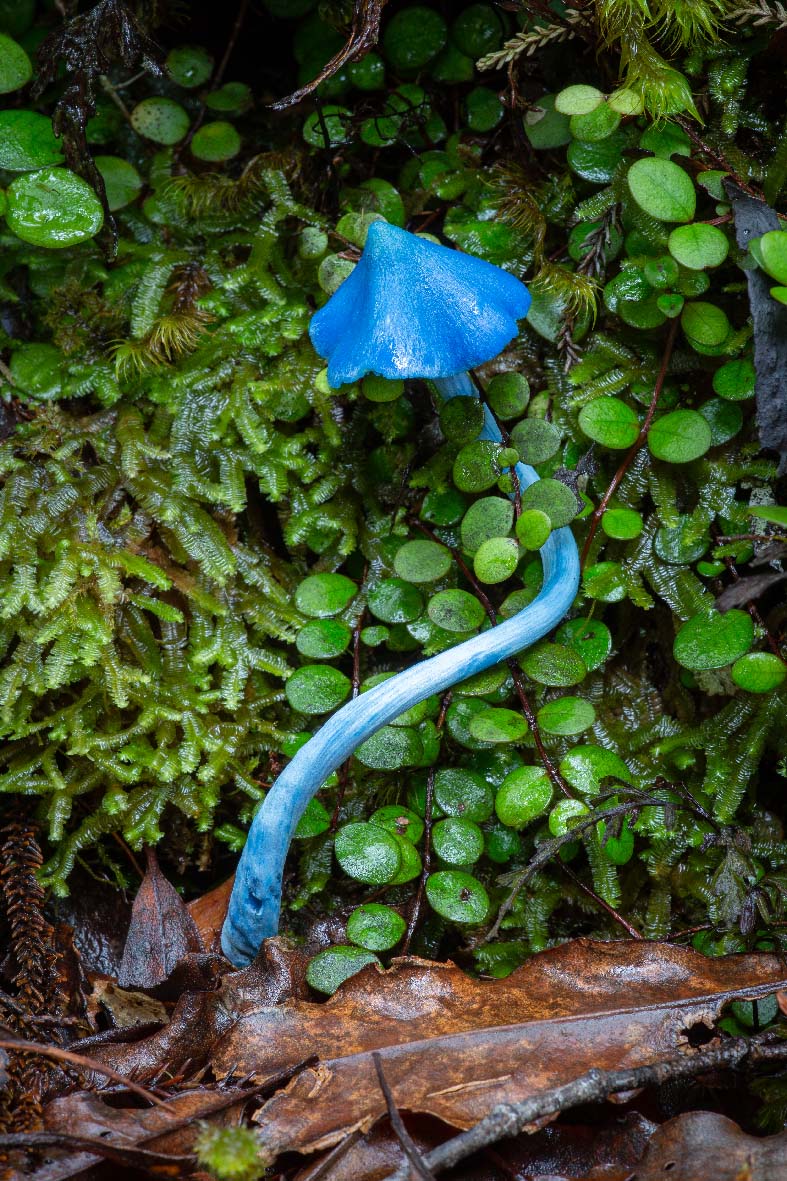
Photographing New Zealand's native Blue Mushroom

It is autumn here in New Zealand at the moment - and autumn for many photographers ushers in the start of something special - fungi season.

I'm a relative newcomer to fungi photography, having really only gotten interested at the tail end of last season. But I've got the bug - hard - and have been waiting patiently (or not so patiently as the case may be) for the new crop to start appearing. 

We have had a very hot, dry, summer on the West Coast of New Zealand - and it's taken a while for the rains to come. But come they have. And with it, comes the appearance of one of New Zealand's most iconic native mushrooms - the Blue Pinkgill.

Entoloma Hochstetteri - Blue Pinkgill. Sony a99 with Minolta 100mm macro. f/8 @ 1/3rd sec, ISO 100

Two weeks earlier (as I write this), my wife and I had taken a drive to Lake Kaniere. My wife has some friends coming from Australia to visit, and we were scouting locations to take them to. I suggested we go to Sunny Bight, to a small bushwalk there, and see if it was somewhere worth taking them to. It had been raining earlier in the week - although not a lot - so I really wasn't expecting much.

On the small walk at the Sunny Bight picnic area, we came across a little patch of Calocera viscoa, or Yellow Staghorn - a coral fungi that I had never seen before. I was very excited by this find and took a couple of quick snaps. But I didn't have my macro gear with me, so made a mental 'note-to-self' to return as soon as I could with my macro setup.

Calocera viscosa - Yellow Stagshorn. Sony a99 with 100mm macro. f/16 @ 2.5secs, ISO 100

Since the Sunny Bight picnic area walk is just a short 10 minute loop through native bush, we decided to explore further. Just past the picnic area is a dirt road that leads to the Lake Kaniere Walk - a 7hr return tramp that I had never taken a look at. We walked up the road, again surrounded by native bush, until we got to the carpark that is located at the start of the trail. Since neither of us were keen on a 7hr tramp, we turned around to head back to the picnic area. Just a few metres back along the road, a flash of brilliant blue caught me eye. And then another. And another! I stopped my wife and called her over, and together we discovered a a forest floor blooming with Entoloma hochstetteri - the native Blue Mushroom. 

I was so excited - never having seen one 'in the flesh' before. We spent the rest of the afternoon exploring, finding more and taking photos (mostly just snapshots), completely enthralled by this beautiful little fungi. It is the most beautiful, vibrant, almost iridescent blue. I was delighted to have discovered them, and couldn't wait to come back to photograph them properly.

Unfortunately, that wouldn't be until two weeks later!. Fortunately, they were still there - if not in even greater abundance than last time. Again I was so excited and set about making the most of my afternoon.

Twisted. Sony a99 with 100mm macro. f/16 @ 3.2secs, ISO100

With such a vast array of subjects, I was somewhat spoilt for choice. Believe me, I'm not complaining. But it did mean I could be a bit more picky about my subjects. Normally I come across one or two mushrooms and get to choose between the two. But the blue fungi were everywhere I looked! So much so that I needed to be careful where I walked (and I was - no mushrooms were harmed in the making of these photos).  I therefore started looking for either the unusual - or the most photogenic and prisitne examples that I could find. 

Mostly the blue mushrooms grow tall and straight. But the one exception I found was of the image above - appropriately titled 'Twisted'. As soon as I saw it I knew I had to take a photo of it - as unusual as it was amongst all the other upright specimens.

Out from Under. Sony a99 with 100mm macro. f/11 @ 1 sec. ISO 400

Entoloma hochstetteri is thought to engage in mycorrhizal relationships with Nothofagus and Podocarpus tree species. Mycorrhizas are beneficial fungi growing in association with plant roots, and exist by taking sugars from plants 'in exchange' for moisture and nutrients gathered from the soil by the fungal strands. The mycorrhizas greatly increase the absorptive area of a plant, acting as extensions to the root system. The native Kahikatea tree (a Podocarpus tree species) grows all around Lake Kaniere, providing a perfect breeding ground for the small blue mushroom species. Find a Nothofagus or Podocarpus tree species in New Zealand, and you are likely to find Entoloma hochstetteri at a certain time of the year.

Together alone. Sony a99 with 100mm macro. f/16 @ 15 secs, ISO 100

Photographing fungi is a bit like bird-watching - in that when you find and photograph a particular species you tend to tick it of your list. I wanted to find the New Zealand Blue, as occasionally it can be somewhat elusive. But not this year. This year there seems to have been an abundance at the start of the season - although that's the other thing about fungi. They seem to go as quickly as they come. Only to be replaced by another species as the season progresses.

I don't know what I'll find the next time I'm out on a fungi forage - but that's also a large part of the fun. But whatever the season brings, I'm thrilled that I've already got Entoloma hochstetteri in the bag!

Saturday, 25 March 2023

Setting up the Lumix S5 for stills photography

I've had a couple of forays out with my new Panasonic Lumix S5 and have gradually been setting it up for my shooting style.

The S5 has 3 custom dials (although you can set up to 13 shooting styles since C3 has slots for 10 different variations), and I have programmed all 3. I don't usually use Custom modes (in fact I don't think I ever have), but since this was a brand-new camera, and the option was there, I thought 'why not'?

Waterways. Lumix S5 with 20-60mm. F/8 @ 1/2sec, ISO 100

There are certain settings I change on all cameras as soon as I get them. First things first - the autofocus confirmation 'beep' gets turned off! Then the file format is set to RAW (I seldom bother with RAW+Jpeg), and the control dial is set to 'A' (aperture priority). I'm shooting a lot in M (manual) now too, but for casual shooting I stick with 'A'.

Then it's a matter of tweaking the rest of the buttons and dials to work how I like them to. And fortunately, with most of todays cameras, there isn't a dial or a button that can't be reprogrammed! I do, however, try to keep it as simple as possible and I don't go changing all the buttons functions.

The Lumix S5 is a great camera to reprogramme, since it allows you to name each custom setting with something that makes sense to you (and not just CS1, CS2 etc). I have called CS1 'General Photography' and CS2 'Landscape Tripod'. Pretty self-explanatory, don't you think!? The CS3 setting (with 10 extra slots for different variations) I've kept for 'fun' at the moment, and have programmed some black and white settings. In this post I'll just concentrate on the CS1 and CS2 settings - the two I will use most often.

Old Mine Site. Lumix S5 with 20-60mm. F/11 @ 1/15thsec, ISO 100

For both CS1 and CS2, I have them set up in Aperture Priority, to start with an aperture of f/8 and an ISO of 100. Because I'm working in A mode, the front dial is set to choose the aperture, the back dial is set to change the exposure compensation, and the real control wheel is set to change ISO. When (and if) I switch to M mode (manual), the exposure compensation rear wheel changes to controlling shutter speed. So with the two top control wheels, and the rear control dial, I have the exposure triangle instantly accessible.

Also, and very importantly, I have 'Constant Preview' set to ON! This is set to OFF by default (don't ask me why), and means that if you're changing the exposure you won't see the effect in real-time in the viewfinder! If you want to see what is happening when you change exposure values, make sure 'Constant Preview' is set to ON.

You will also need to enable the histogram to appear in the viewfinder as well - which is also OFF by default!? The great thing about the histogram in the S5 is that you can place it wherever you choose within the frame (I have it bottom right). Very cool.

The level gauge in the viewfinder is on by default. I find it somewhat annoying so turn it off. This is easy to do by simply hitting the 'back arrow' button on the camera body - which will toggle between the level gauge being on or off when in live view.

For the CS1 'General Photography' setting, I have picture mode on 'Normal'. This gives me a fairly good indication of how the RAW file is going to look. For my CS2 'Landscape Tripod' setting, I have the picture mode set to Landscape. This gives me punchier colours and helps me visualise what my final, processed image might look like.

In CS1 I have single autofocus area (centre) and single shot mode activated. For CS2 I have the self-timer automatically set for 2 seconds, and I have the Image Stabilisation turned OFF (it's turned ON for my CS1 general photography setting). In CS2 Landscape Tripod mode, I also have the 'touch to focus' screen activated (it's turned OFF in CS1).

The Blue Men. Lumix S5 with 20-60mm. F/8 @ 1/80th, ISO 6400

I hope that's not too confusing? Basically in Landscape Tripod mode I have IS OFF (because the camera is on a tripod), 2 second self timer, and touch to focus activated.

As mentioned earlier, you can 'tweak' the camera to your heart's content. But the more you fiddle and change, the more you need to remember what you changed it too! So I try to keep the fiddling to a minimum - just changing the parameters that make sense for what I'm trying to achieve with my images.

Of course none of this relates to video - this is purely a stills-centric setup. As much as the S5 is a film-making beast, I will never use the video. Video is there because we demand it (apparently). I'd be more than happy if it wasn't included, but there you are. That's progress I guess.

There are other settings I could mention, but really they come down to personal preference. You can, for instance, change the direction of the dials as they relate to moving the settings, tell the camera what to do for both card slots, set up auto ISO, control AF magnification, change photo gridlines, focus peaking colours - the list goes on, and is practically endless. 

Which is why I have only changed a few parameters so far, and I live with them for a while. Then, when I'm out in the field actually taking photos and I think - "I wish I could change/add this...", that's when I know I need to dig back into the menu and add this functionality to my custom settings.

So the custom mode settings are used somewhat fluidly, and can be changed or added to over time. But I think I'm fairly set now with my C1 'General Shooting' and C2 'Landscape Tripod' custom modes.

If you haven't set up the custom modes on your camera before then give them a try. They speed-up the shooting process considerably. Just make sure you can remember what you re-programmed all those buttons and dials to do!

Sunday, 12 March 2023

My new 'forever' camera system

In my last post I discussed my struggles recently with the Sony system. More specifically the A-mount system. I won't go over this again (read my last few posts) - needless to say I had decided it was time to move on to something else. Something 'new'.

And this time, when I say 'new' I actually mean it. In the past on this blog, when I have changed systems and introduced my 'new' camera, it's always been placed in inverted commas. 'New' has meant 'new - for me', but second-hand in reality. And I can't say that I've had a brilliant run with used camera equipment in the last year.

I'm not going to draw this out too long (you'll be pleased to know) - other than to say that I did do some serious thinking, and a bit of research to try and figure out what my 'forever' camera should be. But in the end, as is often the case (weirdly), the decision was almost made for me. How so?

I had a good idea of the features I wanted, if I was going to stick with this camera/system for the rest of my life (yes, you heard that right). And to be fair, my list wasn't long. I really don't have a large wish-list of must-haves - especially if you take video out of the equation altogether (which I do). Several brands could have quite easily have fit the bill.

And then a post came through my Facebook page from Photo & Video in Christchurch. And I had 'found' my forever camera and system. They were (and still currently are as I write this) having a fantastic deal on the Panasonic Lumix S5 with 20-60mm (almost $1k off the price) - while stocks last!

Panasonic Lumix S5 with 20-60mm f3.5/5.6
To be honest, I didn't know all that much about the Lumix S5. I'm not even sure I knew it existed! The Lumix S1 had vaguely been on my radar a few years ago when Panasonic launched it - but it wasn't a camera - or a system - that I'd taken much notice of. It was a) full frame, b) big and heavy, and c) didn't have many lenses available for the system.

But that was about four years ago, and the system has grown since then. Panasonic have addressed all of the above issues during that time. The S5 is smaller and lighter than the S1, is still full frame, and the lens lineup has grown substantially. This has been helped by the S series being built around the Leica 'L' mount, and the establishment of the 'L' Alliance between Leica, Panasonic and Sigma. With all three companies producing lenses for the system, the line-up has trebled almost overnight! That's great news for anyone looking to 'invest' in the Lumix S full-frame system.

And if that wasn't enough, the S5 itself is an absolute beast of a camera (in terms of specs). It is mentioned, and reviewed, favourably - up against the likes of the Sony a7iii, Canon R6 and Nikon Z6. Of course Lumix are well known as a video brand, and as such the S5 is crammed with seriously impressive video specs (including built-in vlog). But since I'm only interested in it as a stills camera, those are really the specs that interest me. And the S5 doesn't disappoint. 

For a start, it has a fantastic 24MP full-frame sensor with dual ISO (whatever that is!?), amazing low-light image quality and 14+ stops of dynamic range! It has dual card slots (one UH1 and one UHII), Live Composite Mode, High Res Shooting Mode (for a 96MP image), Image Stacking, Intervalometer, Face and Animal Focus/Tracking, and a host of other features I'll probably never use. Although it uses contrast detection AF, Panasonic have mastered this for stills photography, and the AF is as fast and as accurate as any other system on the market. Once I'd read the specs on the S5, and watched a few review videos on Youtube, I couldn't order one fast enough!

But first things first - I needed to convince my wife that we should be buying me a brand new camera!

Moana Sunrise. First image shot on my Lumix S5 with 20-60mm lens. f/11 @ 1.3secs, ISO 100

I've been writing this blog for over 15 years now, and I've stopped counting the number of times I've changed camera gear. In numerous posts I've written about my latest purchase being 'the one' - only to change to something else six months later. Anyone could be forgiven for rolling their eyes when I claim that 'this is the one'. But my wife, who has followed along on this journey with me, has more reason than most to be sceptical. So when I sat her down and proposed that we buy me a brand new 'forever' camera, I could completely understand (and was expecting) her scepticism.

But to her great credit, she did listen. And she did understand my frustration at the second-hand gear woes I had been having. She doesn't understand all the techy jargon I throw at her, but she does appreciate my knowledge and enthusiasm for all things photographic. So in the end, she said 'yes' (thanks honey), and I purchased the camera on-line that evening.

Lake Brunner Reflection. Lumix S5 with Lumix S 20-60mm. f/11 @ 5 secs, ISO 100

Is her support misplaced? Am I going to change my mind in six months time?

No, I'm not. Unequivocally. And here's why... 

I've been a serious photographer for over 35 years. And in that time, I've purchased maybe four cameras brand-new. My first was the Canon T70 - my first film camera. The second was the Canon EOS 10, which I purchased new after trading in all my manual focus Canon gear once they had changed their lens mount to the EF auto focus technology. My third was the Nikon D70 when I moved (eventually) from film to digital. And my last brand-new camera purchase was the Canon 5D. 

I loved the 5D, and would probably still be using it (or have upgraded to the Mk2/3/4) were it not for the fact that it developed a circuit board problem. Although to be fair, even that statement is somewhat disingenuous, since the 5D isn't a mirrorless system. And I have, for a very long time, been an advocate for mirrorless cameras. So in fairness, my change to mirrorless was inevitable. But that's also the point...

Whenever I have purchased a new camera, it has been at a pivotal moment in technology, and I have moved with the times (eventually). The T70 was replaced by the EOS10 when Canon switched to autofocus. The Nikon D70 was brought when I moved from film to digital. And the 5D was purchased when digital cameras finally went to full-frame sensors. I've never purchased a new mirrorless camera. The closest I got was with the Olympus OMD-EM-5Mk2. And I wanted to love that camera. I really did. But in the end, it was too small and fiddly, and really not for me.

Mt.Te Kinga, Moana. Panasonic S5 with Lumix S 20-60mm. f/11 @ 1/25th, ISO 100

The Panasonic Lumix S5 is my first - and last - brand new mirrorless camera. And I do say this with utmost confidence. I have thought for a few years now that cameras - at least if you are primarily concerned with stills photography - have seriously peaked. Manufacturer's just don't make bad cameras anymore. Period. I honestly believe that camera technology for the stills photographer has plateaued. To the point where 'what' camera you buy if you are a general (travel/landscape/portrait) stills photographer has basically become irrelevant.

Does that mean manufacturers will stop adding new features to their cameras? No, of course not. But most, if not all, of the 'new' features will be 'fluff'. Heck, most of the upgraded features on cameras for the last five years could be considered fluff. Nice to have, but fluff. In a recent review video I watched for the new Canon R8, at the end of the video the reviewer said that he hated reviewing modern cameras. Because they are just all brilliant. They all have everything that 99% of photographers will ever need.

Which is why I can say, with the utmost confidence, that the Panasonic Lumix S5 will be the only camera I will ever need. And, barring accidents or malfunction (please no), it will be the camera I will use for the rest of my life! There, I've said it.

Andersonia. Panasonic Lumix S5 with S 20-60mm. f/8 @ 160th, ISO 100

I'm 56 this year (don't tell anyone). God willing and if my eyesight holds up, I may have another 30 years of taking photos left in me? The S5 should last 30 years (I've got a Nikon D70 that is coming up for 20 years old and still takes great images) all things being equal. But even if I get 20 years of solid work out of it (I'm no longer a heavy shooter) I'll consider that a win.

As you can see from this post, I have already been out on my first shoot with the S5. And very successful it was too - as can be seen in the images. The full-frame 24MP sensor is fantastic, the lens is sharp and contrasty - with a great range for travel/landscape photography, and the body controls and ergonomics are a joy to use. Can I finally say I've found my mirrorless home? Yes, I think I can.

Saturday, 11 March 2023

What is it with me and Sony?

In my last post I talked about getting ready to shoot a wedding, and the gear that I was planning on using for it. I had my Sony a77ii and a bag of lenses that I was looking forward to putting through their paces on a wedding day. Good times ahead....

Because the a77ii was a very recent purchase, and the bag full of lenses hadn't been used for quite a while, I decided to do due diligence and test everything before the big day. And boy am I glad I did! 

Te Kinga Macrocarpas. Sony a77ii. f/8 A 1/200th, ISO 100

To cut a very long (and very stressful) story short, it seemed that most of the lenses I had 'acquired' for the a77ii were past their best and badly in need of calibration. I've already discussed in previous posts how I've decided to build an A-mount Sony kit around the very generous gifting of a camera bag full (literally) of Minolta and Sony lenses. Well it seems like I may have been a little hasty in my decision.

I'm not going to cram this post full of slightly un-sharp photos just to prove a point, but basically that's what I was getting with the lenses I had. With a couple of exceptions.

The Minolta 85mm f1.4 was bitingly sharp. Ironically, for portraiture, you might even say it was a bit too sharp! The same goes for the Minolta 50mm f2.8 macro used as a regular 50mm lens. Incredibly sharp on my a77ii. So I know the camera can produce sharp images - with the right lenses.

But try as I might (and believe me, I did try), all the zoom lenses I had for the a77ii just didn't cut the mustard (as they say). For some they were sharp at the long end, but not so sharp at the wide end - and for others it was the exact opposite! The Minolta 24-70mm F2.8D wasn't sharp at all, at any focal length. While the Sony Zeiss 16-35mm f2.8 and Sony Zeiss 24-70mm f2.8 were just 'so-so'.

I took so many 'test shots' (thanks to my wife for being a willing(?) and very patient model) and poured over so many images at 100% that I started second-guessing myself and tying myself up in knots! One moment I'd think everything was 'soft', and the next I'd decide that some of them weren't 'too' bad. But were any of them good enough to shoot a wedding with? I didn't think so....

Rapahoe Relics. Sony a77ii. f/11 @ 1/50th, ISO 100

With only a week to go, and no lenses that I was happy with (other than an 85mm and 50mm prime), I was in panic mode. And wishing I hadn't agreed to shoot the damn wedding! But, once again, my mate Stew came to the rescue. Since I was getting all of his 'old' gear, and he was replacing it with new E-mount gear, he let me borrow his new Sony a7iii and Sony 24-105mm f4 to shoot the wedding with. Whew!

And again, long story short - it worked perfectly! Of course. In fact it was a joy to use. And I'm even getting used to the Sony A7 series ergonomics! So I'm getting one - right?

Hold that thought for a moment. Because yes, I have decided that the Sony A-mount system is obviously not for me. The a57 with the sensor alignment issue was the start of my A-mount woes. And although the a77ii is an amazing piece of kit, getting lenses for it has proven to be somewhat of a challenge. As much as I want to love the system, it seems the powers that be have other ideas.

So what's next, you may ask? And that, dear reader, is a very good question. Perhaps it's already been answered with my favourable experience with the Sony a7iii? But there are a couple of things that give me pause to jump straight into the Sony E-mount system.

First, it's a Sony. Duh! Do I really want to continue to tempt fate with my Sony woes? Who's to say these won't extend into the E-Mount system? And while no - I'm not a suspicious person by nature - this seems too much like out of the frying pan....

Trapdoor Spider. Sony a77ii with Minolta 100mm f2.8 macro. f/18 @ 1/4sec, ISO 400

The good thing about switching to the Sony E-mount is that it's a) full frame, and b) fairly plentiful on the used market. I could pick up an a7ii body for about $1k, and then have to figure out what lens to put with it (and how I'm going to afford it!?).

Then again, I could go back to my old flame - micro four thirds. A used Olympus E-M1 mk2 with a lens would be about the same price as an a7ii body - and further lenses down the track are surprisingly affordable.

But you know what... I think I've had it with second-hand gear! Recently it feels like I've just been inheriting somebody else's problems, and I'm getting tired of it. I'm also getting old, and frankly fed up with changing systems all of the time - even when there have been good reason to. I want a system, and a camera, that I can 'hang my hat on' so to speak - and grow old with. So yes, I think I'm going to buy new this time (and for the last time).

No, I haven't won the lottery, or fallen into a big pit of money. But my wife and my circumstances have changed recently. I've started a new job this year, with a bit more pay, so I think it's now or never! All I have to do is decide what my 'forever' camera system will be - oh, and convince my wife that it's a good idea! One of those things will be easier than the other 😳😂

Sunday, 5 February 2023

Camera gear for the occasional wedding photographer

I'm shooting a wedding in a months time.

Not earth-shattering news, I know. But for someone who doesn't photograph weddings very often anymore, it becomes something of a big deal. Or maybe you're just starting out on your wedding photography journey and don't know what gear you need (or want, or should have)? What to take to a wedding if you're 'the' photographer can be quite daunting (I know it was for me).

I was a wedding photographer for several years - several years ago. And I still get asked to shoot the occasional wedding for friends or family. Hence the wedding next month (as I write this). 

Fortunately, I'm in the enviable position of having a lot of very nice gear to choose from. But I don't need to use all of it. In fact I shouldn't take all of it on a wedding. That would be overkill.

So then what should I take? What gear do you need to photograph a wedding? Do you have to use all f/1.4 primes with pro DSLR's, or will a basic camera and kit lens suffice?

As with most things in life, the answer isn't always simple. And I could fall back on the old 'it depends' answer. But that's not particularly helpful. What I want to do in this post is go through my choices for what I will be taking to photograph the upcoming wedding - and why. I'm not for a moment suggesting that the list will be exhaustive, or that it's what you should take whenever the need arises. But I do hope that it will help someone maybe looking to get into wedding photography, or who might have been asked by a friend to shoot their wedding. So lets go photograph a wedding, shall we? 


Ok, so let's start with the easy one first shall we? First things first, you're going to need a camera. You've got one of those - right? Great. Let's move on.

But hang on. Not so fast. You'd better make that two. 

Yes, that's right. If you are the main photographer at a wedding, never - I repeat never - go with only one camera! This kinda goes without saying for most paid (or non-paid) professional gigs. Especially if it's a 'once-in-a-lifetime' non-repeatable event like a wedding. Back-up is the key. And maybe even a back-up for the back-up! (although that may be slightly overkill)?

Does it need to be the exact same camera as your main one? No, not really. If your main camera is a Canon 5D Mk3, your 'back-up' could be a 5D Mk2, or even a Canon 80D. Preferably something that will take the lenses you've got. Just as long as if your main camera dies (for whatever reason), you can just pick up another camera and keep shooting.

And while we're on the subject of cameras, don't worry if you haven't got the latest or greatest gear on the market. Are big, expensive 'pro' cameras necessary for photographing weddings? No. They are not. Should you feel 'inferior' if you shoot a wedding on a Canon 80D, a Nikon D7200 or an Olympus E-M5? No - you should not. I realised very early on in my wedding career that some guests at the wedding were likely to have 'better' gear than me. Did that make them better photographers? (That's a rhetorical question). Take a look at any of the wedding images that accompany this post and tell me if they were taken on a Canon 1D Mk4 or a Canon Rebel. What's that? You can't tell!? Of course you can't. And that's the point....

Are 'pro' cameras more solidly built that prosumer cameras? Of course they are. But that doesn't mean that Canon Rebels are prone to failing constantly. Want to know the only camera that has ever failed on me? The Canon 5D. The most expensive camera I've ever purchased brand new. It lasted just as long as the warranty period and then died on me - just before a wedding. Which takes me back to point number one. Whatever camera you choose to use, have a back-up.

Are dual card slots in a camera necessary for photographing weddings (hang on, it's about to get controversial)... No, they are not!

Yes, I realise that I've just finished banging on about the importance of back-up. But trust me, hundreds of thousands of weddings have been photographed, by professionals, who used cameras that only had one card slot - long before dual-card slots in cameras were a thing. If your camera has dual card slots, then by all means use one slot as a back-up. Of course. But if your camera doesn't have dual card slots, it's NOT a deal-breaker. 

Case-in-point, my main camera for the upcoming wedding will be the Sony a77ii - which has a single card slot. My back-up camera will be the Sony a99 (which does have dual card slots, but which is getting old in the tooth now so will only be my back-up camera).

Ok. That's enough about cameras. What about the seriously difficult question of lenses....? What lenses should you buy/beg/borrow/steal to photograph a wedding?

Everyone is different. Some wedding photographers pride themselves on using only two primes over an entire wedding (usually something like a 35mm and an 85mm), while others have a bag-full of fast glass and three camera bodies slung over their shoulder (perish the thought).

Again, do you need to use fast primes at a wedding? No, you don't. Do you even need to have 'fast' lenses to cover a wedding? Again, I would argue (especially with the recent crop of modern digital cameras) that no - you don't. But should you have some fast glass on a wedding shoot? Yeah, I think you probably should.

At least as fast as you can afford. Because I also don't think that anyone starting out in wedding photography should need to take out an extra mortgage or personal loan to buy a bag full of fast glass. You can get by without it. 

My recommendation if you are just starting out, is to at least have a 50mm f/1.8, especially if you are using an APS-C sensor camera. That will equate to a 75mm (or 80mm on Canon) f/1.8, which I use mostly for hair and makeup shots of the bride and bridesmaids getting ready - and for some individual portraits. Used at around f/2.8 I get some very nice, out-of-focus creamy backgrounds which help to remove any distracting elements that may be present. A 50mm f/1.8 is the cheapest fast prime in any manufacturers line-up, and a must-have for the budding wedding photographer (imho).

Ironically I don't have a 50mm f/1.8. But what I do have is a 50mm f/2.8 macro which, at f/2.8, is a sharp lens. And as a bonus, it can also do double-duty as a macro lens to take detailed ring, dress and flower photos (see first image of this post).


As useful as a fast prime like a nifty fifty is, it probably won't see you through an entire wedding! For your main wedding lens - something that you might use at least 80% of the day, you will be better suited with a zoom lens. Something like a 24-70mm (or equivalent for APS-C).

Since most (if not all) cameras come packaged with a 'standard' zoom (often referred to as a 'kit' lens), will this do, since you probably already own one? And the answer, which may surprise some of you, is undoubtedly 'yes', it will do. I shot my first half-dozen weddings using the 18-70mm f/3.5-4.5 Nikkor 'kit' lens than came with my Nikon D70, and not one bride complained about her images - ever.

Again, look at most of the images in this post. I'm not sure any of them were taken at f/2.8? More than likely they were all shot around f/5.6 - which all lenses are capable of. Wedding days aren't about capturing background blur and 'bokeh'. they are about capturing emotion and moments that express that emotion. That's what will make a bride cry when she sees your images after the wedding is over.

Are there 'better' lenses out there? Of course there are. I would suggest, if  (and when) you can afford it, to 'upgrade' to a constant aperture standard zoom. Something like the outstandingly sharp (and reasonably priced) Sigma 18-50mm f/2.8. These can be found regularly on the second-hand market, and make a great wedding/portrait standard zoom.

My zoom of choice for the upcoming wedding? I'll probably take two (remember back-up) - the Sony 16-80mm f/3.5-4.5 Carl Zeiss Vario-Sonnar T* and the Minolta 28-105mm f/3.5-4.5. One of those will probably be on my lens for most of the wedding, covering everything from group portraits to the service itself, and bridal photos afterwards.

To be honest, you could get away with just those two lenses for an entire wedding - a 50mm prime and a reasonably fast standard zoom (and in all honesty, you could probably ditch the prime).

But there is one more lens that I will be taking in my bag, and that I will use on about 10% of the shots. And it's another prime - a medium telephoto 85mm.

On my a77ii this will equate to roughly a 130mm field-of-view - still somewhere in the medium telephoto range. And this is a lens that I will use for a specific look -  those classic, out-of-focus background, creamy bokeh, portrait images. I like swapping to the 85mm prime when I'm working with just the bridal party on individual portraits. There's just something about an 85mm prime that oozes confidence, and it's a lens I really enjoy using when I get the chance.

I'm fortunate to own the Minolta 85mm f/1.4, but the f/1.8 version is certainly just as good, and a lot cheaper when you're starting out. So the Minolta 85mm f/1.4 will be the last lens to go into my wedding bag.

To be clear, this last lens is an optional extra - the icing on the cake, and not strictly 'necessary'. I shot dozens of weddings before owning an 85mm prime. But when I finally got one, it 'elevated' my portrait work to the next level - so is a highly recommended piece of kit to work towards if you are serious about your wedding/portrait work.

So is that it? What else do you need on a wedding day? What else will I be taking with me?

Well I guess the rest is almost common sense for any photography shoot. Lots of charged/spare batteries (I'll take five), spare SD cards (64Gb x4), a flash (with spare batteries) for the reception/indoor shots (if allowed), and a good solid backpack to keep it all in.

I'm not one of these wedding photographers who carries spare needle and thread with them so they can be the hero on the day if there's a serious dress mishap. Some may disagree (and that's their prerogative), but I really don't see that as my job. And I've never actually needed it on any wedding I've ever shot - so there's that.

I also don't take a drink bottle or snacks with me. There tends to be enough drink and food around as a natural occurrence on a wedding day, and I don't mind asking for a glass of water if needed. New Zealand wedding days are fairly relaxed as a rule (at least the ones I've been involved with have been), and now I only shoot for friends or family, so I'm not a 'stranger' on the day.

The last piece of kit worth mentioning, that certainly is an added 'extra', is a vertical grip for your camera (if it supports one). Whilst certainly not a 'necessity', I always tend to shoot weddings with a vertical grip attached. For two reasons. 

First, it adds a second battery, which means you get double the shooting time. Depending on your system, you might even be able to get through an entire wedding without having to change batteries.

And second, it makes shooting in the 'portrait' orientation (which I do during a wedding a lot), so much easier. Yes, it adds weight and bulk to your system - but the two benefits I've mentioned above out-way the extra weight (in my humble opinion). Your mileage may vary. 

I don't actually have a grip for my a77ii at the moment - but one is on its way. It's an after-market product (I'd prefer an actual Sony one), but should do the job.

So, as you can see, you don't need to take a tonne of gear with you on a wedding shoot. My kit will consist of a Sony a77ii with grip (and a99 body as a back-up), 50mm f/2.8 macro, 16-80mm f/3.5-4.5, 28-105mm f/3.5-4.5 and 85mm f/1.4. A Sony flash, and associated batteries and memory cards, will round out the kit - all kept in a Lowepro Flipside 400 AW backpack. Not a bad kit.


Finally, I want to reiterate what I said earlier. More than about what 'gear' you use, wedding photography is about capturing the emotion, the energy, and the essence of a wedding day. Use whatever gear you can (yes, even a fisheye) to create captivating and memorable images for your bride and groom and you will have successfully fulfilled your purpose.

Trust me, your clients won't care what camera/lens combination you shot their wedding on, what f-stop it was, or what shutter speed you used. If you can present them with a set of photographs that tell the story and encapsulate the joy of their wedding day, you've done your job. Well done you. 

Friday, 18 November 2022

Sony a77ii quick shoot

Since receiving my Sony a77ii last week (while I was isolating at home with my second bout of Covid), I've been itching to get out and shoot with it. If only to set me mind at ease, due to my experience with the a57 (see here).

Given that I'm still in the Covid recovery phase, all I really want to do in the evenings is rest after a day at work. But I was determined to take some photos with the a77ii. And with bad weather forecast for the next week, I decided to go out last night (as I write this) and make the most of the good weather.

We've been having some stunning sunsets here on the West Coast recently, and I was hoping that this evening would be no exception. The conditions looked promising - but alas, it was not to be.

Cobden Beach. Sony a77ii with Zeiss Vario-Sonnar T* 16-80mm f/3.5-4.5 ZA DT (SAL-1680Z)

The above image is pretty standard stuff - nothing to get too excited about. But it's the first photo taken on my 'new' Sony a77ii, with my 'new' Carl Zeiss Vario Sonnar T* 16-80mm ZA DT lens (wow, that's a mouthful)!

Again, nothing special - the spectacular lighting never eventuated. But it is sharp (shot at f11), has good detail, and the colours look natural. So I'm happy.

Rusty wheel. Sony a77ii with SAL-1680Z. f/5.6 @ 1/30th, ISO 100

Taking landscape shots with the camera focused to infinity is all well and good. Even the a57 could do that. It was with subjects at closer focusing distances where the sensor alignment issues on my previous a57 showed up. So I found a subject to focus on, set the a77ii up on a tripod, and used the central spot focus area to lock on to the rusted wheel.

Result - pin sharp focus exactly where I wanted it. Whew! I can breath a sigh of relief. My Sony a77ii has no sensor alignment issues and is focusing perfectly on where I'm aiming. Great news 😀

In fact, I'm very pleased with the sharpness, although I guess I shouldn't be surprised - given that I was using the 16-80mm Carl Zeiss Vario Sonnar T* lens. You should expect nothing but stellar results from a Carl Zeiss designed lens, and I'm happy to report that that appears to be the case. I'm pretty sure this lens will remain practically glued on to the front of this camera, given its fantastic 24-120mm focal range and fairly good f/3.5-4.5 aperture. I will write a more in-depth review of the lens in due course...

Cobden Tiphead Sunset. Sony a77ii with SAL-1680Z. HDR blend in Photoshop

As previously mentioned, the brilliant sunset colours never eventuated. Which is a shame, since the clouds were looking very dramatic. The image above is really as good as it got, and even this had to be created from a two-shot blend - one for the highlights and one for the shadows. 

Soon after taking this image, and having only been out for about 20 minutes, it actually started to rain. The a77ii is weather-sealed, but I wasn't that keen to test that out just yet (and also, the lens is not). So my first landscape outing with the new gear was unfortunately cut short. It was long enough to show that everything seems to be working ok though. So I'd say despite the weather, lack of light, and average images, I'd call the first outing a resounding success! Onwards and upwards...

Wednesday, 16 November 2022

Micro adjusting your DSLR

I've got my 'new' Sony a77ii and a whole bunch of lenses. Now comes the fun part - taking them all out and testing them in the field.

I enjoy testing cameras and lenses - always have. But I'm not really the 'brick wall and colour chart' kind of tester. I'm more of a 'how does it actually perform out in the real world' type of guy.

With one exception - the micro adjustment of lenses. For this sort of testing you kinda have to resort to some charts to be a little more 'exact' in your results. You are, after all, effecting the autofocusing results of said lenses.

Having said that, you don't have to spend hundreds of dollars on the fancy lens calibration charts that you need a degree in origami to be able to fold in exactly the right angle. A simple downloaded focusing chart off of the interwebs will do. Just do a google search and you'll come up with plenty of them.

But before we get underway with all of this AF micro-adjustment palaver, the question needs to be asked - "do I need to micro adjust my lenses?" And that's a very good question. The answer to which may very well be a resounding 'no'!

Are you happy with the results from your lenses? Do they look sharp to you? Do you have any fast (f1.4 - f2.8) lenses where autofocus will be critical? Or are all your lenses zooms, with an f4 - f5.6 range? If you don't have any fast glass, then chances are the aperture ranges you are using won't show up any 'slight' autofocus alignment issues.

But if you aren't happy with the sharpness you are getting out of your lenses, or if some seem sharp while others not so much, then maybe you need to consider in-camera micro-adjustments for certain lenses? That is, of course, if your camera actually supports such a thing. Many don't.

In-camera micro adjustment is a feature in more hi-end enthusiast or professional level DSLR's. You won't find this option on any of your Canon Rebels. And mirrorless cameras don't need to be micro-adjusted, since autofocusing happens directly at the sensor level, whereas DSLR's use separate AF modules. Sometimes these can be ever so slightly out of alignment, necessitating micro-adjustment. In the 'good-old-days', you would have to send you camera and lens(es) in to Canon/Nikon etc to have them calibrated if you thought the autofocus was 'out'. Photographers' talked of their camera either front or back focusing - especially portrait photographers who would lock the AF onto the eye of a model, only to find that the camera had focused ever so slightly in front of, or behind, the point of focus.

I haven't started using my a77ii yet, so I can't say that I'm having any focusing issues whatsoever. But I do have some very nice, fast, prime lenses for it. So I thought it was worth going through the motions, just for giggles. First up, the Minolta 85mm f1.4.

As mentioned earlier, their are lots of different suggestions online as to how to go about micro-adjusting your lenses. I decided to try a couple of different options, to see if they gave me the same results. Firstly, I found a chart where you set the camera up at a 45 degree angle and then focus on the chart laying flat, at a horizontal line with measurements down either side. Access your micro adjustment menu (check your manual since it will be different for each make of camera), and then shoot at a series of steps (I did 0,5,10,15,20,-5,-10-15-20) with your camera locked down on a tripod, 2 sec timer, aperture wide open, all stabilization turned off (since you are on a tripod). Take the images into Photoshop, enlarge to 100%, and check the areas of sharpness. It will soon become very evident as you go through the images whether this particular camera/lens combination is front or back focusing (or not).

It may be tricky to tell from the above re-sized image for the web, but the a77ii with 85mm f1.4 was ever-so-slightly front-focusing. On initial inspection a +10 adjustment looked the sharpest, but then I refined the process by shooting from +5 to +10 and reviewing the results. After inspecting this set closely, I determined that +7 was the sharpest of the lot.

Not totally convinced, I tried a second method. The 'flat-image-on-a-wall' test. This time you shoot some text on a wall with the camera parallel to the words. Same procedure with the camera (tripod, wide-open, self-timer etc). And wudda ya know - same result! It must be true 😀

Again, it might be hard to tell in these low-res images, but trust me - '0' was nowhere near sharp enough, and +7 sharpens things up nicely. Job done.

My a77ii can retain up to 30 lens adjustments - automatically. Meaning once you have adjusted the lens, the camera will remember it again once that particular lens is mounted on the camera. Brilliant. And I don't know about you, but I think even I might struggle to have 30 lenses to worry about?

So yes, it would seem that at least some of my lenses will benefit from micro-adjusting. And it also seems that either process will give you the exact same results.

But don't take my word for it. Download the charts, grab a fast prime, and try it yourself (as long as your camera supports micro adjustments). You may just breath some new life into that 50mm f1.8 that never quite felt sharp enough?