Showing posts with label mirrorless. Show all posts

Sunday, 12 March 2023

My new 'forever' camera system

In my last post I discussed my struggles recently with the Sony system. More specifically the A-mount system. I won't go over this again (read my last few posts) - needless to say I had decided it was time to move on to something else. Something 'new'.

And this time, when I say 'new' I actually mean it. In the past on this blog, when I have changed systems and introduced my 'new' camera, it's always been placed in inverted commas. 'New' has meant 'new - for me', but second-hand in reality. And I can't say that I've had a brilliant run with used camera equipment in the last year.

I'm not going to draw this out too long (you'll be pleased to know) - other than to say that I did do some serious thinking, and a bit of research to try and figure out what my 'forever' camera should be. But in the end, as is often the case (weirdly), the decision was almost made for me. How so?

I had a good idea of the features I wanted, if I was going to stick with this camera/system for the rest of my life (yes, you heard that right). And to be fair, my list wasn't long. I really don't have a large wish-list of must-haves - especially if you take video out of the equation altogether (which I do). Several brands could have quite easily have fit the bill.

And then a post came through my Facebook page from Photo & Video in Christchurch. And I had 'found' my forever camera and system. They were (and still currently are as I write this) having a fantastic deal on the Panasonic Lumix S5 with 20-60mm (almost $1k off the price) - while stocks last!

Panasonic Lumix S5 with 20-60mm f3.5/5.6
To be honest, I didn't know all that much about the Lumix S5. I'm not even sure I knew it existed! The Lumix S1 had vaguely been on my radar a few years ago when Panasonic launched it - but it wasn't a camera - or a system - that I'd taken much notice of. It was a) full frame, b) big and heavy, and c) didn't have many lenses available for the system.

But that was about four years ago, and the system has grown since then. Panasonic have addressed all of the above issues during that time. The S5 is smaller and lighter than the S1, is still full frame, and the lens lineup has grown substantially. This has been helped by the S series being built around the Leica 'L' mount, and the establishment of the 'L' Alliance between Leica, Panasonic and Sigma. With all three companies producing lenses for the system, the line-up has trebled almost overnight! That's great news for anyone looking to 'invest' in the Lumix S full-frame system.

And if that wasn't enough, the S5 itself is an absolute beast of a camera (in terms of specs). It is mentioned, and reviewed, favourably - up against the likes of the Sony a7iii, Canon R6 and Nikon Z6. Of course Lumix are well known as a video brand, and as such the S5 is crammed with seriously impressive video specs (including built-in vlog). But since I'm only interested in it as a stills camera, those are really the specs that interest me. And the S5 doesn't disappoint. 

For a start, it has a fantastic 24MP full-frame sensor with dual ISO (whatever that is!?), amazing low-light image quality and 14+ stops of dynamic range! It has dual card slots (one UH1 and one UHII), Live Composite Mode, High Res Shooting Mode (for a 96MP image), Image Stacking, Intervalometer, Face and Animal Focus/Tracking, and a host of other features I'll probably never use. Although it uses contrast detection AF, Panasonic have mastered this for stills photography, and the AF is as fast and as accurate as any other system on the market. Once I'd read the specs on the S5, and watched a few review videos on Youtube, I couldn't order one fast enough!

But first things first - I needed to convince my wife that we should be buying me a brand new camera!

Moana Sunrise. First image shot on my Lumix S5 with 20-60mm lens. f/11 @ 1.3secs, ISO 100

I've been writing this blog for over 15 years now, and I've stopped counting the number of times I've changed camera gear. In numerous posts I've written about my latest purchase being 'the one' - only to change to something else six months later. Anyone could be forgiven for rolling their eyes when I claim that 'this is the one'. But my wife, who has followed along on this journey with me, has more reason than most to be sceptical. So when I sat her down and proposed that we buy me a brand new 'forever' camera, I could completely understand (and was expecting) her scepticism.

But to her great credit, she did listen. And she did understand my frustration at the second-hand gear woes I had been having. She doesn't understand all the techy jargon I throw at her, but she does appreciate my knowledge and enthusiasm for all things photographic. So in the end, she said 'yes' (thanks honey), and I purchased the camera on-line that evening.

Lake Brunner Reflection. Lumix S5 with Lumix S 20-60mm. f/11 @ 5 secs, ISO 100

Is her support misplaced? Am I going to change my mind in six months time?

No, I'm not. Unequivocally. And here's why... 

I've been a serious photographer for over 35 years. And in that time, I've purchased maybe four cameras brand-new. My first was the Canon T70 - my first film camera. The second was the Canon EOS 10, which I purchased new after trading in all my manual focus Canon gear once they had changed their lens mount to the EF auto focus technology. My third was the Nikon D70 when I moved (eventually) from film to digital. And my last brand-new camera purchase was the Canon 5D. 

I loved the 5D, and would probably still be using it (or have upgraded to the Mk2/3/4) were it not for the fact that it developed a circuit board problem. Although to be fair, even that statement is somewhat disingenuous, since the 5D isn't a mirrorless system. And I have, for a very long time, been an advocate for mirrorless cameras. So in fairness, my change to mirrorless was inevitable. But that's also the point...

Whenever I have purchased a new camera, it has been at a pivotal moment in technology, and I have moved with the times (eventually). The T70 was replaced by the EOS10 when Canon switched to autofocus. The Nikon D70 was brought when I moved from film to digital. And the 5D was purchased when digital cameras finally went to full-frame sensors. I've never purchased a new mirrorless camera. The closest I got was with the Olympus OMD-EM-5Mk2. And I wanted to love that camera. I really did. But in the end, it was too small and fiddly, and really not for me.

Mt.Te Kinga, Moana. Panasonic S5 with Lumix S 20-60mm. f/11 @ 1/25th, ISO 100

The Panasonic Lumix S5 is my first - and last - brand new mirrorless camera. And I do say this with utmost confidence. I have thought for a few years now that cameras - at least if you are primarily concerned with stills photography - have seriously peaked. Manufacturer's just don't make bad cameras anymore. Period. I honestly believe that camera technology for the stills photographer has plateaued. To the point where 'what' camera you buy if you are a general (travel/landscape/portrait) stills photographer has basically become irrelevant.

Does that mean manufacturers will stop adding new features to their cameras? No, of course not. But most, if not all, of the 'new' features will be 'fluff'. Heck, most of the upgraded features on cameras for the last five years could be considered fluff. Nice to have, but fluff. In a recent review video I watched for the new Canon R8, at the end of the video the reviewer said that he hated reviewing modern cameras. Because they are just all brilliant. They all have everything that 99% of photographers will ever need.

Which is why I can say, with the utmost confidence, that the Panasonic Lumix S5 will be the only camera I will ever need. And, barring accidents or malfunction (please no), it will be the camera I will use for the rest of my life! There, I've said it.

Andersonia. Panasonic Lumix S5 with S 20-60mm. f/8 @ 160th, ISO 100

I'm 56 this year (don't tell anyone). God willing and if my eyesight holds up, I may have another 30 years of taking photos left in me? The S5 should last 30 years (I've got a Nikon D70 that is coming up for 20 years old and still takes great images) all things being equal. But even if I get 20 years of solid work out of it (I'm no longer a heavy shooter) I'll consider that a win.

As you can see from this post, I have already been out on my first shoot with the S5. And very successful it was too - as can be seen in the images. The full-frame 24MP sensor is fantastic, the lens is sharp and contrasty - with a great range for travel/landscape photography, and the body controls and ergonomics are a joy to use. Can I finally say I've found my mirrorless home? Yes, I think I can.

Wednesday, 8 September 2021

My 'dream' kit in 2021

I belong to several Facebook groups to do with buying and selling camera gear (surprise, surprise). Mostly it is people looking to upgrade, sell the occasional lens, or change systems. I've used it myself from time to time. It's actually how I found, and purchased, my Panasonic Lumix 12-35mm f2.8 recently.

Most of the time I just flick through the posts quickly, especially if I'm not looking to buy or sell anything. But one recent post made me stop in my tracks, and almost made my eyes water! And it also got me thinking (and dreaming).

Someone was selling their entire Sony kit - for $16,000NZ! No, that's not a typo. $16k! That price is enough to make anyone stop and look more closely.


To be fair, this wasn't just some scam artist trying to dupe an unsuspecting newbie into paying way too much for outdated gear. This was a legit seller, with a LOT of quality Sony camera gear, who was hoping to sell it all as a package deal. And I'm sure it was good value, even at sixteen grand NZ. I didn't dive too deeply into exactly what he had in the package, but there were at least two Sony A7R III camera bodies, probably with grips, and about five or six G series lenses to go with it. As well as flashes and other accessories. And it all seemed very lightly used. I think one of the bodies had only done around 15000 shutter actuation's. That's nothing.

But, as much of a bargain as it may have been, it got me thinking about someone's ability to drop $16k on a camera system. Obviously it was being pitched at a professional photographer. And I assume (although I don't know for sure) that the guy selling it was a professional themselves. Although maybe not? I've known a few hobbyists in my time who had the ability to drop some serious cash on photography gear. And good on them, if they can afford to do so.

For me, however, that kind of money to spend on photography gear is dream territory. Although I'm sure if I added up all that I had spent on photography over the last 35+ years, that figure would also make my eyes water! But I have certainly never had the ability to spend that kind of amount all in one go. And I'm sure I never will. And yet, from time to time, I think we all play the 'what if' game in our minds. And this Facebook post, with the seller asking $16,000NZ for his Sony gear, got me thinking - and dreaming - about 'what if'? What if I had $16k to drop on photography gear. What would I get, in 2021?

Of course the very first question I would need to ask myself is "Should I stay, or should I go" (apologies to The Clash).

To be honest, I didn't really have to think about this for too long. I think I'd stay. Which might, for some, be a surprising answer. After all, if you had $16,000 wouldn't it be the perfect opportunity to 'start again' and buy into a completely new system?

And the answer is, of course, 'yes'. It would be a perfect time to buy into a new system. If you were unhappy with your 'old' one. Thing is, I'm not unhappy with my Olympus/Panasonic micro four thirds system at all. Just the opposite in fact. I still maintain that it is an amazing, incredible, fully featured and mid-blowingly capable image-capturing system. So why would I want to change?

But what about the future of micro four thirds - I hear you ask. Yep. Very good question. The future is certainly uncertain (to quote an obscure Rowan Atkinson skit). And yet, my honest (although perhaps somewhat flippant) reply would actually be - I don't care.

I'm not sure how long JIP (Japan Industrial Partners) is going to keep the micro four thirds Olympus camera system going for? Nobody really does. Will they produce another iteration of OM-D models? Will there be an E-M1 mk4, or E-M5 mk4? Or an entirely new E-M'something'? Will we ever see an E-M1x Mk2? I honestly don't know. 

And what of Panasonic? We know the GH6 is coming, which is a good sign. But if Olympus folds, will there be a GH7? Or a G10? Or any new lenses? Again, I simply don't know. We do know that Sony seems to still be developing micro four thirds sensor technology, which is a very positive sign. But this is Sony. So we also know that the development could cease at any time if it no longer becomes profitable. And fair enough.

But in the end, as I stated earlier, I just don't care. And why not? Well, quite simply, even if all production of micro four thirds stopped tomorrow (and it won't), there would be enough product - and probably enough spare parts - in existence already to see me through to the end of my photography days. I'm no spring chicken. I realistically only have about another 20 years of good photography left in me. If that. And barring accidents, I look after my gear. So I reckon, based on current technology, any new camera I purchased in 2021 would probably have twenty years of use in it - easily. I have, and use, a Nikon D70 - which was released in 2004. That's 17 years ago. And it's still going strong. And still produces great results. I have no doubt that the current technology would see me through to the end of my photographic journey.

Having just said all that... if I was 20 years old and just starting out in my photography career, then my decision would be completely different. If I was serious about a photography career, had my whole life ahead of me, and wanted to invest heavily into a system, it would not be micro four thirds. I would look, instead, at the Nikon Z (or Canon R) mirrorless system.

But I'm not (20 years old), so I'm very happy to stick with micro four thirds. And would still suggest that a hobbyist or amateur photographer give it serious consideration in 2021 as well. Despite what I've postulated above, I still think there's life left in the old girl yet 😉

Okay, enough already. If I had $16,000NZ to spend today, on photography gear, what would I get? Not allowing for discounts (but I'd want something taken off  - or included - if I was dropping $16k), and given my bias towards landscape photography, the list would go something like this:

Olympus OM-D E-M1 Mk3 bodies x2  $6,194.00
Olympus HLD 9 Power Battery Grip $498.00
Extra BLH-1 Olympus battery x2 $240.00
M.Zuiko 8-25mm ED F4 Pro lens $1,750.00
M.Zuiko 12-40mm ED F2.8 Pro lens $1,400.00
M.Zuiko 40-150mm EZ F2.8 Pro lens $1,800.00
Olympus MC-20 2x Teleconverter $785.00
M.Zuiko 8mm ED F1.8 Fisheye Pro lens $1,500.00
M.Zuiko 60mm F2.8 Macro lens $600.00
Olympus FL-700R Flash $650.00
Filters and Camera Bag $600.00

For a grand total of $16,000NZ (approx)
Prices in NZ dollars, rounded up, as at 8.09.21

I'm not going to go into great detail about why I've chosen what I have, a lot of it is probably self-explanatory. I will, however, clarify a couple of things...

First, I went for two E-M1 Mk3 bodies and one grip for flexibility over going for the E-M1x with built-in grip that can't be detached. If I want to travel 'light' I would simply use the E-M1's sans-grip. That's not an option with the E-M1x. I could have gone with an E-M1 Mk3 plus grip, and an E-M1x body for basically the same cost, but decided that two identical back-up bodies would be a better idea.

The lenses are probably all obvious. I opted for the 8-25mm f4 over the 7-14mm f2.8 as my landscape lens because a) I don't need f/2.8 for landscapes, and b) the 8-25mm allows for using filters, whereas the 7-14mm doesn't. And I think that the range of the 8-25mm is far more versatile as well.

The fisheye, and to some extent the macro, are in the list just because I can. They are very 'specialty' lenses that I wouldn't use very often, but are achievable within budget - so why not. I'm obviously not really a 'prime' guy, but these specialty lenses are an exception to the rule. I also don't feel the need to wait for the 100mm macro Pro version that OMD Solutions are said to be releasing soon. As already stated, I'm not really a macro shooter, so the 60mm will be more than sufficient for my needs.

So there you have it. My 'dream' kit. And as you can see, even purchasing all new, you can get a lot of gear for your money if you go with a micro four thirds system. And I didn't even look at any Panasonic lenses - even though it's what I shoot with at the moment.

I know that this has been a long post already - and thank you if you are still reading this. If you are, bare with me a little longer. I thought it might also be interesting, as a comparison, to see what $16kNZ would get you if you bought into the Nikon Z system that I mentioned above.

Nikon Z6 Mirrorless bodies x2 $6,380.00
Nikon MB-N10 Battery grip $450.00
Extra Nikon Z6 battery x2 $240.00
Nikon XQD Memory Card 64GB x2 $680.00
Nikkor Z 14-30mm F4 S lens $2,185.00
Nikkor Z 24-70mm F4 S lens $1,685.00
Nikkor X 70-200mm F2.8 VR S lens $4,300.00

For a grand total of $16,000NZ (approx)
Prices in NZ dollars, rounded up, as at 8.09.21

I have tried, as much as possible, to find like-for-like in the two systems. And as you can see, $16,000 buys you a lot less if you opt for a full frame Z series Nikon. I have even chosen the first generation Z6, as opposed to the latest model Z6 II. You could also save yourself some money by using the F series adapter and using the older 'F' mount lenses, instead of going for the Z mounts. But if you are 'investing' in the system long-term, why would you? Just get the Z mount lenses in the first place.

While the above may seem a bit futile (I haven't got $16,000 to spend on photography gear after all) and pointless, it's still quite fun. No harm in dreaming - right? It may also be interesting to look back on this post in a few years time - say 2025 - and re-visit it, to see if my 'wishlist' may have changed?

What would be on your wishlist if you suddenly found $16,000 to spend on photography (and you can't say 'a world trip', it has to be on actual gear)? Go on, dream a little...

Tuesday, 22 October 2019

A Day in the Life of the Okarito Boat Shed

Every year, a group of men from my local anglican church in Cobden, go away to Okarito for a 'mens weekend'. This usually involves lots of fishing (for trout and whitebait), lots of walking (around the lagoon and up to the Okarito Trig Lookout) and lots of cards (500 seems to be the card game of choice).

I've only been once before, six years ago, so I thought it was high time I went away again. And of course, my focus (excuse the pun) was always going to be on one thing only - photography.

Okarito Boat Shed at pre Dawn. Fuji X-E2 with Fujinon XC 16-50mm. F/11 @ 6 secs, ISO 200.
To get away for a whole weekend, no other pressures or concerns, to concentrate 100% on photography is practically unheard of - for me at least. And an amazing luxury. So I was determined to make the most of the opportunity. Unfortunately, the long-range forecast one week out didn't look promising. There was, in fact, Civil Defence rain warnings in place, especially for the Friday that we were travelling to Okarito (a two hour trip from Greymouth). As we drew closer to the end of the week, the forecast for Saturday began to look a little more promising. But I wasn't all that hopeful, and had a good supply of books with me along with the camera gear.

Okarito Boat Shed at Dawn. Fuji X-E2 with Fujinon XC 16-50mm. F/11 @ 1/35th, ISO 200
Friday came, and there was indeed torrential rain all day! The drive down to Okarito was slower than usual, with heavy surface flooding in places, although fortunately never enough to close the roads. When we eventually got to the Okarito settlement, the rain was starting to ease (a little), although it was obvious that they had also had their fair share throughout the day. Yet as the evening turned to night, the rain continued to ease. And when we finally called it a night, I set my alarm for 5.30am with a sense of optimism for the following day.

Okarito Boat Shed at Sunrise. Fuji X-E2 with Fujinon XC 16-50mm, F/11 @ 1/35th, ISO 200
As you can see from the images in this post, that optimism was well founded! Saturday dawned with a beautiful, calm, clear and still morning. Not a breath of wind or rain in sight. Just glorious! I was so ecstatic, and was treated to one of the most beautiful mornings I've ever had the pleasure to experience - let alone photograph. Last time I was in Okarito (six years earlier), the morning light was wonderful. This time, it was spectacular. May prayers were answered in a truly special way and I felt very blessed.

From a technical perspective I am, and continue to be, impressed with the Fujifilm X series cameras. I used the X-E2 exclusively over the weekend, although I had the X-E1 and 27mm pancake lens with me as a back-up. Just prior to leaving for the weekend, I purchased a new camera bag - a Vanguard 'Sydney' messenger-style bag. It's a small bag with top-loading access through a zip, or conventional access through a flap, and fits the X-E2 with 16-50mm, the X-E1 with 27mm, as well as spare batteries and memory cards. Just brilliant to wander around with all day, and was the ideal travel camera bag for the X-E's.

Boat Shed in Early Morning Light. Fuji X-E2 with Fujinon 16-50mm. F/11 @ 1/60th, ISO 200
I arrived at the famous Okarito Lagoon Boat Shed pre-dawn, at around 5.30am. The sky was just beginning to brighten, even though sunrise wasn't for another hour. Since the boat shed looks east, the sun rises right behind it (as you stand at the waters edge), so most of the time the boat house will be in silhouette against the rising sun. All you can really do is expose for the sky and let the boat house go to dark shadow, especially as the sky brightens and the sun begins to climb.

Eventually, if it's a clear morning, the sun will be so bright that it's no longer feasible to shoot from behind the shed, and another vantage point will need to be found. Fortunately, it was also low tide, so access to other areas of the lagoon wasn't a problem. At high tide you can't really vary your viewpoint too much, as getting in front of the boathouse becomes difficult.

Morning has broken, Okarito Boat Shed. Fuji X-E2 with Fujinon 16-50mm. F/8 @ 1/640th, ISO 200 
If you get a great day, then you can shoot at just about any time at the iconic boat shed wharf. It's such a fantastic structure, sitting out on its own in the lagoon. It looks great in almost any light - morning silhouette, daytime side-lighting or back-lit in the evening. I often used a 6 stop ND filter to slow down the water and give a stronger reflection, but using a faster shutter speed can also work to accentuate the ripples in the water.

Of course during the middle of the day the light is never the best for landscapes, so I went elsewhere. But I would often return to the lagoon, drawn to the boat shed, just to check up and see what the light was doing at any given time of the day. This is a luxury that only time can afford and as noted earlier, I was very lucky to have a day to spend just on photography.

Late evening long exposure, Okarito Boat Shed. Fuji X-E2 with Fujinon XC 16-50mm. F/11 @ 14 secs, ISO 200
As the day progressed to evening, and the sun began to set in the west, the boat shed was now lit up at the back. This low, soft light was ideal for some long exposures with the 6-stop ND filter. And since the light was also quite muted, the tones worked perfectly in black and white.

That's another reason I love shooting with the Fujifilm X series cameras - the custom film simulations are superb. The above image is a straight-out-of-camera jpeg, shot using my own Acros film simulation recipe. The range-finder style Fuji X-E's just cry out to be shot with film simulations and they are super easy to access with the 'Q' Quick selector screen. Just tap the 'Q' button and flick the scroll wheel next to it to access up to 7 user-defined film simulation recipes. My two favourites are my 'Classic chrome' and 'Acros' simulations, which I shoot in 90% of the time. And, since I have the camera set to capture RAW + Jpeg, I always get the best of both worlds if I'm shooting black and white jpegs.

It was late in the evening... Okarito Lagoon Boat Shed. Fuji X-E2 with Fujinon 16-50mm. F/11 @ 17 secs, ISO 200
It was a lot of fun, and a great visual exercise, capturing the Okarito Boat House throughout the course of one day. The light had its own unique qualities and feeling at each and every part of the day, and the one location yielded almost endless possibilities.

Okarito isn't a destination I can get to very often. The last time was six years ago. And there certainly aren't many locations that I have the luxury of being able to spend a whole day photographing. So I feel very lucky, and very blessed, to have had the opportunity to capture 'A day in the life of the Okarito Boat Shed'. I came away with a great portfolio of very different photos, and a richer understanding of light and its many facets. Not a bad way to spend a day if you ask me.

Friday, 11 October 2019

Quick shoot with the Fuji XF 27mm f2.8 pancake

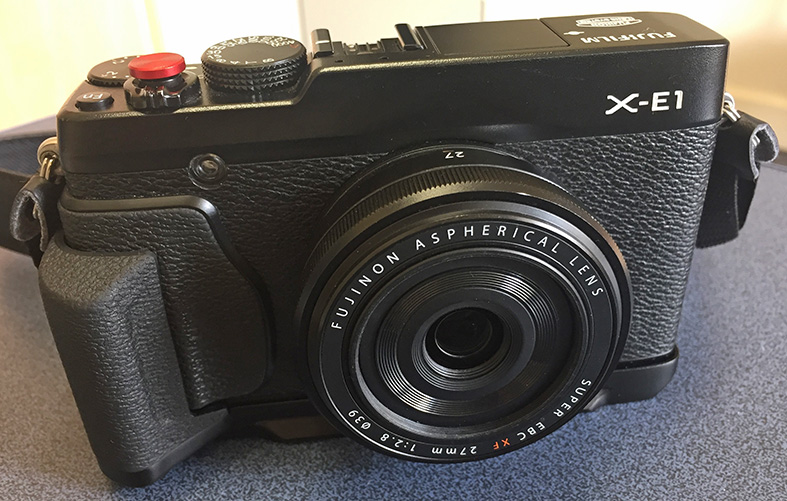
My pimped X-E1 with 27mm pancake... Nice!
As mentioned in my last post, I am using the Fuji X-E2 as my main camera, but have also purchased an X-E1 and Fujinon XF 27mm f2.8 pancake lens as a 'backup'.

Just a couple of  months ago, I put my toe in the water of the Fujifilm system with an X-E1. I was hooked from the moment I took my first image with the compact, range-finder style body, and the beautiful Fuji x-trans sensor.

The X-E1 very quickly made way for the X-E2, although it was far from being a straight forward decision. I was still running a Nikon DSLR kit as well, and couldn't justify keeping both X-E's. So reluctantly the X-E1 had to go.

But, so enamored have I become with Fujifilm, that I soon after decided that it was the one system for me - so I sold my Nikon gear and got an X-T1. Great decision - right? Well, for some maybe. But not for me. Turns out I'm a compact, range-finder style guy. Who knew!? (Certainly not me). So I've sold the X-T1 and got, instead, the X-E1 (yay!). So now I'm back where I started - rockin' two X-E's - and lovin' it.

Hokitika Beach sculptures. Fuji X-E1 with Fujinon XF 27mm f2.8 pancake. f/4 @ 1/950th, ISO 200. C2: Acros recipe
I have been a working photographer in the past (shooting weddings) and have the 'back-up your gear' mindset drummed into me. These cameras are very well built, and it's unlikely that there will be a problem 99.9% of the time. But they are also full of electronics - and electronics do fail. So I like to have that 0.1% covered. Just in case. And then, of course, there's always human error. I have dropped, and destroyed, camera gear on at least two occasions. So yes, redundancy is a thing...

Which also meant that I needed a backup lens to go with my XC 16-50mm zoom. I could have gone for another one, but I decided to see what else I could get for a similar price - to experience a bit more of the Fuji system, since Fuji is all still new to me.

I've said in the past that I'm not a prime kinda guy. And while this is true, there is one prime lens that I've owned regularly, and used a lot. The 50mm f1.8 - in both Canon and Nikon flavours. I've often advised students to go for a fast, standard prime, as their first lens purchase outside the kit lens, so I figured I may as well take my own advice for once!

I was tossing up between either the Fujinon 23mm f2 or the 35mm f2, which would give a 35mm or 50mm equivalent focal length (respectively) in traditional film terms. I honestly couldn't decide which I should go for - and then I saw a review on the 27mm f2.8 pancake (40mm fov).

Fujinon XF 27mm f2.8 lens elements
All the reviews I read or watched were super positive about this tiny little pancake prime lens. Sharp, reasonably fast focusing, well made, small and light - what's not to like? Especially when paired with the X-E's. The 40mm (40.5mm to be exact) field of view in traditional full frame terms seems like the ideal compromise between the 35mm's wide and the 50mm's normal. In fact, apparently 43mm is 'normal' (hence Pentax's 43mm prime). So the Fujinon XF 27mm f2.8 (multiplied by x1.5 for the sensor's 'crop' factor) should give me a great 'standard' walk around field of view. Not to mention a super lightweight and super small profile.

How lightweight and how small, you ask?  It weighs just 78 grams, is only 23mm deep, and uses a 39mm filter thread. Yet it also manages to house 7 elements in 5 groups - with one aspherical element (see diagram above). I've owned the Olympus 17mm f2.8 pancake lens when I was using micro four thirds, and while the Olympus is even lighter still (at 71 grams), and just a touch thinner (22mm deep), it's also designed for a smaller sensor. I'd give the build quality to the Fujinon, as well as focus speed and optical quality.

Beach Sculpture, Hokitika. Fuji X-E1 with Fujinon XF 27mm f2.8. f/4 @ 1/400th, ISO 200. C2: Acros recipe
So far so good in theory. But what about in practice? What's the Fujinon XF 27mm f2.8 pancake lens actually like to shoot with? And what kind of images can it produce?

As its diminutive size and weight would suggest, when popped onto a camera body it really doesn't make much of an impression. Even on the small X-E1. There's just enough lens to rest in your hand when holding the camera up to the eye. But you will be cradling the fly-by-wire focusing ring. Not a big deal, and certainly ok if you are planning to focus manually (I'm probably not). On a bigger camera (like the XT-1) it would probably get lost pretty quickly and maybe even look a little ridiculous? I guess the 23mm f2 or 35mm f2 lenses would be better choices for the X-T range of bodies?

Driftwood Sculpture, Hokitika Beach. Fuji X-E1 with 27mm f2.8 XF pancake. f/4 @ 1/640th, ISO 200
As you can see from the first image on this post, I have attached the extra grip to the X-E1 body. In hindsight, this is probably not really necessary with such a small lens attached, so I think I will actually swap it over to the X-E2. I guess the reason I didn't do so in the first place was because the X-E2 has the leather case attached, which won't fit with the added grip. I'll swap them over and use the grip on the X-E2 with zoom lens, and the leather case on the X-E1 with 27mm pancake. Makes a bit more sense that way around.

I've only had the lens for a few days, so it's far too early to give a full user-review. But so far so good in terms of handling, auto focus response and image quality. From the few images I've taken with it so far, it seems plenty sharp enough. I haven't pixel-peeped edge-to-edge, but nor have I really used it at my optimal landscape apertures yet (f8 to f11). I guess it's not really going to be my 'landscape' lens anyway. It is what it is - a back-up/walk around lens.

Sunset Point, Hokitika Beach. Fuji X-E1 with Fujinon XF 27mm f2.8. f/4 @ 1/850th, ISO 200. C2: Acros recipe
All the images here are jpegs, shot with my C2: Acros film simulation recipe, and lightly edited in Lightroom. Just my standard clarity and dehaze with a slight vignette and some grain added. I'm very please with these initial images, and happy to be using the X-E1 again. It may be 'old' (Really? Is six years really that old?) but damn does that first generation x-trans sensor take some great images!

The weather is clearing (briefly), so I plan to take this combo out again soon and continue to put it through its paces. I'll probably mix it up next time and shoot some colour film simulations as well as black and white. At 40mm (equivalent fov) and an f2.8 aperture, it may even be worth shooting a few portraits with the lens? I haven't done many portraits since moving to Fuji, so if I can find some willing subjects, that might be the next test?

Tuesday, 8 October 2019

Film Simulation Recipe C4: Kodak Tri-X

If you've been following along recently (thanks if you have - shame on you if you haven't), you will have been introduced to the first two of my custom film recipes for my Fujifilm X-E1. If you want to catch up on these posts, go here for my version of Classic Chrome, and here for my version of Acros.

Hansen Park, Christchurch. Fuji X-E2 with Fujinon 16-50mm. f/16 @ 1/100th, ISO 400
C4 film simulation recipe - Kodak Tri-X jpeg
To mix things up a bit (and to keep those who are following along on their toes), I'm going to jump from C2 to C4, missing out C3 - my Kodak Portra 400 simulation - for another time. Couple of reasons for this. First, I haven't used the C3 Portra 400 simulation yet, since I haven't been taking many portraits (which is mainly what I would use this film simulation recipe for). But mainly it's because I recently had the opportunity to shoot in a park early in the morning and decided to use the more 'grittier' C4 film simulation. So I actually have some images to show that use this film simulation.

C4: Kodak Tr-X Film Recipe
ISO 400 (will increase if appropriate)
Dynamic Range: 200
White Balance: Auto
Noise Reduction: 0
Image Size: Large 3:2
Image Quality: RAW + Jpeg fine
Film simulation base: Monochrome + R
Highlight Tone: +1
Shadow Tone: +2
Sharpness: +1

As you can see, my Kodak film simulation is based on the Monochrome + Red filter, for a bit more contrast in the black and white tones. This is further enhanced by boosting both the highlights and shadows much more than with my 'standard' Acros simulation. Base ISO begins at ISO 400 to mimic the classic Kodak Tri-X rating, with +1 sharpness to emulate Tri-X's outstanding edge-to-edge sharpness.

Casting Shadows. Fuji X-E2 with Fujinon 16-50mm XC. f/5.6 @ 1/750th, ISO 400. C4 film simulation: Kodak Tri-X
Of my film simulation recipes for the X-E2 (and X-E1), four are black and white and three are colour. When shooting with actual film, I tend to be more of a black and white user, so it's not surprising that me preferences for 'film stock' in the X-E2 is going to be slightly skewed towards B&W.

Of course all my 'titles' for these film recipes are completely arbitrary. The C4 simulation is simply my attempt at replicating a more grittier, high contrast black and white look. The kind of look I associate more with Kodak Tri-X. And calling it Kodak Tri-X is just more cooler (and more descriptive) than always referring to it as 'C4'.

Creeping shadows. Fuji X-E2. f/5.6 @ 1/320th, ISO 400. C4: Kodak Tri-X
I think I mentioned this in my previous post about the Acros recipe, but it's worth mentioning again. The reason I love shooting in the black and white film simulations, is that it offers me the best of both worlds. Setting the camera to shoot in RAW + Jpeg, I get to 'see' in black and white through the evf and subsequent image on the lcd screen, but I also capture a colour RAW file if I change my mind and want the image in colour.

Actually 'seeing' in monochrome is by far the biggest benefit. Eliminating the colour reduces the image to purely shapes, lines and tones. This was a huge help when visualizing an image like the one above - Creeping shadows. Yes, I could see that the shadows were making interesting shapes on the grass when I was there taking the photo. But by setting the camera to my C4 film recipe I was able to  remove all the distracting elements and nail the image in-camera. I could have shot in colour only, knowing that I was going to convert it to monochrome later on and boost the contrast in Lightroom. But if I knew that already, why not just do it at the time? Fuji's outstanding film simulation recipes allow me to do this.

A shadow of my former self. Fuji X-E2 with Fujinon 16-50mm XC. f/5.6 @ 1/550th, ISO 400
I have visited Hansen Park in Christchurch every month for the last six months, and photographed there at the same time each visit. My wife and I have been going over to a medical centre near there, and I have been taking the opportunity to go for a walk in the park and take photos while my wife has her appointment. It's been the winter months mostly, with very cold mornings. But now it's spring, and at 9.30 in the morning the sun was casting very strong side light through the park. The shadows looked fantastic in b&w through the evf, so this is what I decided to concentrate on capturing this morning.

Treescape. Fuji X-E2 with Fujinon 16-50mm XC. f/8 @ 1/240th, ISO 400. C4: Kodak Tri-X jpeg
The X-E2 with lensmate thumb grip and leather case makes for a surprisingly comfortable grip for such a small compact camera. As I talked about in my last post, this is also helped by using the ultra-light Fujinon 16-50mm XC lens. My 'new' secondhand silver mark II version arrived before the weekend, just in time to take it away with me. It's just as sharp and impressive as my last black, mark I, version of the lens - and looks great in silver on the silver/black X-E2 body.

Handling, ergonomics and shooting experience with the Fujifilm X-E2 is sheer joy. I haven't had this much pleasure using a camera in a very long time. Sure, I 'enjoy' using cameras - full stop. The Nikon D300 was/is a 'great' camera, as are the Canons. But there's just something else about the Fujifilm X-E2 (and X-E1) that captivates me and makes me want to shoot. Something almost undefinable. It's all getting a bit 'zen' (sorry), but the connection I feel to the Fuji's is quite special.

Dappled light. Fujifilm X-E2 & Fujinon 16-50mm XC. f/8 @ 1/450th, ISO 400. C4: Kodak Tri-X - jpeg 
Anyone who has followed my posts on this blog for any length of time will understand that I've been searching for my 'ideal' camera system for years. I've oohed and aahed over many systems through the years - from big pro DLSR's like the Canon EOS 1D, to small micro four thirds Olympus E-M1's. And as I said earlier, I've 'enjoyed' them all. But none have given me the almost 'spiritual' connection (here he goes again) that I feel with the Fujifilm X-E's. Am I reading too much into enjoying using a new (for me) camera system? Maybe. But I've also written about how I wasn't that enamored with the X-T1. So I do feel I have at least some perspective still in tact!?

I'm loving the images, I'm loving the cameras and I'm loving the whole user experience. I can't really say much more than that. I've recently sold off all my other gear and moved entirely to the Fujifilm X-E2. But such is the lure of the original X-E1, I've purchased another (back up) body, having just sold my first X-E1 recently. I had presumed the X-T1 / X-E2 would be my camera combination, but once I'd decided to sell the X-T1, I started looking for another X-E1. I found one almost straight away - a black body in mint condition. So now I have an X-E2 / X-E1 combination. And although I'm not a prime lens kinda guy, I've also snapped up a Fujinon 27mm f2.8 pancake lens, which I will pair with the black X-E1 for a super small, super light combo. Looking forward to trying this out and comparing the IQ with the 16-50mm XC. I will post about this soon.

Monday, 30 September 2019

And then there was one - the X-E2!

Well, it is indeed official. I am now a complete Fujifilm X shooter! And the winner once the dust had all settled? Ok, it's no surprise if you've been following along (or if you've read the title). I've kept the X-E2.

Lone Tree, West Coast. Fujifilm X-T1 and Fujinon 16-50mm XC. f/5.6 @ 1/320th, ISO 200 
In my last post I talked about using the X-T1, and the things I didn't like about its ergonomics. After picking it up for the first time I knew I probably wasn't going to keep it - which was something of a surprise to me. It's positives didn't outweigh its negatives (for me at least), and the fact that it has exactly the same sensor as in the X-E2 didn't help its chances of me keeping it. So it's gone.

Lake Mahinapua reeds. Nikon D300 with Nikkor 17-80mm. f/11 @ 1/6th sec, ISO 200
In another recent post, I took my other recent purchase, the Nikon D300, out for a trip to Lake Mahinapua. I enjoyed the experience of shooting with the DSLR (see the post here), and got some decent images on the morning despite the overcast conditions. I finished that post by saying that I might keep the D300 around to scratch my DLSR itch - but that the Fujifilm X-E2 would be my main system. Well, I didn't - keep it, that is. Upon reflection, I couldn't really justify having the gear just sitting around for when I might want to use it one day. So it's also gone.

Motukeikei Beach, Low tide. Fuji X-E2 with Fujinon 16-50mm XC. f/11 @ 1/5th sec, ISO 800
This left me with the Fujifilm X-E1 - the body that kicked of this whole love affair to begin with - and the X-E2, the 'upgraded' model with a few extra bells and whistles. I outlined this dilemma in this post, concluding that the X-E2 was the 'practical' choice over the X-E1, since it does offer a few helpful software related tweaks over the X-E1. I've since followed through with this decision, and now the X-E1 is also gone (along with the Fujinon 16-50mm XC lens).

So as it stands today, as I write this, I literally just have the X-E2 body left. Nothing else. Not even a lens! Although a lens is coming. With all this selling, I've got a tidy sum together to blow on a lens - right!? So what am I getting? The Fujinon XF 18-55mm f2.8-4 maybe? Or, what about really splurging on the Fujinon XF16-55mm f2.8! I could probably afford one. Oh, I know. Let's really make use of the X-E2's small form factor and get a couple of primes. The 23mm f2 and 35mm f2 maybe?

Nope. Haven't gone for any of those. What I've done, instead, is get another Fujinon 16-50mm XC f3.5-5.6 - plastic fantastic kit lens! I kid you not. Am I crazy? Maybe. Maybe not. I'm actually going to write a post about this lens soon, so stay tuned for my reasoning's to stick with the 'inferior' XC lens lineup.

The lens should arrive soon, along with a grip attachment for the X-E2, and then my 'kit' will be complete (for a while). It will feel a little strange just having one camera body though. I've had the 'back-up' body mentality for such a long time, I may have to relent and get another X-E2? Maybe an all black one to go along with the black and silver I have at the moment? And then again, there is a black X-E1 body going very cheaply online at the moment...

Thursday, 26 September 2019

B&W Landscapes with the Fujifilm X-T1

The Fujifilm X-E2 (and briefly the X-E1) is quickly becoming my go-to camera - for everything! Trust me, this is a huge surprise to me - so much so that I can't quite believe it and am starting to second-guess myself.

How so? Well, as much as I like the look of a range-finder style camera like the X-E2, I've always actually preferred the handling and feel of a more traditional SLR styled camera body. So I figured that if I like the X-E2, I'll love the X-T1!? So yes - you guessed it. I brought one.

Carters Beach tree stump. Fujifilm X-T1 with Fujinon 16-50mm XC. f/5.6 @ 1/240th, ISO 200. Polariser
I've had it for a couple of weeks, but haven't had a chance to get out and shoot with it until yesterday (as I write this). The X-T1 uses a more 'traditional' SLR design, with a few more knobs and dials (it has a dedicated ISO dial), but as can be seen in the comparison photo, it's not actually that much bigger than the rangefinder-esque X-E2.

And actually, that's my first gripe with the X-T1. It feels a bit cramped, and not quite big enough. It's been a regular complaint of mine with all mirrorless systems, not just Fujifilm. When I had the Olympus OM-D E-M5 I had to attach the grip before it felt comfortable in my hands, and I ain't got big hands! I feel exactly the same way with the X-T1. I'm sure it would feel better with the vertical grip attached. Oddly enough, the X-E2 doesn't feel as cramped. It actually feels more comfortable in my hand. Partly I think, due to the thumb grip I have attached. But also partly because it doesn't feel crammed with knobs and dials that are all squashed in together.

Carters Beach driftwood. Fuji X-T1 with 16-50mm XC. f/5.6 @ 1/480th, ISO 200
My second gripe is with said knobs and dials. While I understand what Fuji has done with the SLR styled X-T1 - giving us all the main exposure controls directly on the camera itself - they are a bit too fiddly for my liking. The ISO dial on the top left annoys me because it's automatically locked, and has to be unlocked every time you want to change the ISO! (Arrgghhh).

Also, the front and rear control wheels are very small, and quite recessed. I have difficulty accessing them simply by 'feel' with my eye up to the camera. Whereas the control wheel on the X-E2 seems a bit 'chunkier' and falls nicely under my thumb.

Carters Beach Driftwood 2. Fujifilm X-T1 with Fujinon 16-50mm XC. f/5.6 @ 1/105th, ISO 200
On the far right on both cameras sits the exposure compensation wheel. I use this wheel often, flicking it around to add or subtract exposure while my eye is at the viewfinder. The dial on the X-E2 has just the right amount of resistance (to me). Just enough that it spins freely, but not too much so that it could be knocked and changed accidentally. The X-T1's exposure compensation wheel is a little tighter, requiring just that little bit more effort to move. Not a big thing, and I get why they may have made it slightly stiffer, but as I said, the compensation dial on the X-E2 just feels better (again, to me).

Truman Track Beach, Punakaiki. Fuji X-T1 with Fujinon 16-50mm XC. f/5.6 @ 1/550th, ISO 200. Polariser
Wow, that sounds like a bit of a dump on the Fuji X-T1! And I guess, in some ways, it is. I really do find it a bit cramped and too small, even for my smallish hands - especially without the vertical grip attached (which I don't have). Oddly enough, on such a compact SLR, the one thing I really love about the X-T1 is its evf (electronic viewfinder). It's massive! I mean really. It puts most full frame camera viewfinders to shame. I thought the viewfinder on the Olympus E-M1 was big, but the X-T1's in next level. So there's that.

And also, take a look at the black and white images in this post. Of course they were all taken with the X-T1. But they were also all taken in the middle of the day, when the lighting was pretty harsh and not the best for landscape photography. The dynamic range in most of these was off the chart, so I exposed for the highlights and let the shadows block up in the harsh lighting conditions. Surprisingly, there was still plenty of shadow detail left that I was able to recover later in Lightroom - even though these are all jpegs!

Truman Track Blowhole. Fuji X-T1 with Fujinon 16-50mm XC. f/5.6 @ 1/550th, ISO 200. Polariser
All the landscape images for this blogpost were shot using my 'Acros' film simulation recipe (click here for a previous post on this setup). Yes, there has been some post-process tweaking of shadows and highlights (plus my usual Clarity and Dehaze adjustments), which I would expect even with the RAW files. The point is, there was enough data to recover, even with the jpegs, in less than ideal lighting conditions. So I've got no complaints about the x-trans II sensor used in the X-T1 - which really isn't surprising, since it's the same sensor as in my X-E2.

Punakaiki Coastline. Fuji X-T1 with Fujinon 16-50mm XC. f/8 @ 1/140th, ISO 200. Polariser
Of course I wouldn't suggest that anyone shoot landscape photos in the middle of the day, in full sunlight. But sometimes, when you are a 'tourist', you are only in the location once in your life and you can't control the time of day. It is what it is. If this was the only time I was ever going to be at this location (fortunately for me it's not), I'd be very happy with the photos I was able to get with the X-T1.

Pancake Rocks, Punakaiki. Fuji X-T1 with Fujinon 16-50mm XC. f/8 @ 1/125th, ISO 200. Polariser
So absolutely no complaints with the images that you can get with the X-T1 and the Fuji x-trans II 16MP sensor. They are brilliant. Even as jpegs processed in-camera. I've been incredibly impressed with the x-trans sensor from the very first image I took with the X-E1, and I continue to be impressed.

What it boils down to for me, in the end, is handling. Pure and simple. And, as much as it surprises me to say it, I much prefer the handling of the range-finder styled X-E1 and X-E2, that I do the SLR styling of the X-T1. And that really is a shock to me, since it was exactly the opposite with my Olympus mirrorless gear. With the Olympus cameras, I much preferred the E-M5 and E-M1 over the compact Pen series, especially with battery grips attached to the OM-D's. I get the feeling that I would like the X-T1 better with a grip attached too. But then there would still be the issue of the cramped and fiddly knobs and dials, which just feel a bit too small.

Rock Stack, Punakaiki. Fuji X-T1 with Fujinon 16-50mm. f/8 @ 1/220th, ISO 200. Polariser
Having gone a bit mad initially, buying up everything I could find that had 'Fujifilm' on the front of it, I've now had a little time to use the gear and for the dust to settle. The X-E1 has given way to the X-E2 - which wasn't a straight forward decision in the end. You'd think 'upgrading' to the newer model would be a no-brainer, but I actually really struggled to justify keeping the X-E2 over the X-E1. In the end, it really just came down to one or two extra features that the X-E2 had that I would make occasional use of (wi-fi and intervalometer).

I was very keen to get my hands on the X-T1, since SLR style camera bodies have always been my 'thing'. I grew up with cameras like the Minolta X700 and Canon AE-1, so the Fujifilm X-T1 looked the bees kness 😉

Surprisingly, the reality turned out to be somewhat disappointing. Please don't get me wrong though - the Fujifilm X-T1 is a fantastic camera. Of course it is. It just doesn't feel quite right in my hands. Stick a grip on there and I'm sure things would feel better. But then size, weight, and price, would go up. And it still wouldn't fix the 'fiddlyness' issue.

So yes, I'm going to be selling the X-T1 and keeping the X-E2. That will now be my only camera! For everything! And trust me, there's no one more surprised about that than me...

Thursday, 19 September 2019

Landscape photos with the Fujifilm X-E2

I've fallen in love with the Fujifilm X cameras! Having recently purchased a used X-E1 to get a 'taste' of the system (to replace my Pen E-P3 as my mirrorless travel camera), I'm now gorging myself on all the x-trans Fujifilm goodness I can handle!

Motukeikei Beach, West Coast. Fujifilm X-E2 with Fujinon 16-50mm. f8 @ 1/140th, ISO 800.
(RAF file processed in Lightroom)
I'm definitely in the 'honeymoon' phase, willing to overlook any faults that the system may have (surely not), to focus instead on all the amazing positives. Of which, I believe, there are many.

As I said earlier, and wrote about recently here, the Fujifilm X-E1 is my 'toe in the water'. I've used it on a couple of landscape outings so far, and have been so amazed and impressed by the images it produces, that I've gone and got an X-E2! They are so cheap (relatively speaking) body-only, that I just couldn't say no - and to be honest, I was also curious to see how the E2 improved on the E1.

Motukeikei Beach low tide. Fuji X-E2 with Fujinon 16-50mm. f5.6 @ 1/20th, ISO 800
So is the X-E2 an improvement on the X-E1? Yes - and No. What's that supposed to mean? Let me try to explain...

In terms of technology upgrades, the X-E2 is an improvement over the X-E1 - as to be expected. It has a bigger, clearer (higher resolution) rear lcd screen, much faster write-times (much faster), a 'better' autofocus system, more exposure compensation latitude (+/-3 compared to the X-E1's +/-2), a less laggy evf, wifi capability, and a few more customisable function dials than the X-E1. So all-in-all, it feels like a newer, more responsive, camera. And as I've said already, so it should.

Motukeikei Beach Sunset. X-E2 with 16-50mm. f/11 @ 1/2sec, ISO 200
BUT - (here it comes), in terms of IQ (image quality), the two cameras are as close to identical as to make the differences irrelevant. Yes, the X-E2 is 14bit RAW where the X-E1 is 12bit. But the difference in real-world terms is negligible. The sensor is exactly the same in terms of megapixels (16MP), although as mentioned, processing speed has been greatly improved with the x-trans II sensor on the X-E2. It would have been nice to get a resolution bump from the 1 to the 2, but it was not to be. Not that I'm complaining about the 16MP x-trans sensor in either camera - far from it. Both are outstanding.

I have read that the x-trans II sensor has an 'issue' with waxy looking skin tones shooting at high ISO's (1600+), whereas the original x-trans sensor doesn't. But I could count the times on one hand where I've shot portraits above ISO 1600, so I don't see it as being an issue for me.

Motukeikei Sunset 2. Fujifilm X-E2 with 16-50mm. f/11 @ 2 secs, ISO 200
One thing that does bug me about the X-E2, is the movement of the 'Q' button away from the thumb area and up to the middle-back of the camera. Aaarrgghhh!!! The X-E1 placement makes way better sense to me, and obviously to others as well - since Fuji reverted back to the original position of the 'Q' button on the X-E3! It's not a deal breaker, and something that I'm sure I'll get used to. But it's annoying nonetheless. All the other buttons are identical - if not a little smaller to accommodate the larger lcd screen - and as mentioned previously, more programmable. The only function button I've actually changed on the X-E2, again so that it's more in-line with the X-E1, is the wifi button. I've programmed this to be the ISO selector instead. If I want to engage wifi, I'm quite happy to go into the menu system to do it.

Motukeikei Beach tow tide 2. Fujifilm X-E2 with Fujinon 16-50mm. f/11 @ 1/8th sec, ISO 800.
So apart from a few software upgrades and an annoying button switch, the X-E2 is alarmingly similar to the X-E1. It's a year older, faster and more 'refined' maybe, but the image output from the two cameras is so similar as to be basically identical. I can't justifying keeping both (I don't think), so which one will go?

Surprisingly, it's not been an easy decision. My heart says keep the X-E1 and embrace its beautiful first gen x-trans sensor - while my head says keep the newer X-E2 to enjoy its hardware and software refinements. IQ is, as I've said, a non-issue for me.

I 'think' I've decided to keep the X-E2. For a couple of reasons. First - for its wifi capability. It might not be a feature I'll use a lot, but it is handy to have, and I can see it being useful in certain scenarios. It sucks battery juice like there's no tomorrow, but I have a heap of spare batteries, so should be fine.

Second - for its intervalometer capabilities - which is really only a software upgrade, but something they haven't added to the X-E1. Time lapse photography wasn't on my radar until relatively recently, but I've been doing a few of late and really enjoying it. So having a camera with a built in intervalometer is a bonus for me.

And that's ultimately what it boils down to. Some software/processing upgrades that makes the X-E2 a 'newer' feeling camera - surprise, surprise. I will be sad to see the X-E1 go, but I really don't need two X-E bodies.

My sexy X-E2 pimped out with thumb grip and leather case
As you can see from the photos above, image quality with the X-E2 isn't an issue (certainly not for landscapes). Its 16MP x-trans II sensor produces gorgeous files, with plenty of dynamic range, and a lot of flexibility in post from the RAF (Fuji's RAW) file. And surprisingly (for me at least), even though it's a smallish camera, the ergonomics are actually pretty good. With the Fujinon XC 16-50mm 'kit' lens attached (more on that in a future post), a Lensmate thumb grip attached, and leather case adding a little bulk, the XE-2 is very comfortable in the hand. And hey, let's not deny it, it looks damn sexy!

I said right at the start of this post that I've fallen in love with the Fuji X system - and I have. So much so, that what began as a 'trial' to find an occasional use travel camera, has turned into a serious contender for becoming the only camera that I own!

I have also very recently invested in the Nikon system again (a D300), but I am already trying to sell this on. When I do, the Fuji X-E2, and a Fuji XT-1 that is also a recent purchase (more on that soon as well), will be my only digital cameras. And whereas having something small like the Olympus Pen E-P3 as my only camera would have freaked me out, contemplating an X-E2 being my only digital camera for everything has me actually very excited! Bring it on!