Friday, 7 August 2015

Make a move to Mirrorless - Now!

Ok, so I've sold my Canon 1D Mk3 kit to 'downsize' to a more manageable system size-wise. Why? Well, I took the 1D with me on a family holiday recently (see last post) and ended up not ever really using it. It was just too damn big and heavy to use as a 'general' carry-around camera. And I haven't really got the luxury of owning several systems so that I can mix and match depending on the situation. I have to nail it down with one system, that offers me the quality, versatility, and flexibility to shoot anything and everything. A tall order? Maybe. But I think I've found the perfect system for me...

Yeah, I know. Haven't we heard that before? Maybe. But this time, I really mean it. Honest. Let me tell you why, and how I arrived at my final decision.

Having sold my 1D with lens, I had about $1000NZ to 'play' with. Obviously then, budget was going to be a factor. I thought briefly of staying in the Canon camp (I still have the 75-300mm lens and some accessories) and getting a secondhand 40D, 50D or even 7D body (and maybe another mid-range zoom lens). This would keep me in the DSLR camp - a camp I'm very comfortable in - and give me a possible 'shoot it all' solution.

Nah. Boring.... I've toyed for the last few years with investing in a mirrorless system of some kind, and now seems to be the perfect time. Especially since I had already decided to 'downsize'. What better system than mirrorless?

Olympus OMD EM10
With the budget I had available, my options were going to be limited if I was looking at buying brand new. Limited, but not impossible.

The Olympus OMD EM10, for example, can be had for around $1000NZ at the moment with 14-42mm EZ pancake kit lens. And it's getting rave reviews. It just so happens that my local camera store even has one on its shelf, so I had the chance to actually handle the camera and get a feel for it. And while it was just a 'little' on the small size, it was also something that I could probably get used to. Especially if I added the optional grip for it that helps beef up the handling just a little.

The micro four thirds format has an impressive line-up of lenses and accessories - more than any other mirrorless system, and I especially like the Olympus line of retro styling. Nice for someone who stills owns and enjoys shooting with old film cameras. I even owned an Olympus Pen (the EP1) - one of the first mirrorless cameras to come out in the micro four thirds line. Unfortunately, I didn't really like using it - it was too small, and the image quality from the 12MP micro four thirds sensor didn't impress me at all.

But that was about 5 years ago, and a lot has changed. The latest wave of Olympus and Panasonic m4/3rds bodies with the 16MP sensor are amazingly capable cameras and get nothing but glowing reviews from all who use them. So image quality is no longer an issue. And the SLR styling of the OMD's and the Panasonic G cameras are more to my liking. So we were making progress already and the OMD EM10 was immediately a strong contender.

Panasonic Lumic G6
What about its rival in the 4/3rds market - the Panasonic G6? It's about the same price new as the OMD EM10 (since it's just been replaced by the G7), and is even bigger and bulkier than the Olympus EM10 - styled as it is on a more beefier DSLR. I didn't have the chance to hold one in the flesh, but have held a GH3 (its big brother) and was very impressed. It felt, and handled, just like a DSLR. And there-in maybe lies the problem? Maybe, for me, it's just a little too much like a normal DLSR to be bothered changing? Panasonic is also known more as a 'video-centric' company. If video is your thing, then the Panasonics are for you - hands down. Video isn't my thing.

So rightly, or wrongly, I dismissed the Panasonic G6 as being a) too much like a DLSR, and b) too video-centric in nature. I was obviously looking for something with a slightly different form factor, and more film-centric in approach and design.

Fujifilm XE-2
Which lead me to the Fujifilm XE-2, a recently discontinued camera that was going for around $950 used online, with a fantastic Fuji 18-55mm f2.8/4 OIS lens.

The Fuji cameras are an ex film shooters dream, even down to using 'film simulation' modes like Velvia, Astia and Provia. How cool is that! And look at the retro range-finder-esque design with all those twiddly knobs and dials. Can't you just imagine loading a roll of film in the back of that thing? I certainly can. But it's 100% digital and 100% beautiful!

Fuji have a cult following, and with good reason. The image quality you get from the APS-C sized sensor and Fuji glass is incredible, and their cameras are impeccably made. Just look at them. So the Fujifilm XE-2 was a serious contender, and high on my list as the possible replacement for my DSLR. My only concerns? The form factor of the range-finder style was something I'd never used regularly, and the autofocus system is known to be a generation or so behind the pack. So beautiful image quality, and a real photographer's camera - but slow and methodical in its handling. Is it a great 'do it all' choice?

Sony a6000
If slow auto-focus was a concern, then the Sony a6000 was the answer. And at $1000 or there abouts, it too was in my price range. Sony are technology innovators - no doubt. And they pack their cameras with every bell and whistle imaginable (except touch screens - go figure). The a6000 is an incredible camera, topping many reviewers camera of the year list in 2014. It's small, fast, light, has great IQ from the 22MP APS-C sized sensor, and autofocus is lightning fast. Continuous focus tracking - the bugbear of all mirrorless cameras thus far, is also said to me more than useable. So it really could be considered a 'do it all' contender. The 'gotcha' with the Sony system: lens selection. It's relatively small, and you need to pay quite a bit to get a 'decent' quality lens. The kit lens option that comes with the a6000 doesn't review well, and most will advise that you 'upgrade' as soon as possible. But upgrading wasn't going to be an option for a while, especially if we're talking decent money for Zeiss glass (ouch!).

So many mirrorless options, so many pluses and minuses, so many decisions. And then I saw it - advertised on Trademe (my online auction site). The answer that I had been looking for. My perfect solution and the camera that I knew was meant for me....

Olympus OMD EM5 Mk2
Up for auction - brand new, in the box, in all original packaging, was an Olympus OMD EM5 Mk2 with 12-50mm F3.5/6.3 WR zoom lens. And I could get it, 'Buy Now' for $1100NZ! I couldn't believe it. Still can't really.

The OMD EM5 Mk2 is the latest and greatest mirrorless micro four thirds camera on the market. A marvel of engineering and technology. I hadn't even considered it on my list because it was way out of my price range. But somebody had won it in a competition, already had a Canon 5D Mk3, and just wanted a quick sale for cash to go on holiday overseas. Talk about a win-win :-)

I honestly believe that this is hands-down the best solution for me and my photography. It ticks absolutely every box I had, and then some. It's a system camera with an incredible range of amazing (and reasonably priced) lenses, is weather-sealed, solid and durable, blazingly fast, super-high res evf, flip-out hi-res lcd screen, touch screen capable, fully customisable, great IQ, excellent high ISO performance, well design ergonomics.... the list just goes on and on.

But the real clincher for me, the thing I really like about the OMD-EM5, is the ability to increase (or decrease) its size depending on your shooting scenario. If you purchase the optional battery grip, it actually comes in two parts. The first section beefs up the grip and adds a more comfortable shutter release (very similar to old film camera battery grips), while the second section can then be attached (or not) to add the extra battery, portrait shutter release, and double the battery power. Ingenious!

This will probably be the first accessory I get for the camera (I'm selling a few more Canon things off even as we speak), although I may also be tempted to get a nice fast prime as well. Something like the Olympus 17mm or 25mm? It's with these small fast prime lenses that the micro four thirds cameras really become super-compact and start to shine.

I put off heading down the mirrorless track for quite some time, for several reasons. In the early days (about 5 years ago), the IQ wasn't quite there, the system hadn't matured enough, and the cameras weren't quite as appealing as they are now. I got burned early on with the Olympus Pen EP1, which definitely wasn't the camera for me, and which left me with a sour mirrorless taste in my mouth.

But a lot has changed in the ensuing years, and I now truly believe that mirrorless is the future of photography. And not necessarily for the reasons given by most users - size. Yes, they are smaller (or at least can be), and yes, this does make a difference when you are carrying around a lot of gear. But some of the bodies and pro level all metal zooms are getting back up there in terms of size and weight, so that can't be all that mirrorless is good for.

For me, the reason mirrorless technology is the future is for what it offers the photographer due to its truly digital experience. Seeing the image, through the EVF, in real-time, and being able to make adjustments on the fly - and see these, in real time, is just magical. To watch an exposure building up on the back lcd screen so you can stop it at just the right moment - amazing! That's why mirrorless is the future of photography. If it's this good in 5 years, I can't wait to see what the next 5 will bring? And I can't wait to get the OMD EM5 Mk2 in my hot little hands. I think I've finally, finally, found my camera system. Honest....

Monday, 3 August 2015

Alas poor Canon, I knew you well....

If anyone - and I mean anyone - is actually following me with this blog (and I have strong doubts that anyone is), then they will know by now that I change cameras (and systems) like some people change their underwear! Ok, maybe not that frequently, but you get the idea.

My last few posts (except the very last one before this), have been on my love affair with my Canon EOS 1D Mk3 - an amazing camera - especially for sports. In many ways it was the culmination of my G.A.S. (gear acquisition syndrome), and a camera that I had wanted to own for many, many years. And then I did own it, and it was amazing. But it was also massive. I mean HUGE! It really is a workhorse of a camera, and not really your 'sling it over your shoulder and take everywhere' kind of kit.

I came up against this very recently when we went away as a family on holiday. It was a week long family vacation and although photography obviously wasn't the main goal, I thought that with a week away I would at least get some photography time in? So I packed up the 1D with my 'walk around' 28-135mm IS lens and went on holiday with high hopes of taking some half-decent images.

Nelson City Panorama. Canon 1D Mk3 with 28-135mm. Stitched from 6 images
The above shot is as good as it got - a stitched panorama on the city of Nelson taken from 6 images, taken at the top of the 'Centre of New Zealand' walk. The walk only takes about 15 minutes, and is a reasonably easy walk, although a little steep in places. But lugging the Canon 1D Mk3 up to the top damn near killed me! Ok, I'm not the fittest guy in the world, but I'm also not the most out of shape either. I've lost 15kgs over the last year and am down to a reasonably trim (for me) 88kgs. I'm fitter than I've been in a very long time - but lugging the 1D around with me on holiday wasn't much fun at all. So much so, that the few dozen photos I took on that day to get my panorama were all the photos I actually took while away for the week!

My wife and I even got into a fairly serious argument on one of the days - probably stemming from my growing depression at how little photography I was actually doing! On several of the days we went driving through some beautiful scenery, where I really should have stopped and taken some photos. But I just didn't bother stopping to pull the 1D out. It didn't inspire 'holiday snapshots' and so the moments were missed. My bad.

Of course, this got me thinking. Why have the 1D Mk3 if I'm only ever going to use it for the occasional sports shoot? Is there a 'better' fit for me for both serious and occasional shooting? And what would that fit be?

So yes, I sold my Canon 1D Mk3 and 28-135mm IS lens - for a very good price, and began my search for a different camera/system. And it will be arriving soon.

What did I opt for instead of the 1D Mk3? That's the topic of my next blog post. Yes folks - a good old fashioned cliff hanger ending. Or at least it would be, if anybody was actually reading this :-)

Tuesday, 9 June 2015

Samsung Galaxy S3 Camera (at U21 FIFA WC)

There is a definite soccer theme emerging from my recent posts (largely unintended). So this time I thought I would write about the camera on my Samsung Galaxy S3 smart phone in relation to a recent trip to Christchurch to attend the U21 FIFA Soccer World Cup.

It is my son Joshua's 14th birthday soon, so as part of his birthday celebration, I decided to take him to watch a couple of Under 21 FIFA World Cup soccer matches. Germany was playing Honduras and Brazil vs Korea. It was amazing to be able to watch both Germany and Brazil play on the same day, and of course, I wanted to take some photos to document the event for Josh.

Josh at U21 FIFA World Cup. Samsung Galaxy S3 phone.
I got the Samsung S3 for Christmas (2014) and although I know that it is relatively 'old' technology (Samsung are up to the S6 now), I am very happy and impressed with it as a smartphone, and it is a HUGE step up from the Apple iPhone 3G that I replaced it with.

I also want to make it clear that I don't think 'camera' when I think of a smartphone. I use a phone mainly for texting, the occasional call, and then largely to run some apps - so I'm a relatively light user. The 2MP camera on my previous iPhone G3 was such rubbish that I NEVER bothered to use it, so again, the 8MP camera on the Samsung S3 is miles better in that respect. But I still don't think to take it out and use it as a camera very often, so the World Cup trip was something of an experiment for me, to force myself to actually use the camera and see what it was like.

Our seats - Stand 24, Row S, seats 198 and 199. Samsung Galaxy S3 phone
I haven't bothered to look up the specs, but I do know that it is an 8MP sensor, and it looks to be about a 35mm angle of view fixed focus lens. It does have a digital zoom (more about that later), and under good light is reasonably quick to lock on focus and has minimal lag when actually taking the photo. Of course you have to use the hold-it-out-at-arms-length style of shooting to compose the shot on the lcd screen (which I absolutely loathe) because there is no viewfinder as such.

A 5x7" print should be relatively crisp and 'clean' in terms of noise, although it's a tiny sensor housing those 8 million pixels. In nice light an 8x10" print should be 'ok'. Then good luck with anything after that. Even at those sizes, the images have a definite 'digital' look to them. But as you can see above, for the web they are perfectly acceptable.

Germany v Honduras. Samsung Galaxy S3 with digital zoom.
I mentioned earlier that the S3 has a digital zoom function. Although we weren't too far away from the field of play, I used the zoom function to get in a bit closer to the players on a few of the shots - just to see what the quality would be like. It's crap. Just terrible. Avoid at all costs. As can be seen above, it just enlarges the pixels (as all digital zoom functions do) until they are just digital mush. My sister-in-law took her Canon Powershot digital camera (itself an older 8mp model) to the game as well and got some very clean and impressive close ups thanks to her cameras 10x 'Optical' zoom. In fact, her images were better all round and really showed to me the importance of using an actual digital camera over the one that comes with your cellphone - even with the latest technology. And let's face it, todays digital cameras aren't that much bigger so that you can't carry both with you to an event and take photos with an actual camera.

Getting warm for the Brazil v Korea game. Samsung Galaxy S3 phone
Close focusing distance on the S3 is fairly impressive - presumably for all those 'selfies' we are supposed to take now? And flare is also reasonably well handled, probably because the lens on the camera is so small.

In the area that we were sitting every second person had their cellphone out, snapping away, taking 'photos' during the whole event. I only saw one person who actually had a DSLR, so he was definitely outnumbered. But I know who got the better photos :-)

Brazil v Korea under lights. Samsung Galaxy S3 phone
I do, however, realise that the tide has turned and cellphone photography is where it is at now for a major percentage of the population. Which is why I wanted to try this experiment and be like everyone else for a day. To find out exactly what kind of images are being taken on these devices, and if they actually are good enough to replace your DLSR (or micro four thirds) camera.

And I suppose the answer is - it depends. It depends on what you want to do with the final captured image? Is it just going up on Facebook (which I imagine is probably 90% of the usage)? Is it just to show your friends from the device itself? Is it to illustrate your latest blog post? Or is it to email to friends and family overseas so they can see them on their computer? If the answer is 'yes' to all of the above, then even my 'old' Samsung Galaxy S3 8MP camera phone does the job.

But does photography, and the capturing of certain events, mean a little more to you? Do you plan on actually printing any of the images you take? Do you need some flexibility in the framing, zooming or creativity with which you take pictures? If your answer is 'yes' to any of the above, then I think it still calls for a more capable image capturing device, even if that simply happens to be a digital point and shoot with a good 10x optical zoom.

So will I bring my cellphone out more often now to take photos? Probably. Especially if it's the only picture-taking device I have on me at the time. Would I use it again if I'm going to another World Cup match and want to document it for posterity? No. Next time I'll bring a point-and-shoot with a decent optical zoom on it with me.

Trouble is, I don't really own one :-)

Sunday, 10 May 2015

Junior Soccer Part II

It's Sunday again and, despite the weather predictions, junior soccer was on this morning. I was keen to get back out there with the 1D Mk3, this time shooting from the goal-side of the field head-on to the action.

Canon 1D Mk3 with Canon 75-300mm IS lens at f5.6 @1/1500th, ISO 800
I set the camera up again as per last week (see the previous post), for the optimum AF selections for soccer (according to Canon). I still, however, didn't feel like I was getting the full 10fps machine gun burst that the Mk3 is capable of, and was beginning to worry that there was something wrong with the camera itself?

1D Mk3 with 75-300mm at f5.6 @1/1500th sec, ISO 800 (at 300mm)
One thing I did change from last week was to go hand-held so that I could shoot predominantly in the portrait orientation. Because I was shooting hand held, I left the IS of the lens on, to help with any shake I may have introduced. The 75-300mm is the first lens Canon made with IS, and you can tell. It clanks, whirs and buzzes while the IS is working, and while this does give a more stable image, it is a little distracting. After a few sluggish bursts, I figured that the shutter speed (of around 1500th sec) was fast enough not to actually need the IS turned on, even hand-held, so I turned it off. No more whizz, whir, click. But suddenly.... bang, bang, bang - a series of machine gun burst that were exhilarating!  The camera was finally shooting at its full 10fps. Yay! :-)

1D Mk3 with Canon 75-300mm IS lens, with IS turned OFF.
So lesson number 7 (or whatever number I'm up to know on my gradual coming to grips with the 1D Mk3): if you want the full 10fps burst speed of the camera, turn the darn IS off! Maybe that's not the case with the more modern image stablised lenses, but it sure is the case with the 75-300mm. Makes perfect sense to me now that I've figured it out - there were a lot of things happening in that lens to stabilise the image and get a sharp shot. It's really not surprising that to do all that it needed to slow the frame rate down.

All-in-all then, a successful morning. Josh's team won (and he played really well), I got some okay images, and learnt how to get the full speed out of the Canon 1D MkIII. As Mr Burns would say - "Excellent".

Sunday, 3 May 2015

Junior Soccer with the Canon 1D MkIII

Tis the start of the soccer season here downunder, and my son Joshua is getting to play for the first time. We live in a small town, with limited numbers, and soccer is way down the list of 'popular' games for local kids. As such, the competition happens on a Sunday morning - right at the time when we are heading off to church :-(

He has wanted to play for a few years now, but it's really only now that he is in High School that he has been able to join a club and get involved in a competition. And the games seem like they will be early enough that he will get to play and maybe even make it to church after?

Joshua in his first game for Grey Main Junior U14s. Canon 1D Mk3 with Canon 75-300mm @f5.6
The 'other' great news, now that he is playing soccer, is that I get to be the Dad with the camera (I'm not the only one) and go down to the games to practice my sports photography :-) Yay!

Before heading off I consulted the EOS1D MkIII official guide to AI Servo AF Custom Functions (whew) that I downloaded from the internet. To shoot soccer, it suggested setting tracking sensitivity to '0', AI Servo Image Priority to '0', AI Servo tracking method to '1', and AF expansion with selected point to '1' as well. So I did :-) I also boosted the ISO to 800 (it was a slightly overcast morning), and obviously had continuous servo autofocus with hi (10fps) frame rate capture selected.

1D Mk3 with Canon 75-300mm IS at 300mm @f5.6, 1000th sec, ISO 800
I focused using the central focusing sensor and tried to keep that 'locked on target' as the players moved around. This work fairly well. Of the 200 images I shot during the game, I would say about 70 to 80% of them were acceptably sharp. Of course that doesn't mean I got about 150 great shots :-) I culled this down to about 20 images that are 'keepers', where Joshua is engaged in the action, is in focus, and looks good.
Canon 1D Mk3 with Canon 75-300mm IS at 250mm @f5.6, 750th sec, ISO 800
So that's about a 10% 'keeper' rate. Don't know if that's acceptable or not - but I'm happy, and it was my first time shooting soccer, so there's definitely room for improvement. Which is a good thing I suppose, because I'm keen to keep going back and doing it again. I've already decided that next time I'll change my position on the pitch. I stood with the other parents at about half-way and covered both ends, but next time I think I will go the the goal area and shoot Joshua head-on running towards the camera.

And finally, just a quick word about the Canon 75-300mm f4.5/5.6 IS USM lens. It's the original version - the first lens to introduce IS (Image Stabilization), and probably not the greatest lens in Canon's arsenal. But it's actually performing rather impressively for its price and specs and I'm finding the AF speed more than adequate in decent light with the 1D Mk3. Wide open it's pretty sharp too! I've got not worries shooting it on 300mm at f5.6 and expecting sharp results (not counting user error).

All the above images were shot with the camera and lens stabilized on a Manfrotto monopod, with IS on as well. The monopod helped shoulder some of the weight of the 1D Mk3 and probably increased my percentage of sharp shots. Another dad was there with what looked to be a Canon 7D with 70-200mm f4 IS attached, but he was shooting all hand-held. That would certainly be a lighter combination than the 1D with 75-300mm, although I'd probably still shoot it from a monopod? A friend I know owns the 70-200mm f2.8 which I may borrow and use at some stage, but I'm definitely happy with the results I'm getting from the 75-300mm in the meantime.

So here's to the start of the soccer season in New Zealand! And here's to many more sports outings with the Canon 1D Mk3! :-)

Monday, 30 March 2015

Canon EOS 1D MkIII ISO performance

I'm in the 'testing' phase with my 'new' 1D Mk3, and decided to see what ISO I would be comfortable pushing it to on something like a wedding.

No, I'm not one of those guys who does the scientific testing with test charts or brick walls - I'm more of your 'real world' applications kind of tester for my own gear. So I set my tripod up in my lounge, pointed it towards the corner of the room, set the aperture to a middle-of-the-road f8 (should be pretty sharp around there), set my lens to a middle-of-the-road 50mm(ish), and fired away on all full ISO settings.

Just a boring ISO shot - but hopefully a revealing one? Canon 1D MkIII with Canon 28-135mm IS USM
Once I had taken all the shots (using the 2 second timer delay on the camera so camera shake shouldn't be a factor), I enlarged a portion of the shadow area by 200% and had a good look-see....

The results at 200%
These were all shot in RAW and then converted unaltered the high res jpegs using Adobe Lightroom. NO noise reduction was used in the process.

Probably not great at this resolution, but what do 'I' see? I see fantastic, almost noise-free results up to ISO 400, with just a hint creeping in at ISO 800. At ISO 1600 there is definite noise in the shadow areas, but it's quite a 'granular', film-like noise, and not the horrible banding type I was getting with the 50D. ISO 3200 is pretty grainy - but this is without any noise reduction, and I reckon it might clean up enough for a reasonable 8x10" print - plenty for a wedding album.

Canon 1D MkIII @ ISO 3200 - 200% enlargement
To put this theory to the test, I ran the 200% enlargement from the shadow area through my noise reduction software of choice - Noise Ninja. Above is the un-filtered enlargement, while below is the same section run through Noise Ninja.

Canon 1D MkIII @ ISO 3200, filtered through Noise Ninja (default settings)
Don't know why it's slightly darker (?), but anyway - it is definitely less noisy (albeit with a little less detail). These were the default Noise Ninja settings - I could probably get it looking even better with a little more effort :-)

So where am I comfortable shooting the 1D Mark III at in terms of high ISO?

Canon 1D MkIII @ ISO 1600 - 100% crop
Above is a 100% crop at ISO 1600, and this is probably where I would be happy 'pushing' the 1D MkIII to if I had to. Especially with noise reduction software added into the mix....

Canon 1D MkIII @ ISO 1600 - 100% crop and put through Noise Ninja (default settings)
So yes, ISO 1600 looks pretty good to me once it's all been 'cleaned up'. I wouldn't go there unless I 'had' to, but sometimes, especially during a wedding service, in a church, without flash, I do 'have' to. So it's nice to know that I can.

If the Canon 1D MkIII had an auto ISO feature (it doesn't), I'd probably let it roam between ISO 100 and 800 without a second thought. But I prefer to choose my ISO's anyway, so I will go up to 800 in a church no bother - and 1600 if my shutter speeds need the extra boost. Without comparing the two cameras side by side (which I may do later), I feel that the 1D MkIII is giving me better ISO performance than the Canon 50D. What noise there is, is much 'cleaner' in the 1D MkIII - probably not surprising given its larger sensor and smaller pixel count. Sometimes 'more' in terms of pixels, isn't always better - especially when they are crammed into a smaller surface area.

Overall, I'm very happy with the ISO performance of the 1D MkIII. It reminds me of the high ISO's on my full frame 5D - again not surprising since they are contemporaries of each other (both released around 2007/2008). Sure, it ain't no Nikon D3, and the APS-C Canon 70D would probably eat it for breakfast. But I'd rather have a 1D than a 70D anyday, and even when I've got the performance, I always try to shoot at the lowest ISO I can get away with - period.

So it's a thumbs up for ISO performance with the 1D MkIII for what I will use it for. I'm sure some more 'real world' examples will follow and the proof will be in the next pudding (oops, I mean wedding). 

Monday, 23 March 2015

Sports Day with the EOS 1D Mk3

My Canon EOS 1D Mk3 arrived earlier in the week, just in time to use it to photograph my son competing in the West Coast Junior Athletics day.

As soon as I opened the box containing my new purchase it was love at first sight! What a beautiful camera - big, heavy, incredibly well built and perfectly designed. Form really follows function with the pro 1D series of Canon bodies, and I couldn't be happier.

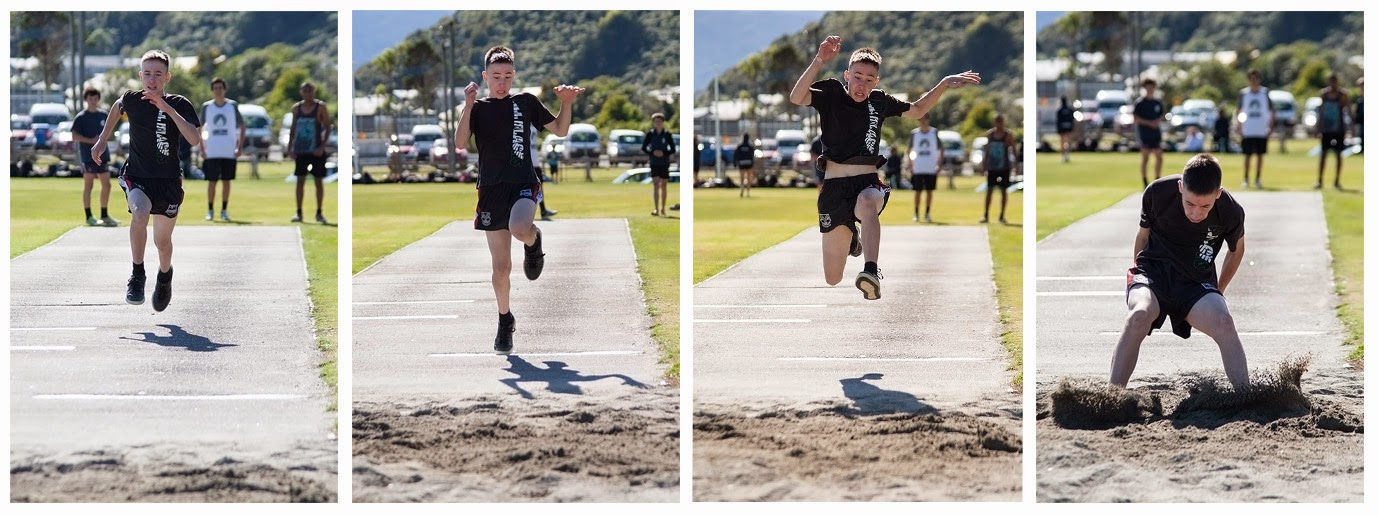
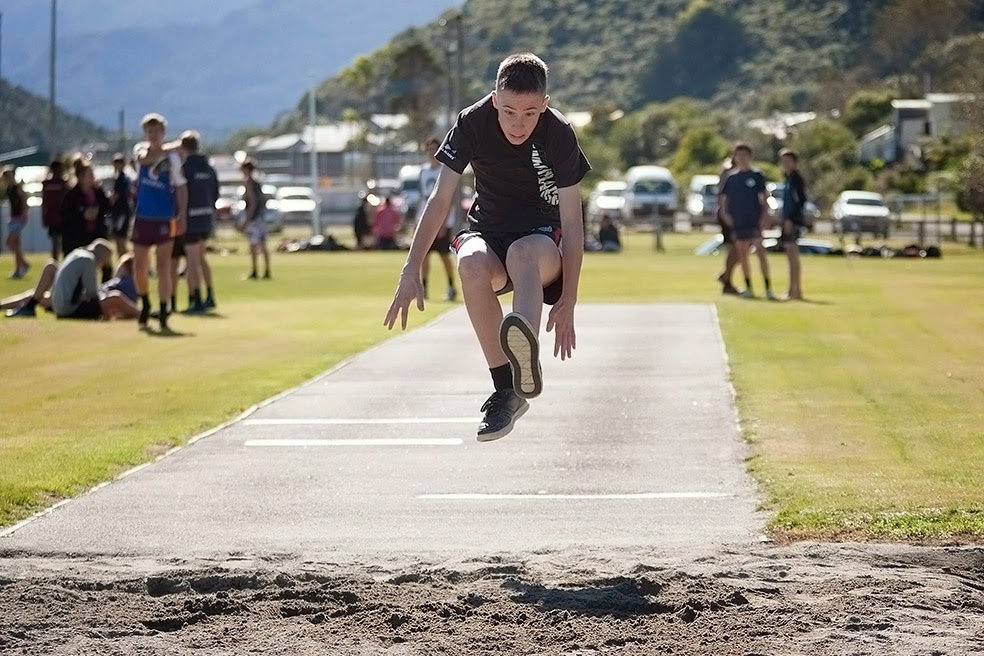
Joshua competing in the longjump. Canon 1D Mk3 with Canon 75-300mm IS USM
I didn't really have time to come to grips with the myriad options that the 1D Mk3 has to offer - especially in the autofocus custom functions - so the night before I just made sure the battery had a decent charge, the camera was set on servo autofocus, hi speed, and group focus point selection.

As you can see above, the 1D Mk3 nailed the autofocus every time, although it felt a little 'sluggish' in real-time, and I wasn't getting anywhere near the 10fps that the camera is capable of. A little further reading after the fact has enlightened me as to the autofocus options that I probably 'should' have chosen - especially if I want that 10fps machine gun burst. I decided to set the tracking priority to focus, rather than speed - so as a result I think the camera was micro-focusing in between each shot, thereby not attaining its 'full' shooting speed. But, as stated above, it certainly nailed the focus and of the 40 or so images I took, only two were out of focus (and both of those were towards the end of the jump).

"Up, up and away"! Canon ID Mk3 with 75-300mm IS USM, 2000th sec @ f4.5 - ISO 400
I've used Canon cameras my whole photographic career (just shy of 30 years now), so in some ways, using the 1D Mk3 is second nature to me already. BUT, I've never owned or used a digital 1 series before, so the plethora of auto focus options is going to take me some time - and practice - to get to grips with. Canon have a very helpful pdf on the autofocus options available for the Mk3 which can be downloaded from here. I'm going to have to study this and go out and try some of the modes to see what works best for me - something i'm very much looking forward to doing.

For now, I'm happy with my first up attempt at some action shots with the 1D Mk3. I didn't screw it up, and I'm encouraged to experiment some more to get to grips with the autofocus system. And I wasn't unhappy with the way the 75-300mm IS performed either. I'm sure that one day I will 'upgrade' it to the 70-200mm, but until then it will help me learn my way around the camera so that I can really make use of the better lenses when I do get them.

I have a Canon 28-135mm f3.5/5.6 IS USM arriving soon that I will use as a 'walk-around' lens for the camera, which should make a nice combo. Will write more about my journey with the 1D Mk3 as it develops. Can't wait.