Showing posts with label action photography. Show all posts

Thursday, 27 October 2022

Pre-focusing for action photography

Every year in the town where I live, they put on a motorcycle street race event. It's always over a long weekend (Labour Day here in NZ), and it's always a great day out. Especially if we get a warm spring day.

Fortunately, the weather Gods were smiling on the event this year, and the weather couldn't have been better. So I decided that I was going to attend this year and use the chance to get in a full day of photography - a very rare occasion nowadays. 

Catch me if you can. Sony A7iii with Sony G Master 100-400mm.  f/5.6 @ 1/2500, ISO 400

In my previous post I talked about scoring a bunch of Minolta lenses from a friend (thanks again Stew) to use for the event. Specifically the Minolta 100-400mm f/4.5-6.7 Apo and a Sigma 180mm f/3.5 macro. I was looking forward to using these on my also borrowed Sony a99.

I have shot this event several times over the years, with a lot of different gear, so I knew that lenses in the vicinity of 200mm would be about right if I wanted to get close to the action. In fact there are places around the track where you can get so close as to almost reach out and touch the riders as they hurtle past at 100mph. I kid you not! I, however, like to keep a slightly safer distance from the action as it unfolds. So the 100-400mm and even the 180mm macro were going to be about perfect for the whole day.

The observant among you (I'm sure that's everyone who reads this blog) will have noticed by now that the opening image in this post was not taken with the a99 in combination with the two lenses I've just discussed. It was taken with much newer gear that I also had a chance to 'play' with. More on that later.

Knee-scraping action. Sony a99 with Sigma 180mm macro. f/4 @ 1/1000th, ISO 200

It may, at first glance, seem unusual to take a macro lens to a motorsport event. Macro lenses are for close up photos of bugs and flowers - aren't they? Well yes, they are. But they can also be used as a 'normal' lens. And they also tend to be reasonably fast, and reasonably sharp. For a 180mm focal length, that's a pretty slick combination.

The one thing they maybe aren't, however, is extremely fast focusing. And neither is the 10 year old Sony a99. 6 FPS (frames per second) isn't what you would call blazingly fast. And its continuous autofocus isn't anything spectacular either. It's a fantastic landscape camera. But for fast sports action shooting - not so much.

But then again, I knew this wasn't going to be a problem. Because my favourite technique for shooting these extremely fast action sports is rather old-school. It's known as pre-focusing, and was used by all the sports photographers before this snazzy thing called autofocus tracking was invented. And it's pretty easy to do.

Bascially, just put your camera into manual focus (yes, I know, manual focusing is scary - but bear with me), 'pre-focus' on an area that you know your subject is going to move through, and then fire a burst of images as they move through the pre-focused zone. All in manual focus. Simple. And very effective.

All concentration. Sony a99 with Minolta 100-400mm Apo. f/6.3 @ 1/800th, ISO 640

There's really only one drawback using this method. You have to take a lot of images to make sure you get the sharp frame you are after. Unfortunately this dramatically increases the processing you need to go through afterwards. And I mean dramatically. For example, to get a decent 'hit rate' using this method, I took over 3500 images on the day. That's not a typo. 3500 images! And of that, around 80% are out of focus and will needed to be deleted. I'll probably end up throwing away 3000 images. But at least I'll be left with about 500 sharp ones.

Despite the tedious post-processing that this technique requires, I'm very happy with the results. If you don't have the latest and greatest gear, or a camera system that isn't optimised for fast action autofocusing, then this really should be your go-to technique.

Of course there is a better way. And it's not going to please the 'gear doesn't matter' brigade. Because for some types of photography (in fact for most types) the gear does matter. This was made abundantly clear to me later on in the afternoon.

Out in front. Sony A7iii with Sony G Master 100-400mm. f/5.6 @ 1/1600th, ISO 400

My mate Stewart turned up in the late afternoon to see how I was getting on. We chatted for a while, I told him that I was using the pro-focus technique, and he asked me if I would like to try using his Sony A7iii with Sony 100-400 G Master lens for a while?

Who am I to turn down an offer like that! So of course I said yes - thinking that I would fumble my way through, making a terrible hash of trying to follow and capture the action. OMG - was I wrong!

You can always hear the roar of the bikes approaching before you see them so you have some time to prepare. Stewart told me he had the camera set to focus tracking with a wide autofocus area, so all I needed to do was point and shoot. Yeah - right!

And yeah, he was right! As the first riders came screaming around the bend, I held the camera up to my eye, the focus points instantly locked onto the front rider, and they all lit up green. Click-click-click, the shutter fired in blazingly quick succession, and I had a series of tack-sharp images. All of them!

Need for Speed. Sony A7iii with Sony G Master 100-400mm. f/5.6 @ 1/2000th, ISO 400

I almost couldn't believe the speed and accuracy of the autofocus on the A7iii, paired with the Sony G Master 100-400mm teleophoto. It was mad, crazy, unbelievably fast. And the results were so much sharper than anything I got with the Minolta 100-400mm or Sigma 180mm. Period! I've never used anything quite this fast and accurate before. It was scary good - and exhilarating - I'm not gonna lie. 

It also happens to be over NZ$7k worth of kit! So yeah, there's that.

If you can afford it, and if you need it, then absolutely go for it. If I was doing this for a living it would be a no-brainer.

And for the rest of us mere mortals? Well, there's always the pre-focusing technique. Which does work. It just requires a lot more computer time in order to find the 'keepers' from the rest. 

Oh well. I'd better get back to post-processing then, I guess?

Tuesday, 25 October 2022

Alive and kicking

It's been 6 months since I last posted on this blog! Why so long?

Well, as my last post described I had a bit of gear trouble, which took a couple of months to work through. My Sony a57's sensor was out of alignment, resulting in blurry images no matter what I did (unless the camera was focused to infinity). The camera store was really good about working this out with me (thanks Greg and the team at Photo & Video in Christchurch). They tried to find me another a57 (or equivalent) to replace the faulty camera - since it wasn't really worth repairing the sensor alignment issue.

Anyhoo - long story short - they couldn't find me a replacement, so I took my Olympus E-M1 back (with two Panasonic kit lenses). I dived back into micro four thirds, and even started a new Wordpress blog about it. So I may not have been writing about photography on this blog, but I have been writing on another.

So why this new post here? What gives?

Greymouth Street Races 2022. Sony a99 with Sigma 180mm macro. f/4 @ 1/1000th, ISO 200

A few reasons spring to mind -

A) it's about damn time I wrote something on this blog!

B) the Wordpress experiment didn't go all that well. I didn't really enjoy Wordpress as a platform.

C) things are starting to happen again in my photography sphere, and I want to write about them.

and D) it's about damn time I wrote something on this blog!

First things first, you'll notice that the above image, of last weekends (as I write this) street races, wasn't taken on my Olympus E-M1. I still have the Sony a99. And I still enjoy using it. And I still have access to some fantastic lenses for it. So no - I still haven't given up on using the Sony A-mount system. Things have, in fact, got even more muddy in those waters recently. Let me explain....

No.74. Sony a99 with Sigma 180mm macro. f/4 @ 1/1250th, ISO 200

Stewart - my photographer friend who I can borrow all this Sony gear from (hi Stew), called me recently and asked if I was still interested in using the Sony A-Mount gear. He has moved over fully to Sony E-Mount now, and was wondering whether I wanted his A-Mount gear!

That would be a YES!

We left it at that, but with the Greymouth Street Races coming up, I had an excuse to spend a full day on photography (a rarity). I got back in touch with Stewart and asked if he might have any telephoto lenses I could borrow for the a99. A couple of days before the event Stew turned up at my house with a bag full of lenses and proceeded to hand them to me. Two stood out as useful - a Minolta 100-400mm APO f4.5/6.7 and a Sigma 180mm f3.5 macro. But he also 'gave' me a Minolta 100mm macro (fungi photography here I come!), a Minolta 28-75mm f2.8D (gorgeous), and a beautiful Minolta 85mm f1.4.

See what I mean about being able to get good glass for the Sony A-Mount system! There's no way I could afford to get the equivalent lenses for my Olympus - or any other system, for that matter. I feel very blessed, and very spoilt. But I can't lie, I'm also now a little confused.

No.99. Sony a99 with Minolta 100-400mm APO. f/6.3 @ 1/800th, ISO 640

I've written before on this blog about how much I enjoy using the Sony a99. It's a full-frame beast of a camera, with a tonne of great features, and is a joy to use. But, (there's that but) I've also said that it isn't a camera body that I could base a system around, given that it's had a lot of professional use and is certainly nearing the end of its rated lifespan. So I would need to get another, lighter used a99, or similar, to seriously consider it as my new system going forward.

And there in lies the rub.

For some reason, Sony users here in New Zealand who have mint condition a99's, expect ridiculous prices for them. Far more (and I mean FAR more) than I would expect to have to pay for one. I know they are a good camera, but come on people...

And it doesn't stop their either. I would also consider getting an a77 - their top A-mount APSC body, if not for the fact that it too tends to fetch crazy-stupid prices on the secondhand market. What is it with these Sony users?

No.54. Sony a99 with Sigma 180mm macro. f/4 @ 1/1000th, ISO 200 

I guess I'll just have to bide my time and wait for something to come along at the right price? I'm sure it will? 

And even though the Sony A-Mount is a 'dead-end' (discontinued a year ago by Sony), for me it's practically the ideal camera system. I love the weight and feel of a traditional DSLR, but I also really love the 'new' technology that includes electronic viewfinders. The Sony SLT (single lens translucent) technology has both.

I think at this point I'd be crazy not to be thinking about going down the Sony A-Mount route. With my Olympus E-M1, I have the camera body and two Panasonic kit lenses. That's it. With the Sony A-Mount, I have the full-frame a99 (admittedly on its last legs), a Minolta 28-75mm f/2.8D, Minolta 24-105mm f/3.5-4.5D, Minolta 16mm f/2.8 fisheye, Minolta 50mm f/2.8 macro, Minolta 100mm f/2.8 macro, Sigma 180mm f/3.5 macro, Minolta 100-400mm f/4.5-6.7 Apo, and last, but by no means least, a Minolta 85mm f1.4. See what I mean.

If I sell my Olympus E-M1 kit, I still won't have enough for a used a77 or a99. Not without selling some other gear, or subsidising the purchase some other way. Like getting money from doing some photography. Which I will be doing shortly 😄

BTW - my next post will be about my day spent using the a99 and various lenses to actually take the street race images that accompany this post. It was an enlightening experience. But that's a story for next time...

Sunday, 10 May 2015

Junior Soccer Part II

It's Sunday again and, despite the weather predictions, junior soccer was on this morning. I was keen to get back out there with the 1D Mk3, this time shooting from the goal-side of the field head-on to the action.

Canon 1D Mk3 with Canon 75-300mm IS lens at f5.6 @1/1500th, ISO 800
I set the camera up again as per last week (see the previous post), for the optimum AF selections for soccer (according to Canon). I still, however, didn't feel like I was getting the full 10fps machine gun burst that the Mk3 is capable of, and was beginning to worry that there was something wrong with the camera itself?

1D Mk3 with 75-300mm at f5.6 @1/1500th sec, ISO 800 (at 300mm)
One thing I did change from last week was to go hand-held so that I could shoot predominantly in the portrait orientation. Because I was shooting hand held, I left the IS of the lens on, to help with any shake I may have introduced. The 75-300mm is the first lens Canon made with IS, and you can tell. It clanks, whirs and buzzes while the IS is working, and while this does give a more stable image, it is a little distracting. After a few sluggish bursts, I figured that the shutter speed (of around 1500th sec) was fast enough not to actually need the IS turned on, even hand-held, so I turned it off. No more whizz, whir, click. But suddenly.... bang, bang, bang - a series of machine gun burst that were exhilarating!  The camera was finally shooting at its full 10fps. Yay! :-)

1D Mk3 with Canon 75-300mm IS lens, with IS turned OFF.
So lesson number 7 (or whatever number I'm up to know on my gradual coming to grips with the 1D Mk3): if you want the full 10fps burst speed of the camera, turn the darn IS off! Maybe that's not the case with the more modern image stablised lenses, but it sure is the case with the 75-300mm. Makes perfect sense to me now that I've figured it out - there were a lot of things happening in that lens to stabilise the image and get a sharp shot. It's really not surprising that to do all that it needed to slow the frame rate down.

All-in-all then, a successful morning. Josh's team won (and he played really well), I got some okay images, and learnt how to get the full speed out of the Canon 1D MkIII. As Mr Burns would say - "Excellent".

Monday, 23 March 2015

Sports Day with the EOS 1D Mk3

My Canon EOS 1D Mk3 arrived earlier in the week, just in time to use it to photograph my son competing in the West Coast Junior Athletics day.

As soon as I opened the box containing my new purchase it was love at first sight! What a beautiful camera - big, heavy, incredibly well built and perfectly designed. Form really follows function with the pro 1D series of Canon bodies, and I couldn't be happier.

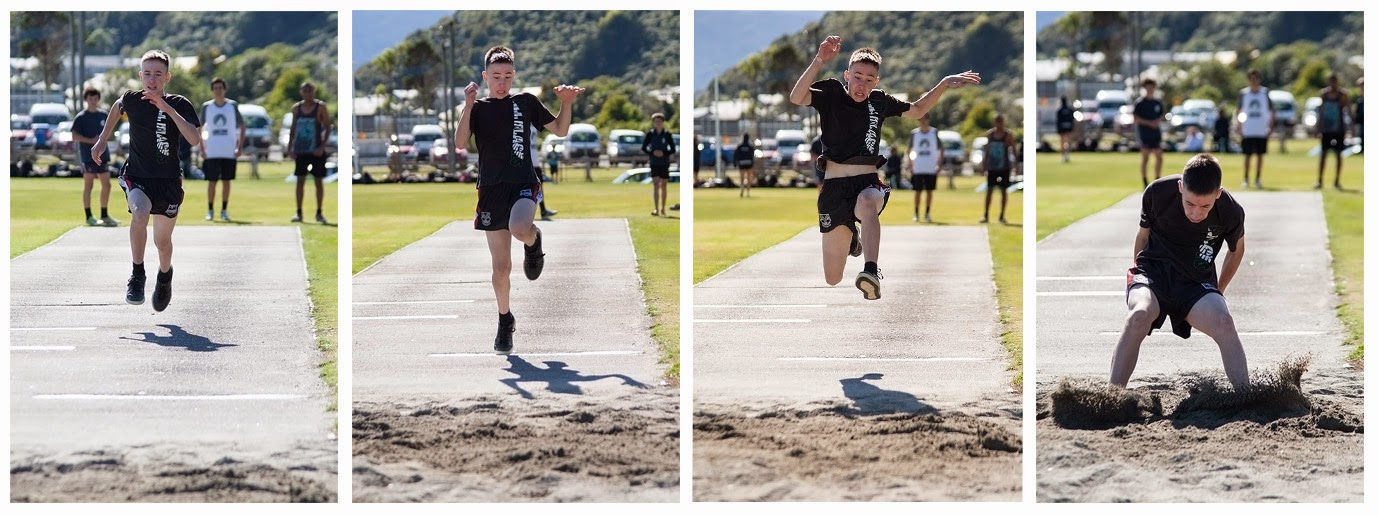
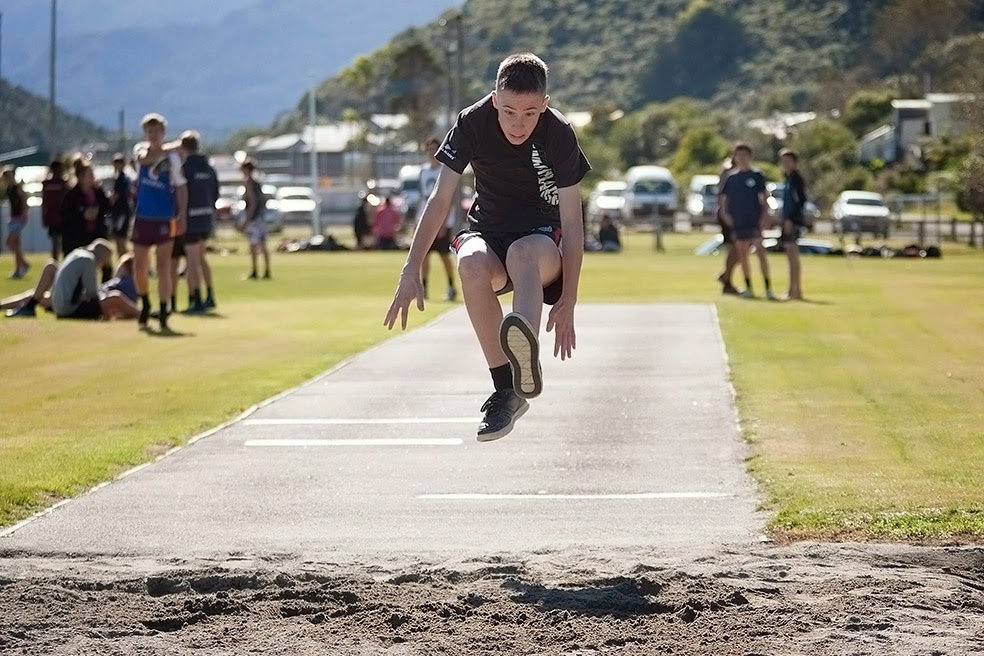
Joshua competing in the longjump. Canon 1D Mk3 with Canon 75-300mm IS USM
I didn't really have time to come to grips with the myriad options that the 1D Mk3 has to offer - especially in the autofocus custom functions - so the night before I just made sure the battery had a decent charge, the camera was set on servo autofocus, hi speed, and group focus point selection.

As you can see above, the 1D Mk3 nailed the autofocus every time, although it felt a little 'sluggish' in real-time, and I wasn't getting anywhere near the 10fps that the camera is capable of. A little further reading after the fact has enlightened me as to the autofocus options that I probably 'should' have chosen - especially if I want that 10fps machine gun burst. I decided to set the tracking priority to focus, rather than speed - so as a result I think the camera was micro-focusing in between each shot, thereby not attaining its 'full' shooting speed. But, as stated above, it certainly nailed the focus and of the 40 or so images I took, only two were out of focus (and both of those were towards the end of the jump).

"Up, up and away"! Canon ID Mk3 with 75-300mm IS USM, 2000th sec @ f4.5 - ISO 400
I've used Canon cameras my whole photographic career (just shy of 30 years now), so in some ways, using the 1D Mk3 is second nature to me already. BUT, I've never owned or used a digital 1 series before, so the plethora of auto focus options is going to take me some time - and practice - to get to grips with. Canon have a very helpful pdf on the autofocus options available for the Mk3 which can be downloaded from here. I'm going to have to study this and go out and try some of the modes to see what works best for me - something i'm very much looking forward to doing.

For now, I'm happy with my first up attempt at some action shots with the 1D Mk3. I didn't screw it up, and I'm encouraged to experiment some more to get to grips with the autofocus system. And I wasn't unhappy with the way the 75-300mm IS performed either. I'm sure that one day I will 'upgrade' it to the 70-200mm, but until then it will help me learn my way around the camera so that I can really make use of the better lenses when I do get them.

I have a Canon 28-135mm f3.5/5.6 IS USM arriving soon that I will use as a 'walk-around' lens for the camera, which should make a nice combo. Will write more about my journey with the 1D Mk3 as it develops. Can't wait.


Monday, 3 November 2014

Is Street Racing the death of my Pentax K10D's!?

For the last 10 months I've hosted a new blog dedicated to my Pentax K10D's - cameras that I have really enjoyed using. They are fantastic, solid, dependable cameras that are perfect for travel and general shooting.

But the rubber hit the road recently (almost literally), when I decided to cover the annual motorcycle street racing in my local town.

Speed demons the Pentax K10D's are most definitely NOT. In fact, they struggle to get past 2fps, and ISO 800 is pretty noisy. Fortunately, I also have a beat up Canon 50D on 'permanent' loan from a friend, and she also let me borrow her 400mm f5.6L lens for the weekend to shoot with. Oh Yeah!

Streetrace action 2014. Canon 50D with 400mm f5.6L @ 1/2000th. ISO 800
The 50D has a much more respectable 5fps, and a fairly solid autofocus system for tracking subjects across the frame (something else that Pentax cameras in general struggle with). It was a pretty miserable, overcast (and then very rainy) day, so I cranked the ISO up to 800 on the 50D, set it on Hi-speed continuous autofocus, and mounted the 400mm f5.6L on a monopod for better stability.

No 167. Canon 50D with 400mm f5.6L @ 1/2500th. ISO 800
I was not disappointed with this setup. In fact, I had an absolute blast and the focus was blazingly fast and accurate 9 times out of ten. And I'm pretty sure that the tenth time was probably user error.

There were only two things I struggled with on the day. First, because it's street racing and you can dangerously close to the action, I found that the 400mm was a bit too much reach and I found myself walking back further than I would have liked to get everything framed right. I could have easily gone with a 70 to 200mm instead. Lesson learned for next time.

And second, as noted earlier, the 50D I've borrowed has had a hard life, and although it performed flawlessly, the batteries for it aren't what they used to be. I took four of them - fully charged the night prior to the event - but they only lasted me until lunchtime and then all four were depleted! Bummer!!

Go Kart demonstration. Canon 50D with 400mm f5.6L @ 1/2500th. ISO 800
So that meant that, after lunch, I had to pack away the Canon gear, and reach for the Pentax K10D with Sigma 55-200mm zoom lens. The good news with going for the Pentax was that now the battery was going to last, the focal length of the zoom was about right, and the K10D body is weather sealed for what was now fairly consistent driving rain.

Unfortunately, that's where all the good news ends for the Pentax. After using the Canon 50D all morning, mowing to the K10D was painful. The Sigma hunted continuously in the low light, ISO 800 is pretty noisy, and I could only get off one shot before the action was over as the autofocus system and frame rate tried to cope. In a word, frustrating.

Pentax K10D with Sigma 55-200mm at f5.6 @1/640th. ISO 800
I did manage to get one good shot with the Pentax (see above). And that's it. One good image. Out of probably 200 shots I took before giving up and calling it a day. Whereas, with the Canon 50D I took over 1000 images, with probably at least half of them worth keeping. Easily 100 would be worth putting on a cd and giving to the race committee (who kindly gave me an all access media pass for the day). I had an absolute blast with the Canon 50D. I hated using the Pentax for Street Racing.

I do want to reiterate what I said at the beginning of this post; I really enjoy using the Pentax K10D for general photography. They are solid, dependable, well designed and rugged little cameras, that within their limits, take excellent images.

Notice the caveat 'within their limits' in that last sentence? What are their limits? Well, for me, there are only two. By far the major issue I am finding as I go deeper into the system, is lens selection. In the autofocus lineup, it's fairly limited - and very expensive to buy brand new. If I then go second hand, I run into another problem; there just aren't very many available for sale - at least here in New Zealand on our online auction site Trademe.  At any given time their might be two or three Pentax auto focus lenses worth considering on auction (and then at fairly high prices), whereas if we look at Canon in the second hand department, there might for over two hundred worthy contenders, at better prices! For someone who is constantly on a budget with their photography gear, and who needs 'best bang for the buck', going with a Pentax systems seems now, in hindsight, a rather unwise decision.

And what's the second limiting factor for Pentax? Well, in case you hadn't already guessed, it's the autofocus system. It kinda sucks. And even on the latest K5IIs and K3 it's reportedly still behind the likes of Canon and Nikon. Which admittedly, up until now, wasn't a major concern to me. But now it seems like it is. Especially if I plan on doing more street race shooting (and I do).

Finally, there is the noise 'issue' at ISO 800 and above. The files were a little noisier than I would like, and obviously more noisier that the Canon 50D at ISO 800 (itself known as one of Canon's noisier bodies). That being said, I'm not someone who chases the high ISO settings as a 'must have' for my cameras. I grew up 'old school' shooting film, and ISO 400 still seems like a heck of a lot! In fact, shooting at ISO 800 is as much as I would want to push any camera sensor - so these 25,000 ISO figures are just crazy stupid to me. But a relatively 'clean' ISO 800 would make me a happy photographer.

So what does all this mean? Well, it means that yes, I am going to sell my Pentax K10D's (somewhat reluctantly) and look at getting something else. What else, you may ask? Well, I think I might know the very thing....