Showing posts with label OMD EM5. Show all posts

Thursday, 6 October 2016

Two EM-5s in the family

My son Josh is 15 and, much to my surprise, has developed a keen interest in photography over the last few months. Now I say "much to my surprise" not because I don't think he has the talent for it - he most certainly does. It's just that he's never expressed much interest in photography before, despite there always being a camera available for him to use on family outings.

It's a matter of timing I guess - and I'm certainly not complaining. It's fantastic that he's getting excited about photography, and not just because it happens to be my passion as well. I think it's very important for everyone to have some form of creative outlet. And in this digital age, photography is an important skill to have.

His older sister is also very creative - taking Visual Art and Photography at Level 2 (6th Form) at High School this year. I've seen some of her photos from earlier in the year and they're fantastic abstract studies. But Em (Emily) is a bit wary of showing Dad too much, and she's always been quite private about her art.

Master and Apprentice? Photo: Joanna Lorimer
Josh, on the other hand, is just like his old man - very interested in the gear/technology side of digital photography; almost as much as the creative side. So he's been keen to chat with me about cameras and techniques. He's been using his mother's Nikon D70 SLR for the last few months, but has also had his eye on my Olympus OM-D EM-5 MkII mirrorless. So we've often talked about the different systems and what he might go with for his own camera.

Both kids have also had part-time jobs for the last year and have managed to save some money. Josh got to the stage where he had enough to start thinking seriously about getting a second-hand camera of his own - and last week (October 2016) we spent a few days in Christchurch while the girls had a trip to Wellington.

Christchurch just happens to have one of the best camera stores in New Zealand (shout out to Matt at Photo and Video in Merivale), and they just happened to have a second-hand Olympus OM-D EM-5 body for sale for a pretty good price. Josh and I went to have a look on our first morning in Christchurch (I said he was keen), and discovered that as well as the Em-5 body, they also had the HLD-6 grip to go with it!

Seagulls. Photo by Joshua Lorimer. OM-D EM-5 MkII with 40-150mm f4-5.6. F5.6 @ 1/250th ISO 200
If not for the price of the body and grip combined, I think Josh would have walked out with them both right there and then. But together they were going to take up a large chunk of his savings, so we left the store to 'think about it' for a day.

Two Dogs. Photo by Joshua Lorimer. OM-D EM-5 MkII with 12-50mm f3.5-6.3. F4.5 @ 1/4000th ISO 400
Josh had never really used my Olympus for very long, so I gave him the opportunity to spend an afternoon shooting with the EM-5 MkII, knowing that it would be similar (yet different) to the EM-5. He used it with and without the extra grip for the whole afternoon and, to cut a long story short, loved using it in both configurations. We went back the next day and purchased the EM-5 body with the HLD-6 Grip. So now there are two EM-5 mirrorless shooters in the family!

 On our third and final day in Christchurch, we went to the Botanic Gardens (it's late Spring and the flowers are still in bloom). Since Josh's EM-5 was sold 'body-only', he didn't have a lens. So I loaned him my 12-50mm EZ kit lens for the day, while I used the 40-150mm f4-5.6. I've never seen a teenage boy more fascinated with flowers - especially after I showed him how to use the macro function on the 12-50mm lens. I had to practically tear him away from the gardens after three hours. Needless to say, he had a great time and is loving his EM-5!

Old Piano. Photo by Joshua Lorimer. OM-D EM-5 MkII with 12-50mm lens. F4 @ 1/500th ISO 200
So yes, I am thrilled that Josh has been bitten by the photography bug. I think it's a fantastic hobby for anyone - but will be even more rewarding for us as something that father and son can do together. And if I'm really lucky, we may even convince big sister to come out shooting with us on the odd occasion too?

Tuesday, 25 August 2015

Olympus 45mm f1.8 initial thoughts

I weakened, and I bought one...

This weekend just gone, I went to Christchurch with my son to do two things; attend Promise Keepers and buy the HLD-8 grip for my OM-D EM-5 Mk2.

I did one of those things, and not the other :-)

Promise Keepers was fantastic and I thoroughly enjoyed it. The HLD-8, however, did not turn up in time. And then I had second thoughts about spending $400NZ on a battery grip when I could get just the grip itself for $175NZ and then maybe get another couple of lenses as well!

To that end, another camera store in Christchurch just happened to have an incredible deal on a new Olympus 45mm f1.8 for $385NZ (that's $180NZ off normal retail) - so yeah, I got one.

Joshua. Olympus OM-D EM-5 Mk2 with 45mm f1.8

It's small, it's light (although it does have a little heft to it) and it's largely made of plastic, albeit with a metal mount and lots of nice glass.

On the trip back home, I couldn't resist getting Josh to do a little model shoot - just to test the lens you understand. I'll be doing a much more comprehensive shoot soon, but initial impressions are obviously very good. It's known as a sharp, fast lens with decent bokeh - not to mention amazing portability. It really is a tiny lens, ideally suited to the size of the OM-D EM-5 (or EM-10 for that matter).

Olympus Zuiko 45mm @ f2.2, 1/100th ISO 320


I shot at f2.2 - opened up a little bit to increase sharpness - and kept an eye on the exposure compensation to make sure I didn't blow the highlights. These are the first portraits I've taken with the EM-5 Mk2, so it was the first time I had experienced face detection auto focus. I must admit, it felt weird watching the auto focus point move around over Joshua's face, without me controlling the point manually. But I forced myself to let the camera do its own thing, so I could gauge its accuracy afterwards. If it works as intended, then I can see it being an amazing help on a wedding shoot.

Face detection close-up. Check the bokeh as well.
Looks nice and sharp to me. Of course I intend to give it a decent work-out, but initial impressions are positive. And I'm pleased with the bokeh in the images, even opened up to f2.2. The forest behind Joshua isn't an easy background to blur nicely, but the lens did a decent job of it.

Joshua at Arthur's Pass. Olympus 45mm @ f2.2, 1/100th sec ISO 320
Many people argue that the whole reason to get a micro four thirds system is for their small, fast, sharp prime lenses. I'm not necessarily of that opinion. I like the idea of sharp, fast primes, but I would actually rather shoot with fast zooms. I really have my eye on the 12-40mm f2.8 zoom which, while heavier, will probably suit my shooting style a bit more. Having said that, the lens is about $1500NZ, which is way above my price range. So in the interim, maybe a small prime like the 45mm f1.8 will fill the gap? Yes, I have the 45mm range covered with my current 12-50mm f3.5/6.3 - but at 45mm that lens will open to f5.6 at best. That's 4 times slower than the 45mm f1.8 prime! Not to mention the difference in bokeh. I will test this soon to show the difference with the two lenses at the 45mm focal range, and I suspect that it will be like night and day!?

So yes, at the moment the 45mm f1.8 has a 'prime' (excuse the pun) place in my kit. Hopefully I will eventually get the 12-40mm f2.8 and then I might have to re-evaluate things. But for the price I paid for it, I can probably sell the 45mm in a couple of years time and not loose any money on it. That's the other upside of buying good fast glass.

Saturday, 15 August 2015

Building up my Olympus MFT (Micro Four Thirds) kit

Ok - I now have the Olympus OM-D EM-5 Mk2 body with the 12-50mm WR kit lens. This will form the basis of my mirrorless micro-four-thirds system. I want to build on this basic kit now, but one restraint is always unavoidable: budget. I don't have a lot of money, and need to get the best 'bang' for my buck - without compromising (too much) on quality.

Aftermarket BLN-1 spare battery
I'll assume that the SD Memory card is a given, although this time around I did decide to buy a new card for the OMD-EM-5 Mk2 (a Sandisk 16GB Class 10). But generally speaking most photographers will have a few of these floating around. So the first additional purchase is unavoidable really - for any digital camera system. A spare battery (or batteries). I ordered a spare battery as soon as I purchased the Em-5 Mk2, and I'm probably going to purchase a few more.

BUT - I certainly didn't go out and order a second Olympus branded battery, not at $120NZ for one battery! I ordered a much cheaper aftermarket no-name rip-off, that is much cheaper ($25NZ) and actually more powerful. Go figure. It's rated at 1750mAh, whereas the Olympus battery is only 1220mAh - so in theory (at least), the aftermarket battery should last longer?

Yes, I am nervous about using cheap batteries - but this one seems fine. It does work, it does charge (in the Olympus charger), and it does seem to last as long as the Olympus battery that came with the camera, so I'll probably end up getting a couple more. With these smaller mirrorless, you can never have too many spare batteries.

Aftermarket lens hood.
Next up on the must-have accessory list; a lens hood for the 12-50mm kit lens. Again, I've already bought one - and again, I chose to get an after-market hood rather than the Olympus branded option. And, yet again, this was purely for budget constraint. The Olympus LH-55B is $90NZ!! Not quite as expensive as a spare battery, but just about! Seriously, that's just ridiculous! Apart from the fact that it really should be included with the lens in the first place, to have to spend $90NZ on it is criminal. So an after-market lens hood it is. For $35.00NZ - which I still think is pricey for a bit of plastic, but there you go.

It arrived just the other day, and the one thing I will say about the third party hoods is that they tend to be rather stiff to twist on and off. I'm always scared that the twisting is going to wrench the lens and ruin some internal electronics, so I usually get a craft knife and scrape away some of the inside plastic first so it gives a 'looser' fit. Not too loose - but looser. Helps with my piece of mind, and the hoods do come on and off better.

With SD cards, spare batteries and a lens hood sorted, which is really just the basic components to any kit, attention now turns to the big ticket items. Usually, this would be another lens. But this time my first big purchase isn't going to be another optic for the camera. This time I've got my sights set on the most important (for me) accessory for the EM-5 Mk2; the HLD-8 Grip.

Olympus OM-D EM-5 Mk2 with 2 piece HLD-8 Battery Grip. SEXY!
I'll just come straight out and say it - I'm a battery grip fanatic. I always purchase the grip for every camera I own, so the EM-5 Mk2 will be no exception. I don't have big hands (they are probably medium to small for a 48 year old male) but I still find that no matter what camera I've owned, adding a grip to it has always made the ergonomics more pleasing and the handling more comfortable. There is also always the added bonus of better portrait oriented shooting (I shoot in portrait a lot on weddings) and doubling of the battery life.

The truly great thing about the HLD-8 is that it actually comes in two different pieces; the 'grip' portion and the 'battery/portrait' portion. Cleverly, you can configure the camera to have a bigger grip just with the first section attached, or extend the battery life and include a portrait shutter button by attaching the second half. I think that's genius, and really shows the level of thought that Olympus's engineers put into these cameras. Some, if not all of them, must be serious photographers as well.

Many would argue that adding the grip defeats the purpose of switching to MFT and mirrorless to cut down on weight and size. Others question why camera manufacturers make cameras so small that they then need extra grips on them to make them useable?

In response I would say that the addition of the extra weight of the HLD-8 is 'relative'. For example, I've come from a Canon EOS 1D Mk3 which, with battery and lens attached, is about 1.7kgs (3.7 lbs), whereas the EM-5 with grip attached will weigh in at about 700gms (1.5 lbs) - less than twice the weight (and size) of the system I've moved from. I'd say that's a weight saving, wouldn't you?

And second - I don't find the EM-5 Mk2 'too' small to use without it actually. I just prefer to use a grip. In the same way that I don't find a Canon 50D or 7D too small, but still prefer to add the grip. Do I think the handling and ergonomics are improved on the OM-D EM-5 Mk2 with the addition of the accessory grip - yes I do, absolutely. As much as I think they are also improved on the 50D. I do think there are some mirrorless cameras that are too small. But the EM-5 isn't one of them.

Is there anything I don't like about the HLD-8? Yep, sure is. The price! At $400NZ it's about a third of the price of the camera itself (ouch). But even so, I still think it's worth it. Even though that's most of my budget now blown.

Finally, we get to the lens question. This is always the big question you face when looking to add to a basic one-camera, one-lens kit. Many reviewers and users say that the best lens to get after the kit lens is a fast prime - something like the 17mm f1.8 or 25mm f1.4 from Panasonic. These 'smaller' MFT camera systems are, arguably, most suited to using small primes - so it makes sense that this is what you should opt for after the kit lens, doesn't it?

Olympus Zuiko 40-150mm f4/5.6 telephoto 'kit' lens
Maybe. But for me, I think that will happen a bit further down the track. What I'm actually going to get instead of a fast prime, is the 40-150mm kit telezoom - the small, light, plastic, cheap, additional zoom that often comes bundled with Olympus MFT cameras in a two-lens configuration.

Why? For two reasons really (okay, maybe three). First, it will give me a carry-around kit that covers every focal length I could hope to use in a day of shooting - from 24 to 300mm in conventional 35mm terms, so I will have almost every scenario covered. I know from personal experience that if I have a system that contains big gaps in reach, then I get a bit frustrated. I may not use a telezoom all that often, but when I want to, then I want to (if that makes sense?). Sure, a 25mm f1.4, or an 18mm f1.8 would be lovely - but I already have them covered with the 12-50mm kit lens. What I don't have, at the moment, is extra telephoto coverage - which the 40-150mm will give me in spades.

Second, despite it 'only' being a kit lens, and 'only' being f4/5.6, and 'only' being made of plastic, by all accounts the IQ of the lens is pretty amazing. It's 'better' optically than it has any right to be for a cheap plastic lens (although the lens elements are glass, and it does use an ED lens for image correction), and as long as you isolate your subject effectively from the background, the bokeh can be very pleasing. No, it's not a low-light lens. But the OM-D EM-5 Mk2 has very good high ISO performance, and one of the best (if not the best) image stabilization systems on the planet, so even at the telephoto end of the zoom range in lowish light, good sharp images should be achievable. But it is what it is.

And third, it's cheap :-)

So that will be my 'kit' for a while. The Olympus OM-D EM-5 Mk2 with 12-50mm and 40-150mm kit lenses, HLD-8 battery/portrait grip, spare batteries and SD cards. While I'm in Christchurch next week getting the HLD-8, I may have a look at camera bags to keep it all in. The ThinkTank Mirrorless Mover 30 looks good, but I may also just keep using my Crumpler 6 Million Dollar Home for it. It does look a bit lost in there at the moment, but adding the grip and another lens might just help with that. If I get a new bag, I will definitely do a post on what I got and why.

What's missing from the above (apart from the fast primes)? Well, if I'm going to use it to shoot weddings seriously then I will need another body as back-up, a larger flash (the flash supplied is cute, but not really for serious work), and then yes - some of those fast primes. Or maybe even the Olympus 12-40mm f2.8 Pro lens? Now that would be sweet.

Friday, 14 August 2015

Using Olympus ORF files from OMD-EM5 Mk2

Last post I finished by relating my experiences using the Olympus RAW files (ORF), and how my version of Lightroom (Lr4) doesn't support the raw files from this latest MFT (micro four thirds) camera.

I also concluded that this wasn't going to change for me anytime soon, since the newest version of Lightroom (Lr6) that does support the RAW files from the Mk2, won't actually run on my (old) iMac. I'm using OS 10.7, but Adobe CC and Lightroom 6 required at least OS 10.8 to run. So that's that really. I'd consigned myself to becoming a (gasp) jpeg shooter.

I'm not the kind of guy who lives on the 'bleeding edge' of technology - my iMac is seriously at least 10 years old. And since I tend to only be able to afford second-hand cameras from around that time as well, it's never been much of an issue. Photoshop 4 does everything I need it to do - as does Lightroom 4. Heck, I'd still be using Apple's 'Aperture' if they hadn't canned it (don't get me started).

But something like this did happen to me a few years ago, when I was one of the first people to purchase the Fuji X10. Lightroom initially couldn't read the Fuji RAW files, and then when it could, it didn't play all that nicely with the newly developed X-Trans sensor. My fix at that stage was also initially to shoot jpegs on the X10, and then I came across Adobe's own DNG (Digital Negative) RAW conversion software.

I think the DNG file format from Adobe is brilliant, and I've had quite a bit to do with it over the last few years. My Pentax cameras shot the DNG format natively (brilliant), and then when I switched back to Canon, I still converted all the RAW files to Adobe DNG on import (an option from within Lightroom). Many think of this as an 'extra' step, but it really doesn't add too much to the download time, and I see it as a 'future proofing' strategy of sorts.

Do I think Canon, Nikon or Olympus will be around forever? Well, no actually, I don't. Surprisingly, I think of the three, Canon and Nikon are the most shaky of the three - even given Olympus's recent financial difficulties. Why? Simply because they are so far behind the 8 ball with the whole mirrorless movement. As much as we might want to shout and rage against it (and believe me, I've raged with the best of them), I do think that mirrorless is the undeniable future of photography. I'm not saying it's the only possible future. Perhaps something else will come along and take its place too? But that doesn't change the fact that the traditional SLR, as many of us know and love, is a thing of the past. But I digress.

My point is, I find it far more likely that Adobe, and the DNG file format, will be around longer than the camera manufacturers themselves - hence the future proofing of converting to DNG.

But of course, when you jump on to new technology, that isn't supported by your old gear, sometimes proprietary formats like DNG can also be your only option (and saving grace).

Olympus OMD EM5 Mk2 jpeg
So anyway, to cut an already probably long story short, I've downloaded the latest version of Adobe's DNG Converter (which supports the OMD EM5 Mk2's ORF files and runs on my iMac under OS10.7) and will simply take that 'extra' step of converting the ORF files from the EM5 Mk2 into DNG's. Then I can have my cake and eat it too!

Here is just a quick example of what a difference it can make shooting in RAW - and why it's worth persevering with RAW capture if you can.

This first image is as shot, from the camera, using the OMD EM5 Mk2's viewfinder with live histogram to make sure that the highlights were retained and not blown out.

Now of course, the dynamic range of the scene was such that something had to give. There was fairly bright sunshine on the white hull of the boat, and deep shade to the side and behind in the bushes. I exposed correctly for the highlights so they wouldn't blow out (as you should), and just had to let the shadows fill in to black. Shooting in jpeg would mean that this is the image you would be left with. It's ok, but the shadows are a touch on the dark side and could do with 'opening' up.

Olympus OMD EM5 Mk2 RAW 
Shoot in RAW, however, and you still expose in the same way, but you do get the chance to go in with the RAW software processing later on and 'recover' some of the detail in those shadows.

It can be quite subtle, and I don't like to overdo the post processing, but side by side the differences are obvious. That's simply the flexibility that RAW allows you, that jpeg doesn't.

So with the latest version of Adobe DNG Converter I can set the OMD EM5 Mk2 up to shoot RAW and know that it is going to fit into my workflow. Who knows, I may get another 5 years out of the old 'iMac' yet? :-)


Monday, 10 August 2015

First outing with the Olympus OMD EM5 Mk2

My brand spanking new OMD EM5 Mk2 (EM5 2 from now on) arrived late last week and I had a few days of digging into the (extensive) menu to set the camera up before taking it on its first outing.


You certainly do need a few days to familiarise yourself with the incredible amount of personalisation that this camera offers. It has five customisable buttons, and you can set them up to do just about anything you like. Add to this the fact that the two control wheels also do double-duty at the flick of a switch, and you have an impressive (or should that be intimidating?) number of buttons tool at your disposal. Many think that Olympus have gone overboard with the customisation available on the OMD cameras, and complain about the complex menu system. Yes it’s comprehensive. But it’s only there if you need it. Mostly, you can set it once and forget it forever. And it is great to know that if you don’t like the way a button works, chances are you can change it. Kudos to Olympus I say.

Olympus OMD EM5 Mk2 with 12-50mm. First Image
For myself, I’ve largely left the pre-configured function buttons alone – save for two crucial changes. I shoot in aperture priority mode for 99% of my photography, and by default, the EM5 2 has the front wheel change the exposure compensation and the back wheel change the aperture. To my way of working this is the wrong way around. I prefer to change the aperture with the front dial, and then use the rear to increase/decrease exposure compensation if needed. So guess what – I can change it! Yay.

The only other change I’ve made to the programmable function buttons it to change Fn2 (which is right next to the shutter button) from the default highlight/shadow control, to the ‘home’ setting for the autofocus. So now, if I’m moving the autofocus point around the screen to where I want to focus, I simply tap the function button next to the shutter to centre the focus point for my next composition. Excellent.


Other settings? I have auto ISO set within the 200 to 1600 range, single shot focusing (with face detection and nearest eye focusing also enabled for portraiture), RAW file format (more on that later), neutral colour mode, evaluative metering and auto white balance. That should now have the camera is set up for 90% of my shooting style. I have also turned the fully articulating rear lcd screen in towards the camera. This not only protects the lcd screen, but improves battery life (I presume) since the rear lcd is now turned off. This is the first time I’ve been able to shoot with a digital camera this way (all my other digital cameras have had fixed rear lcd screens) and I have to say I’m sold! This alone makes the EM5 2 an absolute joy to use.


So I would have to say that the one feature that I’m the most excited about on the EM5 2 is the electronic viewfinder. Which is crazy to me, since I’ve put off moving to an electronic viewfinder - in preference for an optical one - for such a long time. I was, in fact, probably an ‘optical’ snob! But now, having used the EM5 2’s EVF for just one afternoon, I can’t for the life of me figure out what my problem was?!

Ironically, using the EM5 2 with its retro design, is one of the most film-like shooting experiences I’ve ever had with a digital camera. And it’s all due to the EVF. With the rear lcd screen flipped inwards, the camera has a definite film look to it. When I put the viewfinder up to my eye I compose, set exposure and focus, check the live histogram in real-time, with visible shadow and highlight warnings on-screen, and take the shot. One shot. Nailed it. Move on. There’s no chimping. No checking of the rear lcd screen. No compose, shoot, check, change, recompose, shoot, check, change…. digital dance of a DLSR. That’s all gone now with the EM5 2. Now it’s just compose, check, change in real-time, and shoot. Done. How cool is that?

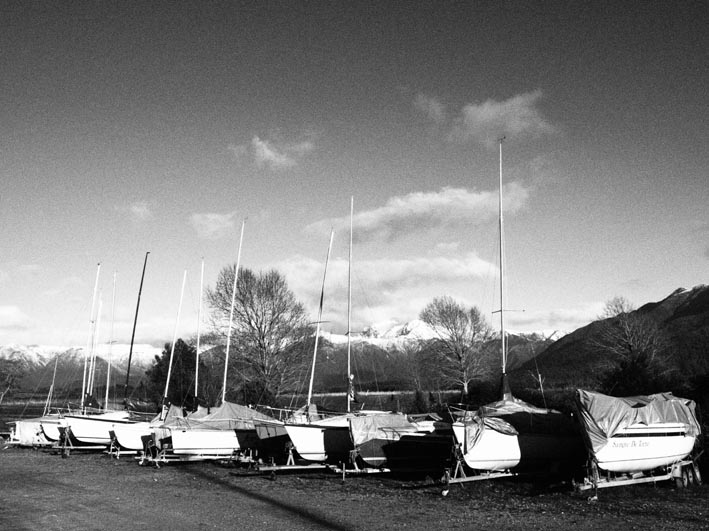
Art Filter - Grainy B&W Mode II
I loved my first outing with the EM5 2. Absolutely loved it. I didn’t get amazingly incredible images. But that wasn’t really what it was all about. This was a first date. And as such, it was just the OMD EM5 Mk2 and me, getting to know each other. Fortunately, it was a great first date (no, I’m not going to push this analogy much more), and I’m looking forward to many more.


Is everything perfect? Of course not. Is it ever? For a start, the camera is a ‘touch’ on the small side – even for someone like me with medium to small sized hands. But hey, that’s what the optional grip is for – right? In fact, the OMD EM5’s ability to accept an optional grip is one of its huge selling points for me. So physical handling gets a 7 out of 10 at the moment, although I fully expect that to go up to 9.5 when I get the grip in a few weeks.

And then there’s the RAW issue. I’m a RAW shooter. Always have been. So that’s what I’ve got the EM5 2 set up to shoot on. But – my version of Lightroom (Lr4) doesn’t support the EM5 2’s RAW files! I have to upgrade to Lr6! Aaarrgghhhh!!!!!! Not going to happen I’m afraid – not for quite a while anyway. So that leaves me with two options. First, use the supplied RAW conversion software that comes with the camera from Olympus. It’s basic, it’s slow, and it’s clunky. But it does get the job done. It ain’t no Lightroom though. And then there’s the second option (and here’s where many photographers start to sweat and tremble). I shoot jpegs and forget RAW for the time being.


With the EM5 2, this doesn’t fill me with the kind of dread it would if I was considering doing the same on a DLSR. The jpeg processing engine built into the Olympus cameras is said to be one of the best in the business (in the same league as Fuji and Pentax), so jpegs out of the camera look amazing. And the other confidence booster for shooting jpegs has to do with that EVF again. What you see is what you’re gonna get. So blown highlights or black shadows are visible in the viewfinder before you click the shutter. Fix it in the viewfinder before you take the shot and hey-presto, great jpegs straight out of the camera. Almost no post processing required. And my version of Lightroom will work perfectly with jpegs J  Plus, I now get twice as many images on a card. So, as my 15 year old daughter would say, “It’s all G”.