Monday, 10 August 2015

First outing with the Olympus OMD EM5 Mk2

My brand spanking new OMD EM5 Mk2 (EM5 2 from now on) arrived late last week and I had a few days of digging into the (extensive) menu to set the camera up before taking it on its first outing.


You certainly do need a few days to familiarise yourself with the incredible amount of personalisation that this camera offers. It has five customisable buttons, and you can set them up to do just about anything you like. Add to this the fact that the two control wheels also do double-duty at the flick of a switch, and you have an impressive (or should that be intimidating?) number of buttons tool at your disposal. Many think that Olympus have gone overboard with the customisation available on the OMD cameras, and complain about the complex menu system. Yes it’s comprehensive. But it’s only there if you need it. Mostly, you can set it once and forget it forever. And it is great to know that if you don’t like the way a button works, chances are you can change it. Kudos to Olympus I say.

Olympus OMD EM5 Mk2 with 12-50mm. First Image
For myself, I’ve largely left the pre-configured function buttons alone – save for two crucial changes. I shoot in aperture priority mode for 99% of my photography, and by default, the EM5 2 has the front wheel change the exposure compensation and the back wheel change the aperture. To my way of working this is the wrong way around. I prefer to change the aperture with the front dial, and then use the rear to increase/decrease exposure compensation if needed. So guess what – I can change it! Yay.

The only other change I’ve made to the programmable function buttons it to change Fn2 (which is right next to the shutter button) from the default highlight/shadow control, to the ‘home’ setting for the autofocus. So now, if I’m moving the autofocus point around the screen to where I want to focus, I simply tap the function button next to the shutter to centre the focus point for my next composition. Excellent.


Other settings? I have auto ISO set within the 200 to 1600 range, single shot focusing (with face detection and nearest eye focusing also enabled for portraiture), RAW file format (more on that later), neutral colour mode, evaluative metering and auto white balance. That should now have the camera is set up for 90% of my shooting style. I have also turned the fully articulating rear lcd screen in towards the camera. This not only protects the lcd screen, but improves battery life (I presume) since the rear lcd is now turned off. This is the first time I’ve been able to shoot with a digital camera this way (all my other digital cameras have had fixed rear lcd screens) and I have to say I’m sold! This alone makes the EM5 2 an absolute joy to use.


So I would have to say that the one feature that I’m the most excited about on the EM5 2 is the electronic viewfinder. Which is crazy to me, since I’ve put off moving to an electronic viewfinder - in preference for an optical one - for such a long time. I was, in fact, probably an ‘optical’ snob! But now, having used the EM5 2’s EVF for just one afternoon, I can’t for the life of me figure out what my problem was?!

Ironically, using the EM5 2 with its retro design, is one of the most film-like shooting experiences I’ve ever had with a digital camera. And it’s all due to the EVF. With the rear lcd screen flipped inwards, the camera has a definite film look to it. When I put the viewfinder up to my eye I compose, set exposure and focus, check the live histogram in real-time, with visible shadow and highlight warnings on-screen, and take the shot. One shot. Nailed it. Move on. There’s no chimping. No checking of the rear lcd screen. No compose, shoot, check, change, recompose, shoot, check, change…. digital dance of a DLSR. That’s all gone now with the EM5 2. Now it’s just compose, check, change in real-time, and shoot. Done. How cool is that?
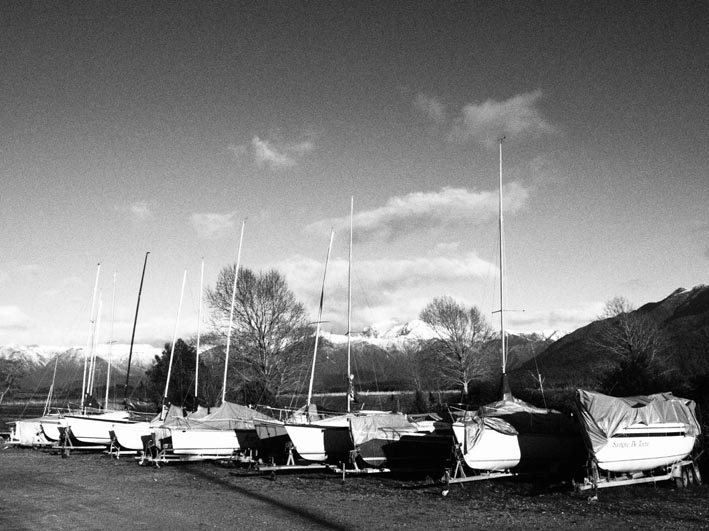
Art Filter - Grainy B&W Mode II
I loved my first outing with the EM5 2. Absolutely loved it. I didn’t get amazingly incredible images. But that wasn’t really what it was all about. This was a first date. And as such, it was just the OMD EM5 Mk2 and me, getting to know each other. Fortunately, it was a great first date (no, I’m not going to push this analogy much more), and I’m looking forward to many more.


Is everything perfect? Of course not. Is it ever? For a start, the camera is a ‘touch’ on the small side – even for someone like me with medium to small sized hands. But hey, that’s what the optional grip is for – right? In fact, the OMD EM5’s ability to accept an optional grip is one of its huge selling points for me. So physical handling gets a 7 out of 10 at the moment, although I fully expect that to go up to 9.5 when I get the grip in a few weeks.

And then there’s the RAW issue. I’m a RAW shooter. Always have been. So that’s what I’ve got the EM5 2 set up to shoot on. But – my version of Lightroom (Lr4) doesn’t support the EM5 2’s RAW files! I have to upgrade to Lr6! Aaarrgghhhh!!!!!! Not going to happen I’m afraid – not for quite a while anyway. So that leaves me with two options. First, use the supplied RAW conversion software that comes with the camera from Olympus. It’s basic, it’s slow, and it’s clunky. But it does get the job done. It ain’t no Lightroom though. And then there’s the second option (and here’s where many photographers start to sweat and tremble). I shoot jpegs and forget RAW for the time being.


With the EM5 2, this doesn’t fill me with the kind of dread it would if I was considering doing the same on a DLSR. The jpeg processing engine built into the Olympus cameras is said to be one of the best in the business (in the same league as Fuji and Pentax), so jpegs out of the camera look amazing. And the other confidence booster for shooting jpegs has to do with that EVF again. What you see is what you’re gonna get. So blown highlights or black shadows are visible in the viewfinder before you click the shutter. Fix it in the viewfinder before you take the shot and hey-presto, great jpegs straight out of the camera. Almost no post processing required. And my version of Lightroom will work perfectly with jpegs J  Plus, I now get twice as many images on a card. So, as my 15 year old daughter would say, “It’s all G”.

Friday, 7 August 2015

Make a move to Mirrorless - Now!

Ok, so I've sold my Canon 1D Mk3 kit to 'downsize' to a more manageable system size-wise. Why? Well, I took the 1D with me on a family holiday recently (see last post) and ended up not ever really using it. It was just too damn big and heavy to use as a 'general' carry-around camera. And I haven't really got the luxury of owning several systems so that I can mix and match depending on the situation. I have to nail it down with one system, that offers me the quality, versatility, and flexibility to shoot anything and everything. A tall order? Maybe. But I think I've found the perfect system for me...

Yeah, I know. Haven't we heard that before? Maybe. But this time, I really mean it. Honest. Let me tell you why, and how I arrived at my final decision.

Having sold my 1D with lens, I had about $1000NZ to 'play' with. Obviously then, budget was going to be a factor. I thought briefly of staying in the Canon camp (I still have the 75-300mm lens and some accessories) and getting a secondhand 40D, 50D or even 7D body (and maybe another mid-range zoom lens). This would keep me in the DSLR camp - a camp I'm very comfortable in - and give me a possible 'shoot it all' solution.

Nah. Boring.... I've toyed for the last few years with investing in a mirrorless system of some kind, and now seems to be the perfect time. Especially since I had already decided to 'downsize'. What better system than mirrorless?

Olympus OMD EM10
With the budget I had available, my options were going to be limited if I was looking at buying brand new. Limited, but not impossible.

The Olympus OMD EM10, for example, can be had for around $1000NZ at the moment with 14-42mm EZ pancake kit lens. And it's getting rave reviews. It just so happens that my local camera store even has one on its shelf, so I had the chance to actually handle the camera and get a feel for it. And while it was just a 'little' on the small size, it was also something that I could probably get used to. Especially if I added the optional grip for it that helps beef up the handling just a little.

The micro four thirds format has an impressive line-up of lenses and accessories - more than any other mirrorless system, and I especially like the Olympus line of retro styling. Nice for someone who stills owns and enjoys shooting with old film cameras. I even owned an Olympus Pen (the EP1) - one of the first mirrorless cameras to come out in the micro four thirds line. Unfortunately, I didn't really like using it - it was too small, and the image quality from the 12MP micro four thirds sensor didn't impress me at all.

But that was about 5 years ago, and a lot has changed. The latest wave of Olympus and Panasonic m4/3rds bodies with the 16MP sensor are amazingly capable cameras and get nothing but glowing reviews from all who use them. So image quality is no longer an issue. And the SLR styling of the OMD's and the Panasonic G cameras are more to my liking. So we were making progress already and the OMD EM10 was immediately a strong contender.

Panasonic Lumic G6
What about its rival in the 4/3rds market - the Panasonic G6? It's about the same price new as the OMD EM10 (since it's just been replaced by the G7), and is even bigger and bulkier than the Olympus EM10 - styled as it is on a more beefier DSLR. I didn't have the chance to hold one in the flesh, but have held a GH3 (its big brother) and was very impressed. It felt, and handled, just like a DSLR. And there-in maybe lies the problem? Maybe, for me, it's just a little too much like a normal DLSR to be bothered changing? Panasonic is also known more as a 'video-centric' company. If video is your thing, then the Panasonics are for you - hands down. Video isn't my thing.

So rightly, or wrongly, I dismissed the Panasonic G6 as being a) too much like a DLSR, and b) too video-centric in nature. I was obviously looking for something with a slightly different form factor, and more film-centric in approach and design.

Fujifilm XE-2
Which lead me to the Fujifilm XE-2, a recently discontinued camera that was going for around $950 used online, with a fantastic Fuji 18-55mm f2.8/4 OIS lens.

The Fuji cameras are an ex film shooters dream, even down to using 'film simulation' modes like Velvia, Astia and Provia. How cool is that! And look at the retro range-finder-esque design with all those twiddly knobs and dials. Can't you just imagine loading a roll of film in the back of that thing? I certainly can. But it's 100% digital and 100% beautiful!

Fuji have a cult following, and with good reason. The image quality you get from the APS-C sized sensor and Fuji glass is incredible, and their cameras are impeccably made. Just look at them. So the Fujifilm XE-2 was a serious contender, and high on my list as the possible replacement for my DSLR. My only concerns? The form factor of the range-finder style was something I'd never used regularly, and the autofocus system is known to be a generation or so behind the pack. So beautiful image quality, and a real photographer's camera - but slow and methodical in its handling. Is it a great 'do it all' choice?

Sony a6000
If slow auto-focus was a concern, then the Sony a6000 was the answer. And at $1000 or there abouts, it too was in my price range. Sony are technology innovators - no doubt. And they pack their cameras with every bell and whistle imaginable (except touch screens - go figure). The a6000 is an incredible camera, topping many reviewers camera of the year list in 2014. It's small, fast, light, has great IQ from the 22MP APS-C sized sensor, and autofocus is lightning fast. Continuous focus tracking - the bugbear of all mirrorless cameras thus far, is also said to me more than useable. So it really could be considered a 'do it all' contender. The 'gotcha' with the Sony system: lens selection. It's relatively small, and you need to pay quite a bit to get a 'decent' quality lens. The kit lens option that comes with the a6000 doesn't review well, and most will advise that you 'upgrade' as soon as possible. But upgrading wasn't going to be an option for a while, especially if we're talking decent money for Zeiss glass (ouch!).

So many mirrorless options, so many pluses and minuses, so many decisions. And then I saw it - advertised on Trademe (my online auction site). The answer that I had been looking for. My perfect solution and the camera that I knew was meant for me....

Olympus OMD EM5 Mk2
Up for auction - brand new, in the box, in all original packaging, was an Olympus OMD EM5 Mk2 with 12-50mm F3.5/6.3 WR zoom lens. And I could get it, 'Buy Now' for $1100NZ! I couldn't believe it. Still can't really.

The OMD EM5 Mk2 is the latest and greatest mirrorless micro four thirds camera on the market. A marvel of engineering and technology. I hadn't even considered it on my list because it was way out of my price range. But somebody had won it in a competition, already had a Canon 5D Mk3, and just wanted a quick sale for cash to go on holiday overseas. Talk about a win-win :-)

I honestly believe that this is hands-down the best solution for me and my photography. It ticks absolutely every box I had, and then some. It's a system camera with an incredible range of amazing (and reasonably priced) lenses, is weather-sealed, solid and durable, blazingly fast, super-high res evf, flip-out hi-res lcd screen, touch screen capable, fully customisable, great IQ, excellent high ISO performance, well design ergonomics.... the list just goes on and on.

But the real clincher for me, the thing I really like about the OMD-EM5, is the ability to increase (or decrease) its size depending on your shooting scenario. If you purchase the optional battery grip, it actually comes in two parts. The first section beefs up the grip and adds a more comfortable shutter release (very similar to old film camera battery grips), while the second section can then be attached (or not) to add the extra battery, portrait shutter release, and double the battery power. Ingenious!

This will probably be the first accessory I get for the camera (I'm selling a few more Canon things off even as we speak), although I may also be tempted to get a nice fast prime as well. Something like the Olympus 17mm or 25mm? It's with these small fast prime lenses that the micro four thirds cameras really become super-compact and start to shine.

I put off heading down the mirrorless track for quite some time, for several reasons. In the early days (about 5 years ago), the IQ wasn't quite there, the system hadn't matured enough, and the cameras weren't quite as appealing as they are now. I got burned early on with the Olympus Pen EP1, which definitely wasn't the camera for me, and which left me with a sour mirrorless taste in my mouth.

But a lot has changed in the ensuing years, and I now truly believe that mirrorless is the future of photography. And not necessarily for the reasons given by most users - size. Yes, they are smaller (or at least can be), and yes, this does make a difference when you are carrying around a lot of gear. But some of the bodies and pro level all metal zooms are getting back up there in terms of size and weight, so that can't be all that mirrorless is good for.

For me, the reason mirrorless technology is the future is for what it offers the photographer due to its truly digital experience. Seeing the image, through the EVF, in real-time, and being able to make adjustments on the fly - and see these, in real time, is just magical. To watch an exposure building up on the back lcd screen so you can stop it at just the right moment - amazing! That's why mirrorless is the future of photography. If it's this good in 5 years, I can't wait to see what the next 5 will bring? And I can't wait to get the OMD EM5 Mk2 in my hot little hands. I think I've finally, finally, found my camera system. Honest....

Monday, 3 August 2015

Alas poor Canon, I knew you well....

If anyone - and I mean anyone - is actually following me with this blog (and I have strong doubts that anyone is), then they will know by now that I change cameras (and systems) like some people change their underwear! Ok, maybe not that frequently, but you get the idea.

My last few posts (except the very last one before this), have been on my love affair with my Canon EOS 1D Mk3 - an amazing camera - especially for sports. In many ways it was the culmination of my G.A.S. (gear acquisition syndrome), and a camera that I had wanted to own for many, many years. And then I did own it, and it was amazing. But it was also massive. I mean HUGE! It really is a workhorse of a camera, and not really your 'sling it over your shoulder and take everywhere' kind of kit.

I came up against this very recently when we went away as a family on holiday. It was a week long family vacation and although photography obviously wasn't the main goal, I thought that with a week away I would at least get some photography time in? So I packed up the 1D with my 'walk around' 28-135mm IS lens and went on holiday with high hopes of taking some half-decent images.

Nelson City Panorama. Canon 1D Mk3 with 28-135mm. Stitched from 6 images
The above shot is as good as it got - a stitched panorama on the city of Nelson taken from 6 images, taken at the top of the 'Centre of New Zealand' walk. The walk only takes about 15 minutes, and is a reasonably easy walk, although a little steep in places. But lugging the Canon 1D Mk3 up to the top damn near killed me! Ok, I'm not the fittest guy in the world, but I'm also not the most out of shape either. I've lost 15kgs over the last year and am down to a reasonably trim (for me) 88kgs. I'm fitter than I've been in a very long time - but lugging the 1D around with me on holiday wasn't much fun at all. So much so, that the few dozen photos I took on that day to get my panorama were all the photos I actually took while away for the week!

My wife and I even got into a fairly serious argument on one of the days - probably stemming from my growing depression at how little photography I was actually doing! On several of the days we went driving through some beautiful scenery, where I really should have stopped and taken some photos. But I just didn't bother stopping to pull the 1D out. It didn't inspire 'holiday snapshots' and so the moments were missed. My bad.

Of course, this got me thinking. Why have the 1D Mk3 if I'm only ever going to use it for the occasional sports shoot? Is there a 'better' fit for me for both serious and occasional shooting? And what would that fit be?

So yes, I sold my Canon 1D Mk3 and 28-135mm IS lens - for a very good price, and began my search for a different camera/system. And it will be arriving soon.

What did I opt for instead of the 1D Mk3? That's the topic of my next blog post. Yes folks - a good old fashioned cliff hanger ending. Or at least it would be, if anybody was actually reading this :-)