Monday, 30 March 2015

Canon EOS 1D MkIII ISO performance

I'm in the 'testing' phase with my 'new' 1D Mk3, and decided to see what ISO I would be comfortable pushing it to on something like a wedding.

No, I'm not one of those guys who does the scientific testing with test charts or brick walls - I'm more of your 'real world' applications kind of tester for my own gear. So I set my tripod up in my lounge, pointed it towards the corner of the room, set the aperture to a middle-of-the-road f8 (should be pretty sharp around there), set my lens to a middle-of-the-road 50mm(ish), and fired away on all full ISO settings.

Just a boring ISO shot - but hopefully a revealing one? Canon 1D MkIII with Canon 28-135mm IS USM
Once I had taken all the shots (using the 2 second timer delay on the camera so camera shake shouldn't be a factor), I enlarged a portion of the shadow area by 200% and had a good look-see....

The results at 200%
These were all shot in RAW and then converted unaltered the high res jpegs using Adobe Lightroom. NO noise reduction was used in the process.

Probably not great at this resolution, but what do 'I' see? I see fantastic, almost noise-free results up to ISO 400, with just a hint creeping in at ISO 800. At ISO 1600 there is definite noise in the shadow areas, but it's quite a 'granular', film-like noise, and not the horrible banding type I was getting with the 50D. ISO 3200 is pretty grainy - but this is without any noise reduction, and I reckon it might clean up enough for a reasonable 8x10" print - plenty for a wedding album.

Canon 1D MkIII @ ISO 3200 - 200% enlargement
To put this theory to the test, I ran the 200% enlargement from the shadow area through my noise reduction software of choice - Noise Ninja. Above is the un-filtered enlargement, while below is the same section run through Noise Ninja.

Canon 1D MkIII @ ISO 3200, filtered through Noise Ninja (default settings)
Don't know why it's slightly darker (?), but anyway - it is definitely less noisy (albeit with a little less detail). These were the default Noise Ninja settings - I could probably get it looking even better with a little more effort :-)

So where am I comfortable shooting the 1D Mark III at in terms of high ISO?

Canon 1D MkIII @ ISO 1600 - 100% crop
Above is a 100% crop at ISO 1600, and this is probably where I would be happy 'pushing' the 1D MkIII to if I had to. Especially with noise reduction software added into the mix....

Canon 1D MkIII @ ISO 1600 - 100% crop and put through Noise Ninja (default settings)
So yes, ISO 1600 looks pretty good to me once it's all been 'cleaned up'. I wouldn't go there unless I 'had' to, but sometimes, especially during a wedding service, in a church, without flash, I do 'have' to. So it's nice to know that I can.

If the Canon 1D MkIII had an auto ISO feature (it doesn't), I'd probably let it roam between ISO 100 and 800 without a second thought. But I prefer to choose my ISO's anyway, so I will go up to 800 in a church no bother - and 1600 if my shutter speeds need the extra boost. Without comparing the two cameras side by side (which I may do later), I feel that the 1D MkIII is giving me better ISO performance than the Canon 50D. What noise there is, is much 'cleaner' in the 1D MkIII - probably not surprising given its larger sensor and smaller pixel count. Sometimes 'more' in terms of pixels, isn't always better - especially when they are crammed into a smaller surface area.

Overall, I'm very happy with the ISO performance of the 1D MkIII. It reminds me of the high ISO's on my full frame 5D - again not surprising since they are contemporaries of each other (both released around 2007/2008). Sure, it ain't no Nikon D3, and the APS-C Canon 70D would probably eat it for breakfast. But I'd rather have a 1D than a 70D anyday, and even when I've got the performance, I always try to shoot at the lowest ISO I can get away with - period.

So it's a thumbs up for ISO performance with the 1D MkIII for what I will use it for. I'm sure some more 'real world' examples will follow and the proof will be in the next pudding (oops, I mean wedding). 

Monday, 23 March 2015

Sports Day with the EOS 1D Mk3

My Canon EOS 1D Mk3 arrived earlier in the week, just in time to use it to photograph my son competing in the West Coast Junior Athletics day.

As soon as I opened the box containing my new purchase it was love at first sight! What a beautiful camera - big, heavy, incredibly well built and perfectly designed. Form really follows function with the pro 1D series of Canon bodies, and I couldn't be happier.

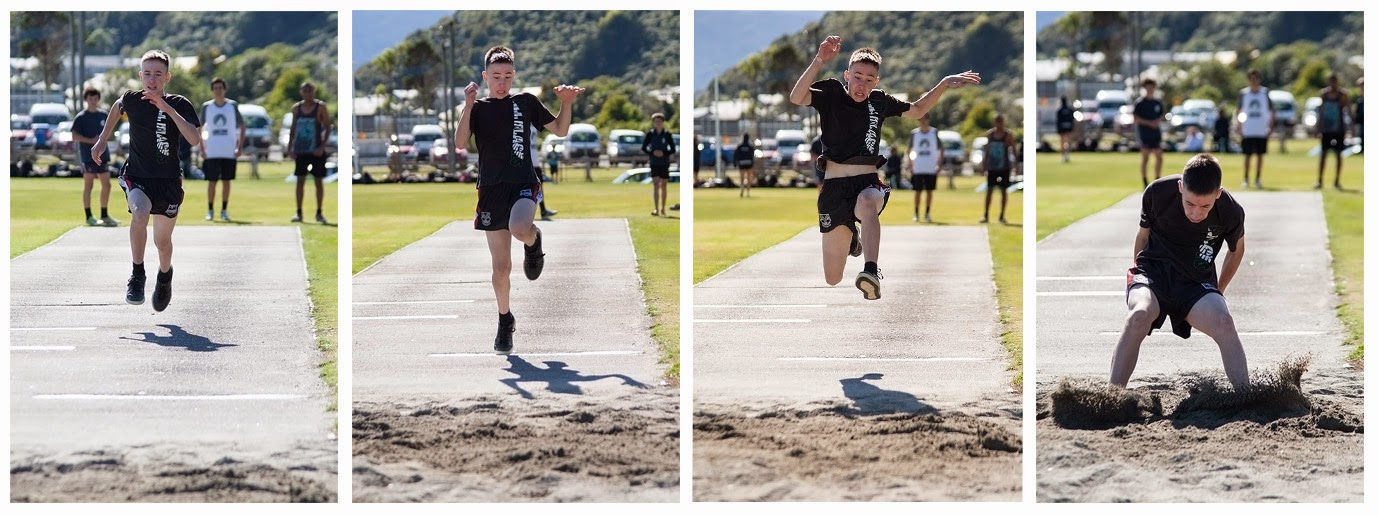
Joshua competing in the longjump. Canon 1D Mk3 with Canon 75-300mm IS USM
I didn't really have time to come to grips with the myriad options that the 1D Mk3 has to offer - especially in the autofocus custom functions - so the night before I just made sure the battery had a decent charge, the camera was set on servo autofocus, hi speed, and group focus point selection.

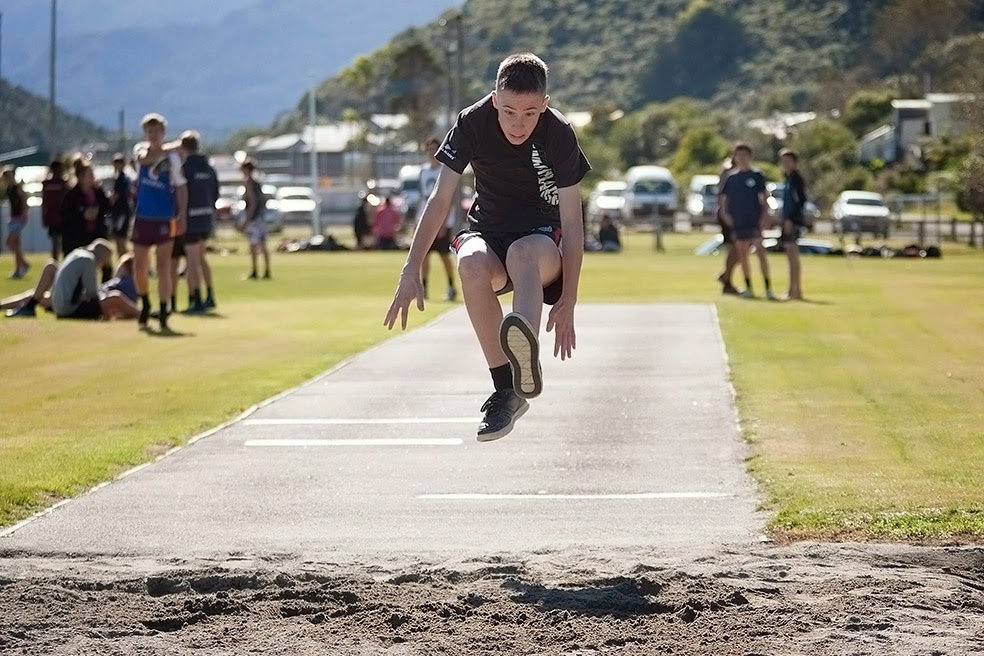
As you can see above, the 1D Mk3 nailed the autofocus every time, although it felt a little 'sluggish' in real-time, and I wasn't getting anywhere near the 10fps that the camera is capable of. A little further reading after the fact has enlightened me as to the autofocus options that I probably 'should' have chosen - especially if I want that 10fps machine gun burst. I decided to set the tracking priority to focus, rather than speed - so as a result I think the camera was micro-focusing in between each shot, thereby not attaining its 'full' shooting speed. But, as stated above, it certainly nailed the focus and of the 40 or so images I took, only two were out of focus (and both of those were towards the end of the jump).

"Up, up and away"! Canon ID Mk3 with 75-300mm IS USM, 2000th sec @ f4.5 - ISO 400
I've used Canon cameras my whole photographic career (just shy of 30 years now), so in some ways, using the 1D Mk3 is second nature to me already. BUT, I've never owned or used a digital 1 series before, so the plethora of auto focus options is going to take me some time - and practice - to get to grips with. Canon have a very helpful pdf on the autofocus options available for the Mk3 which can be downloaded from here. I'm going to have to study this and go out and try some of the modes to see what works best for me - something i'm very much looking forward to doing.

For now, I'm happy with my first up attempt at some action shots with the 1D Mk3. I didn't screw it up, and I'm encouraged to experiment some more to get to grips with the autofocus system. And I wasn't unhappy with the way the 75-300mm IS performed either. I'm sure that one day I will 'upgrade' it to the 70-200mm, but until then it will help me learn my way around the camera so that I can really make use of the better lenses when I do get them.

I have a Canon 28-135mm f3.5/5.6 IS USM arriving soon that I will use as a 'walk-around' lens for the camera, which should make a nice combo. Will write more about my journey with the 1D Mk3 as it develops. Can't wait.


Saturday, 14 March 2015

My Canon EOS 1D - Finally!

Since my last post about micro-adjusting my 50D, I've shot another wedding.

The images were more successful this time around (i.e sharper), and I was happier with the final result. Happier, but not blown away.

Rebeccah and Aldon's Wedding Party with Wedding cars and drivers.
I've heard it said before that the 15MP sensor on the Canon 50D is very noisy, but I had tended to dismiss this as mere internet pixel peeping. But I'm beginning to understand what they are on about - from personal experience. I'm seeing noise in ISO 200 shots that in previous cameras I've owned (around the 10 to 12MP range) would never have been there. I think that Canon over-stretched themselves with the 15.2MP sensor they put in the 50D, and I think it shows.

Overall, although I hate to say it, I'm distinctly unimpressed with the 50D. There's a lot to like ergonomically speaking, but IQ (and let's face it, isn't that what really counts) isn't up to snuff this time.

So, even though I'd really just got the kit together, I made the decision to move on. And as is my want, I decided that I was going to be an open book. Anything goes, and I was open to any suggestion.

Initially my attention turned (once again) to mirrorless system cameras. In particular, the Sony NEX 6. I figured that if I was going to make a change, it may as well be a decent one - to something totally different for me. I looked at the NEX6, the NEX 7, an Olympus OMD EM5, an OMD EM1, and a Panasonic GH3. I almost, almost pulled the trigger on the GH3, but in the end, I just couldn't do it.

For all their 'hooplah' and attention at the moment, even amongst pro shooters, I still personally don't think mirrorless is quite 'there' yet. Give it 5 years more and I'll be seriously interested. Iron out some of the autofocus issues, shutter shock (no, I hadn't heard of it either - look it up), a few more lenses, better evf technology, and I'll be ready to invest. But for me, at least, DSLR's are still where it's at. Especially since I'm thinking of getting back into shooting a few weddings a year.

So given that a DSLR is still my weapon of choice, and I'd just sold all of my 'new' Canon gear, which system was I going to invest in now?

Okay, yeah - I know. The title of the post kinda gives the game away. But seriously, Canon was the last thing on my mind, considering I had just sold all my Canon gear!

From the sale of the 50D kit I had around $1000NZ to get a body and lens (and hopefully flashgun). What I wanted was a serious amateur/pro spec'd body that gave me a decent frame rate, good IQ and solid autofocus performance. Basically what I was after with the 50D.

I've mentioned Trademe - New Zealand's local internet auction website - many times on this blog, as it's about the only way I have of shopping for used photography gear without going off-shore to ebay. Searching every day on Trademe allowed me to amass a pretty sizable watch-list of stuff, and I even bid on a few of them. Top on the list was a Sony a700 body which eventually went for more than I was willing to pay for (although, as it turns out, it went for a lot less than I eventually ended up paying for a camera body). Then I was seriously looking at its big brother - the full frame Sony a850, but that was definitely going for more than I was willing to pay.

Canon 1D Mk3
Throughout my searching, I always kept a lookout for the camera line that I have long desired to own - the Canon 1D series.

The original 1D Mk1's turn up reasonably regularly, generally fairly cheaply because they are either very well used, or they are just plain old. Shutter count on them tends to be fairly high as well, so they are not really a camera that I get that excited about.

The 1D Mark2 and 2N's appear quite often as well, although again they are usually well used and a fair way gone through their life-span (check my previous post on the Mk2 I almost bought recently).

When you get to the 1D Mk3 and Mk4's, you are starting to talk a little more serious money, since they are 'relatively' newer technology. UI (User interface) from the Mk3 onwards was radically changed as well, making them much more user-friendly and in-line with Canon's enthusiast line, yet with the 1D series build and feature set. I've never really considered the Mk3 or Mk4 cameras in the past because they have tended to be out of my price range, especially the ones in good condition.

My 'new' Canon EOS 1D Mk3
During my search on Trademe, however, a Canon 1D Mk3 turned up that looked in very good (to excellent) condition, for a very reasonable price ($795NZ with a 75-300mm f4/5.6 IS USM lens). It was going cheaper than many 1D Mk2's go for on Trademe for the body only, so not surprisingly, my interest was peaked! From asking questions - and then eventually emailing the owner - it seems that he had purchased the combo for over $1000NZ about 6 months earlier, but found that he used his full frame 5D much more. So he simply wanted it to go to a good home, where it would actually be used (yeah, I've heard that story before too, but through conversing with the guy I actually believe him).

Anyway, to cut an already long story short, although I did 'umm' and 'ahh' for a few days (and almost bought the panasonic GH3 in the meantime), I eventually couldn't help myself, and had to go with the 1D Mk3.

There are lots of reasons for my decision, which I won't go into now, since this post is already too long. I will talk about the 1D Mk3 in my next post, when I will actually have it in my hands and have had the chance to shoot with it.

But for now, I'm super excited about it arriving and can't wait to shoot with it. My son has made his High School long jump team and is competing on Wednesday. Might just be the perfect outing for a Dad and his 1D Mk3.


Tuesday, 20 January 2015

Micro Focus Adjusting a Canon 50D

I shot my first wedding in two years last Saturday - with my newly acquired 50D kit. It was a great day, they were a lovely couple, and I came away exhausted and exhilarated; with over 1000 images.

I processed the images through Aperture (yes, I still use Apple's RAW conversion software - but that's about to change), and was generally pretty happy with the results. I used both 50D bodies, and every lens in my arsenal on the day, so I felt that I gave my kit a really decent workout.

But on closer inspection, I began to feel that some of the images weren't as 'sharp' as I would have liked/expected. On an even closer inspection, I narrowed the images that I was less happy with down to 'my' 50D body and the 24-85mm lens. The 70-210mm lens on the same body was a tad sharper, but still not quite right.

My heart sank a little, since the images were indicating that the camera itself was faulty and the sensor not resolving sharply. I did some direct comparisons with my other 50D body a few days after the wedding, and these tests also showed me that on all my lenses, one body was producing sharper results than the other (all things being equal).

I considered sending the body away to Canon to check the sensor alignment - but since the camera is out of warranty I wasn't really thrilled about the cost involved. And then I remembered that the 50D has its own 'micro-adjustment' custom function (apparently the kind of adjustments that the Canon service centre would make anyway).

Since I wasn't happy with the body's performance, but didn't want to send it away to be 'aligned', I decided to give it a go myself.

There are numerous ways to 'micro' adjust your camera and lens combination, using either complex charts or moire pattern computer programmes. But I'm a much more practical, hands-on camera tester, preferring to go out and shoot real subjects rather than brick walls and test charts. So I found a 'real world' micro-adjustment test, and followed that.

Basically, you set the camera up with the lens set to its widest aperture (f2.8 / 3.5 etc) at its longest focal length (if it's a zoom). So for my 24-85mm lens I set it at 85mm @ f4.5. Then you find a target that has some detail and some 'roundness' to it, so you can gauge the movement of the focus point as you 'adjust' it. Many people use the limb of a tree. I chose our clothes line pole.

You then focus on the front of the subject and shoot a series of images, adjusting your alignment in 5 step increments. So, with the Canon 50D, I shot at -20, -15, -10, -5, 0, +5, +10, +15 and +20. That's 9 images in total. Shoot in RAW mode so that no sharpness is applied. Open them up in your RAW conversion software and save them all as high quality jpegs. Then open these in photoshop, zoom in 100%, and crop the final image making sure that you save them with an appropriate name so you remember what each setting was shot at. Go through and find the 'sharpest' number. For arguments sake, lets say it was -10. Subtract 3 from that (which gives you -13), reformat your card, take the camera outside on the tripod, and shoot again, but this time start at the number you just decided on (-13 in our example), and then shoot 7 images, going up by one step each time. This would give you seven images (-13, -12, -11, -10, -9, -8 and -7).

Go through the same process with these images; download them, convert to jpeg, enlarge 100%, crop and then compare the results. You may find that it gets very close at this stage, but a process of elimination should net you the sharpest result?

Do this with all your lenses, and the 50D will 'remember' each setting for each lens thereafter.

So did it work? You betcha. My results varied, but I was able to get the 'softer' 50D matching (and even surpassing) the sharper 50D body in all instances. My 24-85mm lens required a -6 adjustment, my 70-210mm required a +8 adjustment, my 10-22mm required a -8 adjustment, and my 50mm f1.8 required a +14 adjustment! As can be seen below, the 50mm adjustment was the most remarkable of all.

Canon 50D with 50mm f1.8 @ f1.8 with '0' adjustment.

Canon 50D with 50mm f1.8 @ f1.8 with +14 adjustment

It amazed me how 'unsharp' the 50mm was at its default setting before any adjustment. No wonder I wasn't very happy with the sharpness of some of the images I was getting from the 50D.

I've never had to do this with a camera before, as I've never been unhappy with the overall sharpness I was getting - and yes, I shoot wide open as often as I can, especially at weddings. But what about the other focal lengths (on the zooms) and the other apertures? Well obviously, because you are making these adjustments 'wide open', the results are even better when you stop down a bit (they always are) - so no problem there. And the other focal lengths? Well, it just seems that if you get the maximum length right then again, the others fall into place and are just as sharp.

If you are happy with the sharpness you're getting from you camera body/lens combination, then you don't really need to go through any of this. And as I said at the beginning, one body was fine for sharpness while the other was not. I've 'adjusted' the 'off' body now so that it falls in line with the body I was happy with - so for me the job is done.

But If you're not happy with the sharpness you're getting, it 'might' need a micro adjustment for your specific body/lens combination? Give it a try. You may be blown away by the results.

Thursday, 15 January 2015

Canon 50D Gear Update

My last post in November outlined my intention to get together a Canon 50D kit instead of my previously opted for Canon 1D. Given that it's been two months since then (tisk, tisk), how did it go?


It went very well, actually. I eventually managed to sell my Pentax outfit (two K10D bodies with various lenses, accessories, flash etc), and began looking around for their Canon equivalents. The 'newer' 50D body was my first acquisition (I already have a beat up 50D body on permanent loan), followed closely by a Canon 24-85mm f3.5/4.5 as my 'general' all-purpose lens.

The 50D on loan also came with a Canon 10-22mm ultra-wide, so I have that as my landscape and large groups wedding lens. Hence I didn't feel the need to go for an "18 to something" lens as my standard. Yes, the new batch of mid-range EF-S lenses have image stabilization etc, but they also sacrifice build quality and larger apertures in the process. I actually prefer the early 90s 'consumer' lenses that Canon produced, since they tend to be more solid, better constructed, and have faster apertures than the newer wave of techno-whizz-bang lenses. I'd sacrifice image stabilization for better build quality and a faster lens any day of the week. Oh, and yeah, the 'older' lenses tend to be cheaper too! Bonus :-)

My next purchase was an absolute steal! I've always wanted a Canon 50mm f1.8 Mk1 - the metal mount version of the nifty fifty. But they are as rare as hens teeth, were discontinued in the early 90s, and are three times the price of other 50mm 1.8's if you do happen to find one. BUT, surfing the web one night I saw a 50mm f1.8 Mk1 pop up on my local internet auction site at a ridiculously cheap price! I couldn't believe my luck, and nabbed it immediately (fortunately they had a 'Buy Now' price and I was the first to see the auction). So I finally own the much sought after 50mm f1.8 Mk1.

When I sold my Pentax gear, I let go of the Yongnuo flash to sweeten the deal. So I needed to get a new flash for my 50D kit. I 'ummed and arred' about just replacing it with another cheapo flash, but in the end waited until a good value second-hand Canon 580EX came up for auction. I'm glad I went the Canon way; flash is a mystery at the best of times - but the 580EX just works... no issues. Especially in TTL mode (although I'm not adverse to switching over to full manual when I need to either).

And last, but not least, I had just enough money left over to get a telephoto (all be it a 'cheap' one). Surprisingly - since I don't use a telephoto all that often - this ended up being the hardest decision. I was tossing up between a Canon 100-300mm, a Tamron 70-300mm, and the lens I eventually ended up getting, the Canon 70-210mm f3.5/4.5. Once again, build quality and speed won out - the 70-210mm being the better built and 'faster' of the three I was considering. No, it doesn't have IS - but gone are the days when we had to stick to just one ISO, and good technique should take care of the rest - right?

So that's the kit. I got a chance to use all of it last weekend when I shot a wedding (more on that soon), and to cut a long story short, I think I've made the right decisions.

One final word. Of course with all of this, price has been my defining (and limiting) factor. Would I have bought the same lenses if Id just won lotto and money was no object? Of course not! Given a limitless budget I'd probably be shooting full-frame (either the 5D Mk3 or 6D - probably both), with a series of f2.8 'L' lenses :-)

Oh well, we can but dream....

Thursday, 6 November 2014

Hang on. That's not a 1D!

Well, what a difference a day makes.

In my last post I wrote excitedly about my purchase of the Canon 1D MkII, gave all my reasons for going that way, and even started forming a lens buying strategy.

But I also mentioned how unsure I was about the fairly high shutter count of the body I had purchased - especially since it turned out to be quite a bit higher than the buyer had originally suggested.

I slept on the decision overnight - tossed and turned a bit - and in the morning, decided that I really wasn't comfortable with the shutter life left, and pulled out of the deal. I'm happy to report that it ended amicably, with both parties in agreement and keen to get on in other directions.

So for me, what direction was there left to take?

My experience at the Street racing recently rekindle my love affair with Canon through the 50D. Even though I was using a very well-used model, it functioned perfectly and was a joy to shoot with. It had everything I wanted (frame rate, weather resistance, solid feel, great autofocus), and nothing that I didn't (movie mode, touch screen, blah, blah, blah).

So yes, a mint condition (low shutter count) Canon EOS 50D is the way I've now gone. And I'm just as excited about it as I was about owning the 1D.

If I'm being perfectly honest, I am bummed that I don't own a pro series 1D. I was really looking forward to it. But I also had several nagging doubts and really do feel that the 50D is the better fit for me personally.

Its 6.3fps was more than enough for the street racing and the autofocus was almost always dead on. The only thing that really let me down were the old batteries, but of course I plan on fixing that with a few new ones.

I have a 50D turning up any day now (hoping that it arrives before the weekend since I have a camera club field trip to go on), and once I've sold my Pentax K10D's, I'll pick up a few more accessories/lenses for it. The first thing I'll probably opt for is the vertical grip. I almost always get one for whatever camera I own, since I shoot a lot in portrait orientation, and enjoy the extra bulk/weight and shooting power they offer.

I already have a (borrowed) Canon EF-S 10-20mm ultra-wide angle, and the EF-S 18-55mm kits lens I picked up for free at our last photography club evening (yay). So I think the next lens I get will actually be the EF-S 60mm f2.8 macro lens. I like the fact that macros do 'double-duty', working as reasonably fast short telephotos as well for portraiture. So you get two lenses in one!

Not sure if I'll pick up a Canon speedlite for it as well, or try out the Yongnuo flash I had with the Pentax (I think it will work with the Canon as well)? If I don't get a flash, I might have enough money to get a Canon E 70-300mm IS USM too? Have to sell my Pentax's first though!


Monday, 3 November 2014

Canon EOS 1D Mk2

Last post I wrote about my experiences shooting a motorcycle street race event with a Canon 50D and Pentax K10D. Not surprisingly, the 50D stomped all over the K10D in terms of focus speed, ISO quality and frames per second, and was a joy to use. It also gave me some fantastic images!

Canon 50D with 400mm f5.6L @ 1/2000th. ISO 800
While I don't do a lot of hi-speed action shooting, I really enjoy it when I do. It's such a buzz, and I definitely want to do more in the future. We actually have quite a few local events like the street racing, surfing, rodeo, motor cross, karting, and even local sports like rugby, league and hockey, that I would like to try and capture a bit more. Sadly, my Pentax K10D (and some may argue the Pentax system in general), isn't really up to the task.

So I am in the process of, somewhat regrettably, selling my existing Pentax kit, and looking at replacing it with something that has a lot more horse power (i.e fps and focus tracking). And I think I've just bought the very thing....

Enter the Canon 1D Mk2, my newest camera acquisition.

I really enjoyed shooting with the 50D, and still have it on 'permanent' loan from a friend. It will now be my 'back-up' for the 1D. But why didn't I just get another 50D and use a matching pair? Great question. Let me answer that by going through my thought process before buying the camera shown here.

Firstly, though, a run-down on the specs for the 1D Mk2. It's an 8.2 megapixel camera shooting at 8.5 frames per second. I know that 8.2 doesn't seem like a lot of megapixels, but it uses a large 28.7 x 19.1mm sensor at 3504 x 2336 pixels, for a large than APS-C 1.3x crop factor. Apparently this sensor was used to give sports shooters a slightly bigger crop than full frame, while still having a larger sensor size that the x1.6 crop on APS-C sized sensors. Call it 'the best of both worlds'. So 8.2 megapixels on a sensor this size is 'more' than enough resolution for detailed A3 prints - and I've argued in the past that between 8 to 12 megapixels is my happy medium. Not too large and not too small. The 'goldilocks' sensor size if you will :-)

The sensor is double the mega pixel size of the original 1D (from 4 to 8), but is also reported to have better noise control. It only shoots natively up to 1600, although this can be expanded to 32,00. For me and my style of shooting, if it's clean at ISO 800 (and from reviews I've read and samples I've seen it is), then I'll be a happy camper.

The 1D Mk2 is also dual format, taking both CF and SD. You can use them at the same time to shoot RAW to one card and a jpeg back-up to the other, or shoot until one is full and then direct the camera to start shooting to the other. That's a feature I've never had in a camera, but something I'm looking forward to using.

The viewfinder is 100%, it has an amazing 45 point autofocus system with incredibly accurate focus tracking (this camera was specifically designed for sports shooters and photo journalists), and as a professional 1 series body, is built like the proverbial brick.... house. The buffer is fantastic, allowing for 40 jpeg or 20 RAW images in a burst before the camera slows somewhat to read to the card. This is miles better than Nikon's equivalent D2x with a buffer of less than half the Canons. So what's not to like?

Well, it is 'older' technology. Things have, not surprisingly, moved on a bit since this camera was first released ten years ago (in 2004).

The lcd screen is only 2" (the Mark2N upped this to 2.5") and it uses the older (and heavier) NP-E3 Ni-MH battery pack, rather than the newer, smaller and lighter Lithium packs introduced with the Mk3. That said, apparently the Ni-MH battery lasts all day, so the slightly extra weight might be worth it for extended battery life? The lcd is also only 230,000 pixels - although again from reviews I've read it is plenty sharp enough (probably because it's only 2"). The 'newer' 2.5" screen on the Mk2N is also only 230,000 pixels, so there's really not much gain to be had there.

Which leads me nicely into the question of why the 1D Mk2 and not something else?

For me, the Canon EOS 1D Mk2 ticked all the right boxes. It has enough megapixels on a nice big sensor. It shoots at a blisteringly fast frame rate and uses an incredible autofocus system. It doesn't have anything I don't want (video, live view, scene modes, art filters), and it does have everything I do want.

The Mk2N is only a minor upgrade, with a 'slightly' larger lcd screen, but with the same processor, sensor, autofocus system and speed as the Mk2, so I didn't really see the need to pay a little more for the 2N.

I did look very seriously at the Nikon equivalent, the D2x, but with a 12MP APS-C sized sensor, lower frame rate (unless you choose the smaller 6MP resolution crop mode) and only single card slot, I felt the 1D Mk2 was the superior product for my needs. That, and the fact that there weren't any really 'clean' D2x's on auction for what I was prepared to pay.

And really, that's also ultimately what it boils down to for most of us in the end - price. I looked for a clean Canon 40D, 50D or 60D, but they were surprisingly all going for as much as - if not more - than the 1D Mk2 I eventually ended up buying. Same with a Nikon D200 or D300. They were more expensive that the 1D, sometimes by a very high margin.

So why are 1D Mark 2's going for such a good price at the moment? I think it's two-fold. First, it is older technology. And older technology is perceived as bad (or worse than, or less than - however you want to put it). Which is why even top end film cameras are now dirt cheap. They are really old technology :-) But they are still damn amazing cameras! Out with the old and in with the new. And the price drops radically.

Second, and perhaps somewhat more importantly, because these are professional cameras, they do get a fair bit of use. And some of them even more than their fair share! Of course they are built to take this abuse (to a certain extent), which is why they are big and heavy. But even they can only take so much punishment before something gives. And that something is usually the shutter. Especially on a camera built for sports shooters to shoot at 8.5fps.

The camera I've purchased has done 142,115 shutter actuations! That sounds like a lot - and it is. Especially when you start using those sorts of figures with a 40D or D200. However, the shutter on the 1D Mk2 is rated for 200,000 actuations - which is its general life expectancy. Sites I've visited in the last day or so would indicate that many can get their cameras to at least 250,000 shutter actuations, and beyond. So I may be able to get another 100,000 out of the camera before the shutter goes - or I might not. That's the gamble. And I think this gamble is reflected somewhat in the lower prices you can find them for. But mostly, I do think it's the perception of 'older' technology.

I must admit to being slightly alarmed when I saw how many shutter actuations the 1D Mk2 I've purchased has done. But for the 'relatively' cheap price I payed for it (cheaper than most 40D's were going for), I think I'll have to live with the fact that these cameras all see a fair bit of use. But that's what they're built for. And many got to 'infinity and beyond' because of it -)

It hasn't arrived yet, but I'm hoping it will get here this week so I can take it with me on a photography field trip my local camera club are doing on the weekend. Unfortunately I don't really have any lenses for it (the two canon lenses I have with the 50D are EF-S lenses which won't work on the 1D). So I may have to 'borrow' another lens for the weekend?

Lenses, and lens choice, is one of the other major reasons why I've decided to go back specifically to Canon. I love their lens range, their lens choices, and their 'L' series lenses in particular. The Canon 'L' lenses ooze quality and that's the way I will go with my first lens purchase for the 1D Mk2.

If I can get enough money together from the sale of both my Pentax K10D's, I'm hoping to find a Canon 24-105mm f4L in good condition. On the Mk2 this will 'roughly' equate to a 30-135mm f4 'walk around' lens that would probably be on the body 90% of the time.

The other option is the Canon 24-70mm f4L which would give a shorter reach, but a newer IS system and perhaps very slightly better image quality? Again, it will depend on what's available - and for what price - when I'm finally in the position of being able to purchase a lens.

Eventually, I would also like to get a Canon 17-40mm f4L, as well as the 70-200mm f4L IS. This would give me a trio of f4 lenses for an ok price. I'd probably try and pick up a fast 50mm f1.4 for low-light if/when it was needed. That would be a pretty cool kit.

Finally, I know this has been a long post, but I want to say one last thing about my 1D Mk2 purchasing decision. The other option, the option that almost every man and his dog is going for nowadays (and perhaps another reason why dinosaurs like the 1D Mk2 are such a reasonable price), the option that I could have gone for but resisted with every fiber in my being, is the smaller, lighter, holy-grail answer to all photographers prayers; the micro four thirds (or similar) system.

So many 'cool-cat' hipster photographers are publicly (and loudly) declaring the death of the SLR camera with a passion and fervor reaching biblical proportions. "Since converting to mirrorless cameras, my poor 1D Mk3 (or D4) has sat on the shelf collecting dust. I don' know what to do with them", they cry. I know what to do with them. Give them to me and I'll actually use them!

I have owned, and used, several mirrorless - micro four thirds cameras over the last few years, and they just don't do anything for me. As much as I try - and believe me, I have tried - I just don't gel with these smaller system cameras. Maybe the image quality is better (maybe). And maybe they are more convenient to carry around. But I just hate using them.

So I have - perhaps even purposefully - gone 180 degrees in the other direction. I've gone for the biggest, heaviest, chunkiest, manliest, beast of a camera I could find and said "yep, that'll do nicely". And I can't wait to have it in my hot little hands. Good times.

P.S. If you do have a Mk4 or D3 floating around gathering dust and you're never going to use it again, then please feel free to send it to me. I'd love to give it a good home :-)